
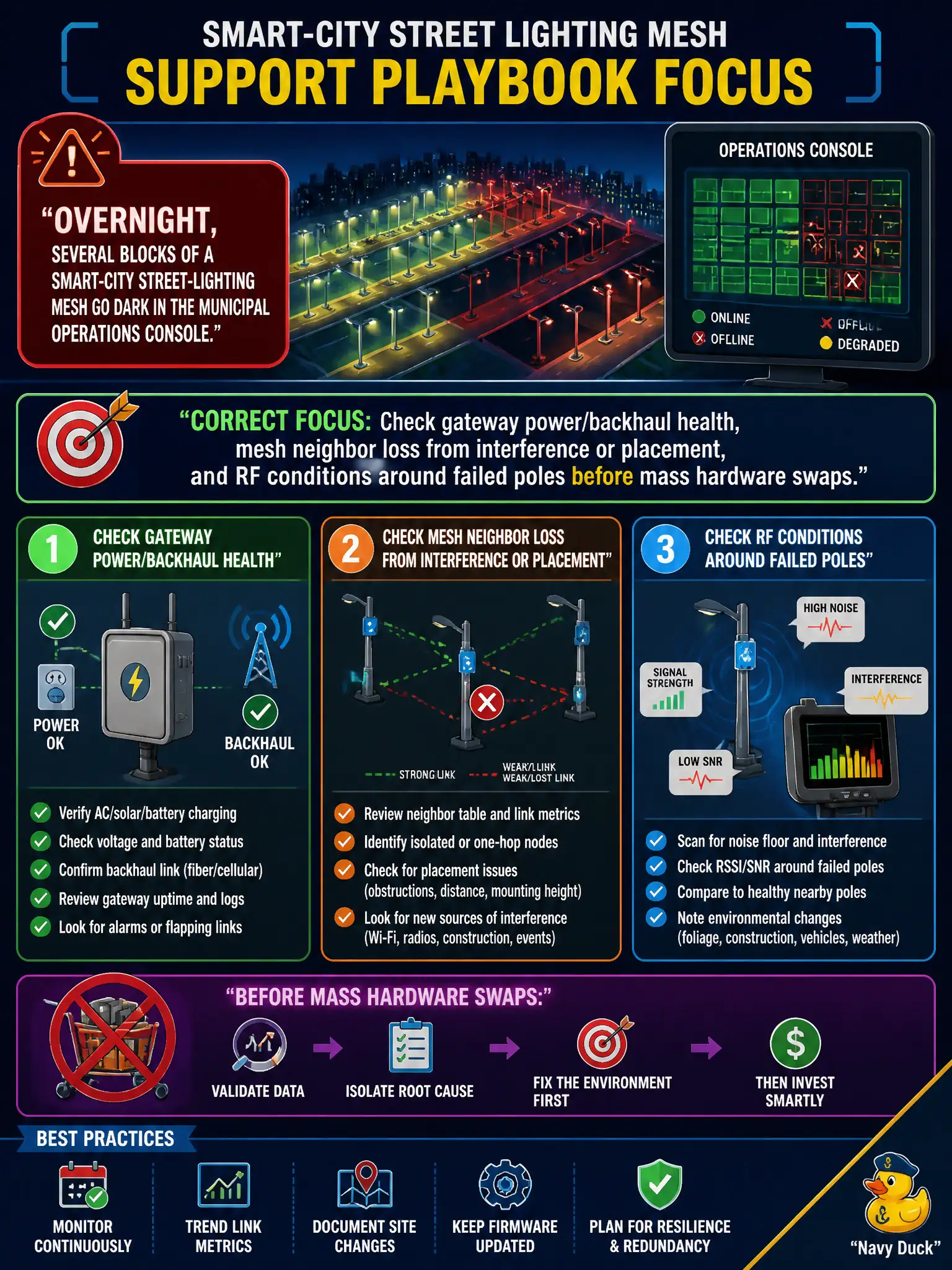
Overnight, several blocks of a smart-city street-lighting mesh go dark in the municipal operations console. What support playbook focus best matches common outdoor IoT mesh and gateway failure modes?
Select an answer to reveal the explanation.
Short Explanation
When street lights vanish from the console, start at the gateway and the air—power, backhaul, and neighbors—not a downtown router reboot lottery. Mesh holes often come from interference or a dead pole gateway. Swapping every luminaire first burns budget.
Full Explanation
When blocks of a smart-city street-lighting mesh go dark overnight, the support playbook should check gateway power and backhaul health, mesh neighbor loss from interference or placement, and RF conditions around failed poles before mass hardware swaps. Only rebooting core routers downtown while ignoring pole gateways and RF misses the likely fault domain. Assuming every outage is a firmware marketing defect and replacing all luminaires without RF checks wastes budget. Disabling the entire city Wi-Fi network as the first lighting-mesh recovery step is unrelated collateral damage. Exam caveat: outdoor mesh triage starts at power, backhaul, and RF neighbors. Operational check: walk the failed poles with gateway telemetry and spectrum checks, restore backhaul/power, and only then escalate hardware for the municipal lighting NOC. In municipal WLAN and IoT operations, record the chosen control and the rejected alternatives in the change ticket so on-call staff understand which failure modes were avoided for city services. Re-validate after the next maintenance window that the same control still holds under the current platform code, device mix, and civic event calendar used by the wireless team.