
A municipal public-works shop floor is evaluating Industry 4.0 sensors and actuators that need deterministic timing. What expectation should the wireless architect set about best-effort enterprise Wi-Fi?
Select an answer to reveal the explanation.
Short Explanation
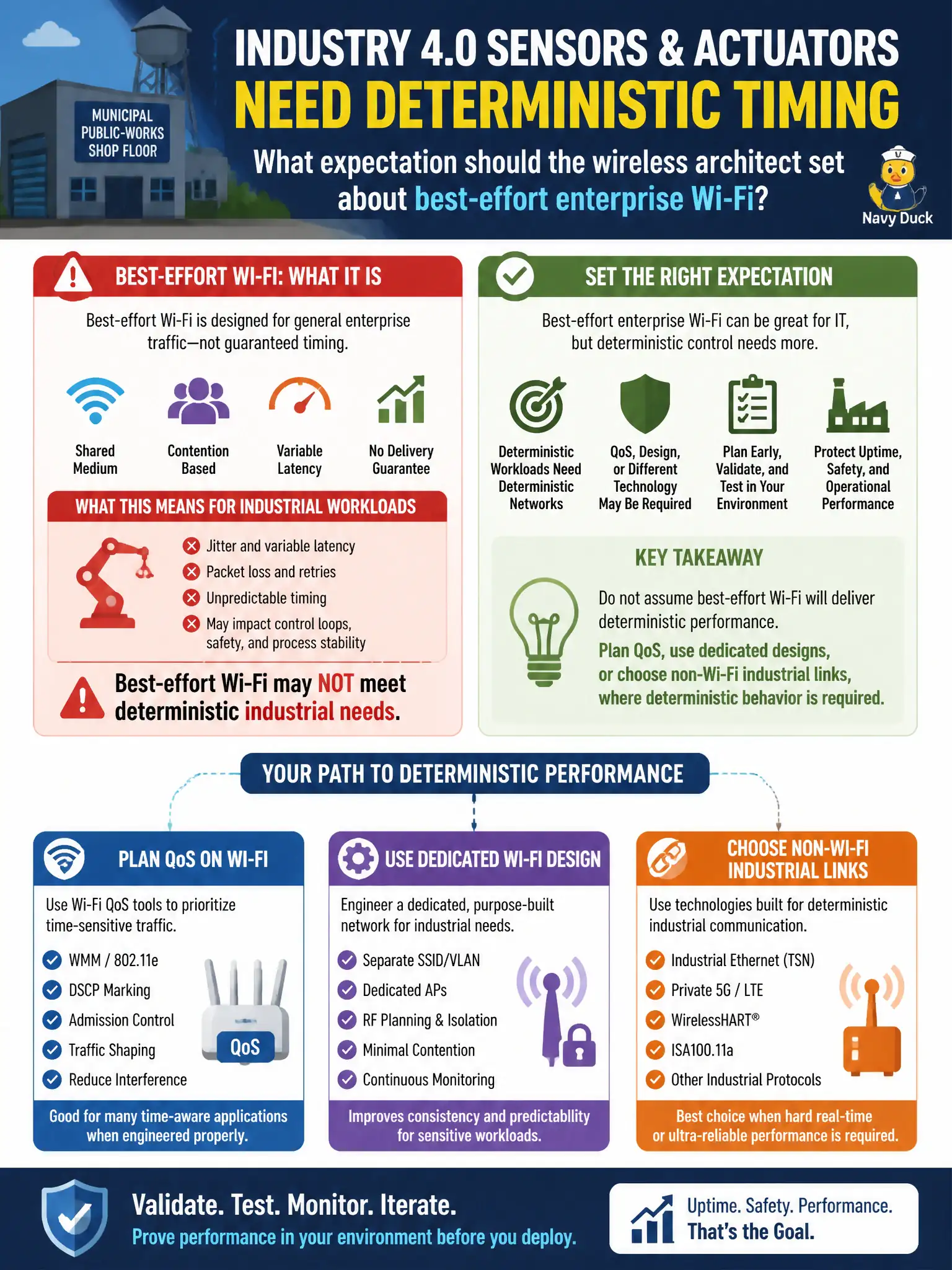
Office Wi-Fi is great for email; closed-loop machines often need clocks that do not wait in a crowded airtime line. Set the expectation early—best-effort may not be enough—and design QoS or industrial links where the process demands it. Turning off crypto does not create determinism.
Full Explanation
For Industry 4.0 sensors and actuators needing deterministic timing on a public-works shop floor, explain that best-effort enterprise Wi-Fi may not meet deterministic industrial needs and plan QoS, dedicated designs, or non-Wi-Fi industrial links where required. Promising hard real-time guarantees on standard best-effort Wi-Fi without QoS or alternate links is misleading. Claiming office WLAN capacity models always meet closed-loop industrial control latency ignores determinism requirements. Disabling encryption so frames become deterministic automatically confuses security with timing. Exam caveat: separate IT WLAN best-effort from OT deterministic networking. Operational check: capture latency/jitter needs from OT owners, choose Wi-Fi QoS versus industrial wireless/wired accordingly, and document the municipal shop-floor decision. In municipal WLAN and IoT operations, record the chosen control and the rejected alternatives in the change ticket so on-call staff understand which failure modes were avoided for city services. Re-validate after the next maintenance window that the same control still holds under the current platform code, device mix, and civic event calendar used by the wireless team.