
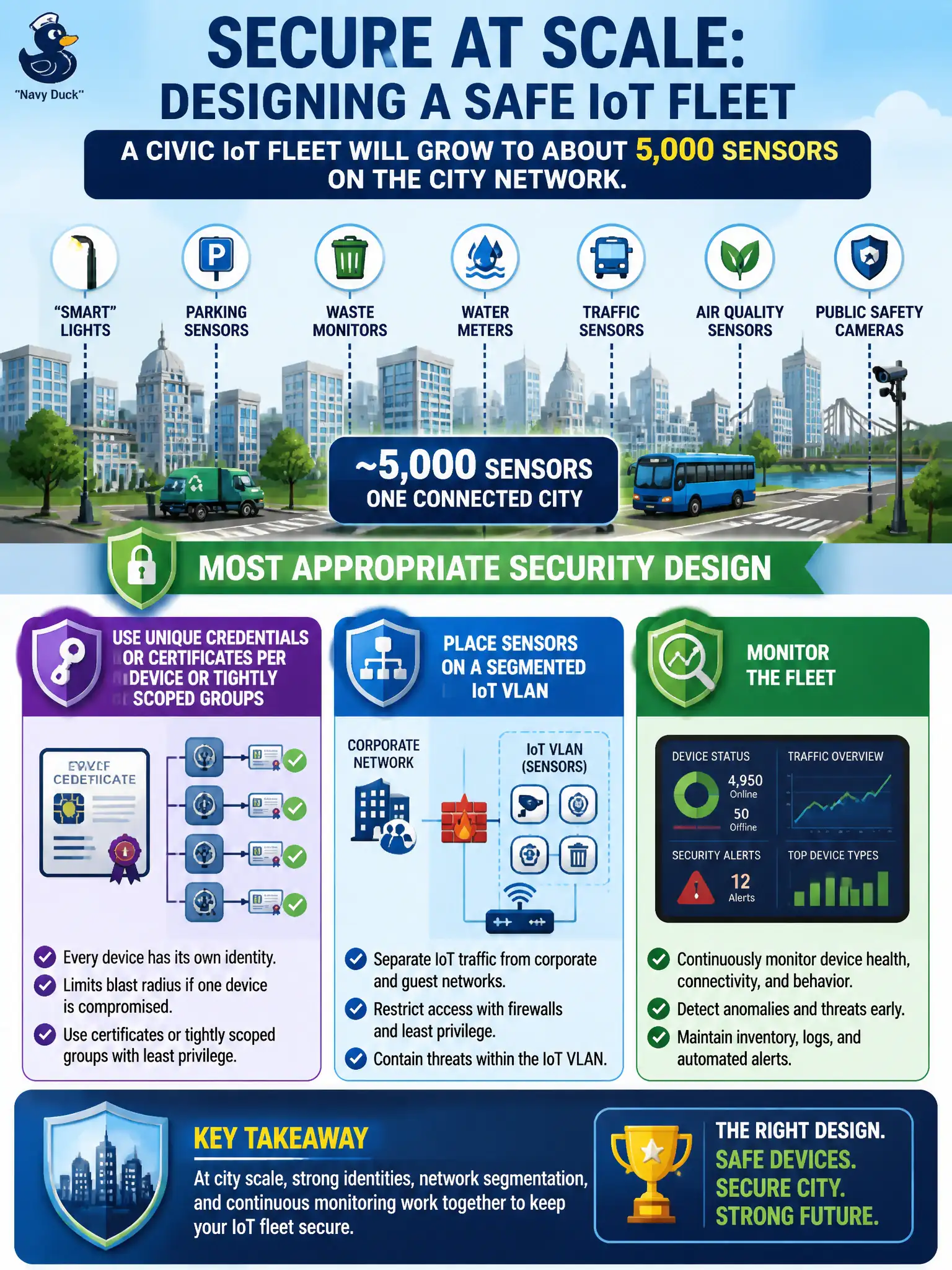
A civic IoT fleet will grow to about 5,000 sensors on the city network. Which security design is most appropriate at that scale?
Select an answer to reveal the explanation.
Short Explanation
One shared PSK for five thousand sensors is like one master key for every city building—lose it once and the whole fleet is open. Unique credentials, a segmented VLAN, and monitoring scale with the city. Flat staff VLANs and no crypto do not.
Full Explanation
At about 5,000 civic sensors, use unique credentials or certificates per device or tightly scoped groups, place sensors on a segmented IoT VLAN, and monitor the fleet. Reusing one shared WPA2-Personal PSK for every sensor maximizes blast radius when the PSK leaks. Putting all sensors on the flat staff VLAN with no monitoring because traffic is low rate invites lateral risk. Disabling encryption to simplify battery math is unacceptable for municipal IoT. Exam caveat: scale multiplies credential and segmentation mistakes. Operational check: deploy per-device or group credentials, verify VLAN ACLs and monitoring alerts, and tabletop a compromise scenario for the city IoT fleet. In municipal WLAN and IoT operations, record the chosen control and the rejected alternatives in the change ticket so on-call staff understand which failure modes were avoided for city services. Re-validate after the next maintenance window that the same control still holds under the current platform code, device mix, and civic event calendar used by the wireless team. Keep RF, capacity, security, and QoS evidence attached to the municipal runbook entry for auditors and future CWNE-level reviews. Attach spectrum, capacity, security, and QoS evidence to the municipal runbook entry so auditors and future CWNE-level reviews can replay why this control was selected for city services.