
A municipal warehouse will use BLE and Zigbee sensors that must reach a city IoT platform. How should gateway placement and backhaul be designed?
Select an answer to reveal the explanation.
Short Explanation
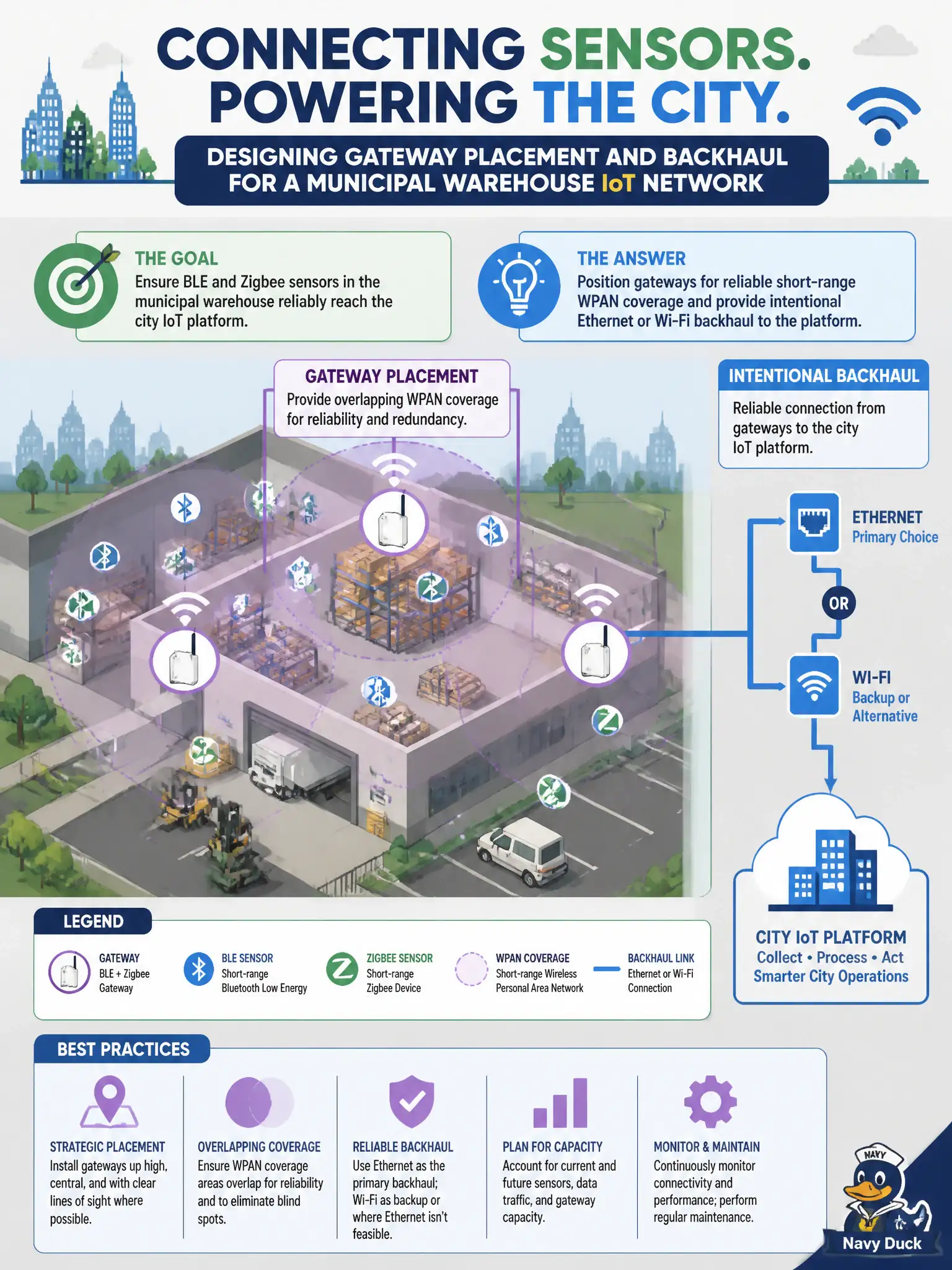
Gateways are the bridges between short-range radios and the network that actually reaches the cloud. Put them where the sensors can hear them, then give them a real Ethernet or Wi-Fi path home. Random hubs and hoping phones carry telemetry is not a warehouse design.
Full Explanation
A municipal warehouse using BLE and Zigbee sensors that must reach a city IoT platform needs gateways positioned for reliable short-range WPAN coverage with intentional Ethernet or Wi-Fi backhaul to the platform. Scattering battery hubs randomly and relying on opportunistic phone Bluetooth for backhaul is not an architecture. Placing a single gateway at the far loading dock so truck traffic shields it creates coverage holes. Forcing every BLE sensor to associate as a full 802.11 STA on the corporate SSID without gateways ignores typical BLE device capabilities. Exam caveat: WPAN sensors need planned gateways and backhaul, not accidental phone relays. Operational check: heat-map gateway coverage across aisles, confirm backhaul redundancy, and test platform delivery for civic warehouse telemetry. In municipal WLAN and IoT operations, record the chosen control and the rejected alternatives in the change ticket so on-call staff understand which failure modes were avoided for city services. Re-validate after the next maintenance window that the same control still holds under the current platform code, device mix, and civic event calendar used by the wireless team. Keep RF, capacity, security, and QoS evidence attached to the municipal runbook entry for auditors and future CWNE-level reviews.