
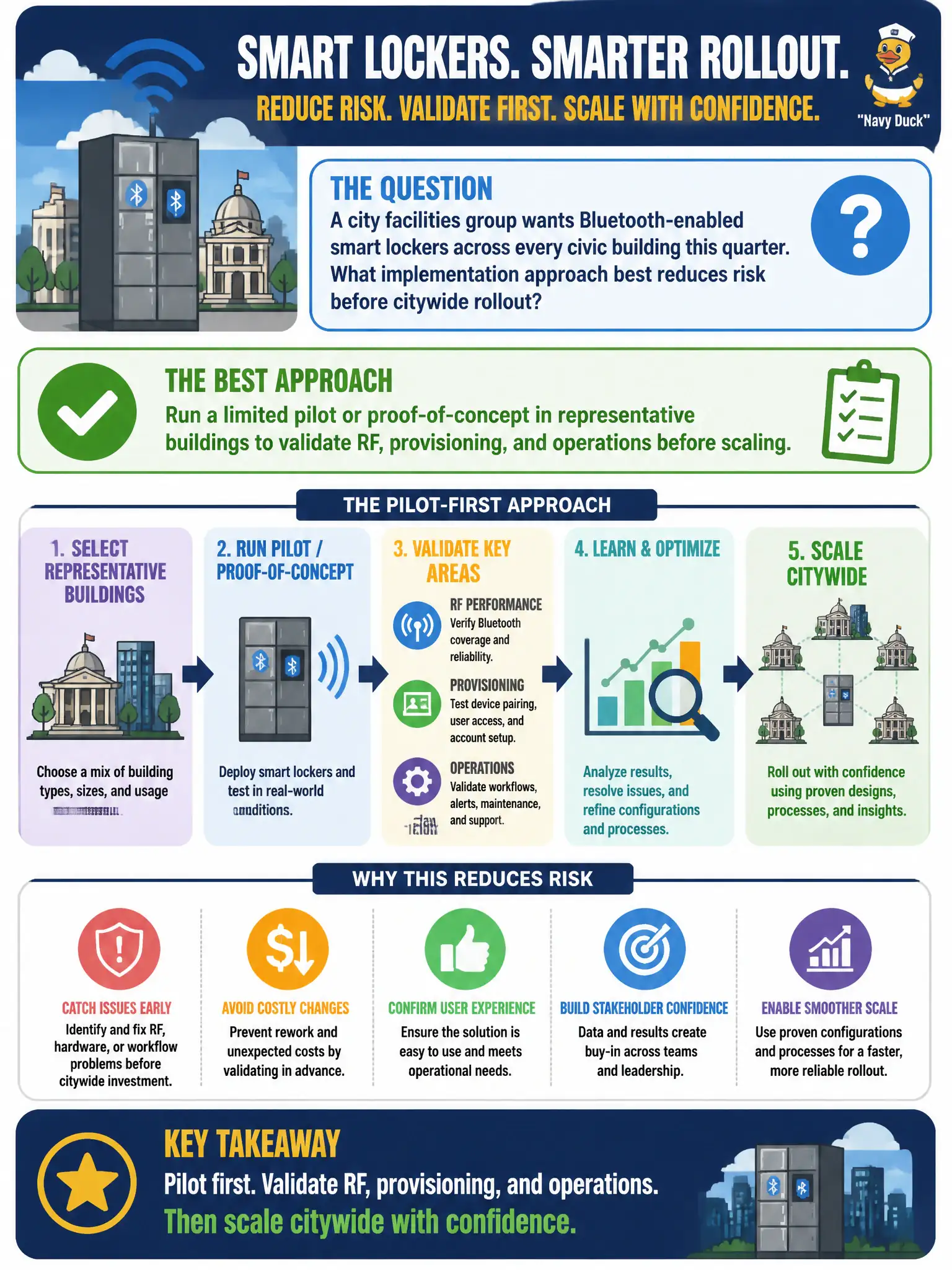
A city facilities group wants Bluetooth-enabled smart lockers across every civic building this quarter. What implementation approach best reduces risk before citywide rollout?
Select an answer to reveal the explanation.
Short Explanation
Think of a pilot like a dress rehearsal before opening night for the whole city. A few representative buildings reveal RF quirks, battery life, and ops pain before you buy a warehouse of lockers. Brochures and guest Wi-Fi shortcuts are how lockers become tickets.
Full Explanation
Citywide Bluetooth smart lockers should start with a limited pilot or proof-of-concept in representative buildings to validate RF, provisioning, and operations before scaling this quarter’s ambition. Ordering and installing everywhere in one weekend from a marketing brochure skips engineering. Skipping pilots because Bluetooth always behaves the same indoors ignores construction variance. Deploying first on guest Wi-Fi citywide and fixing failures only after public complaints mixes access domains and reacts too late. Exam caveat: civic IoT scale follows validated pilots. Operational check: run the pilot metrics for join success, battery, and support burden, then gate the municipal rollout on those exit criteria. In municipal WLAN and IoT operations, record the chosen control and the rejected alternatives in the change ticket so on-call staff understand which failure modes were avoided for city services. Re-validate after the next maintenance window that the same control still holds under the current platform code, device mix, and civic event calendar used by the wireless team. Keep RF, capacity, security, and QoS evidence attached to the municipal runbook entry for auditors and future CWNE-level reviews.