
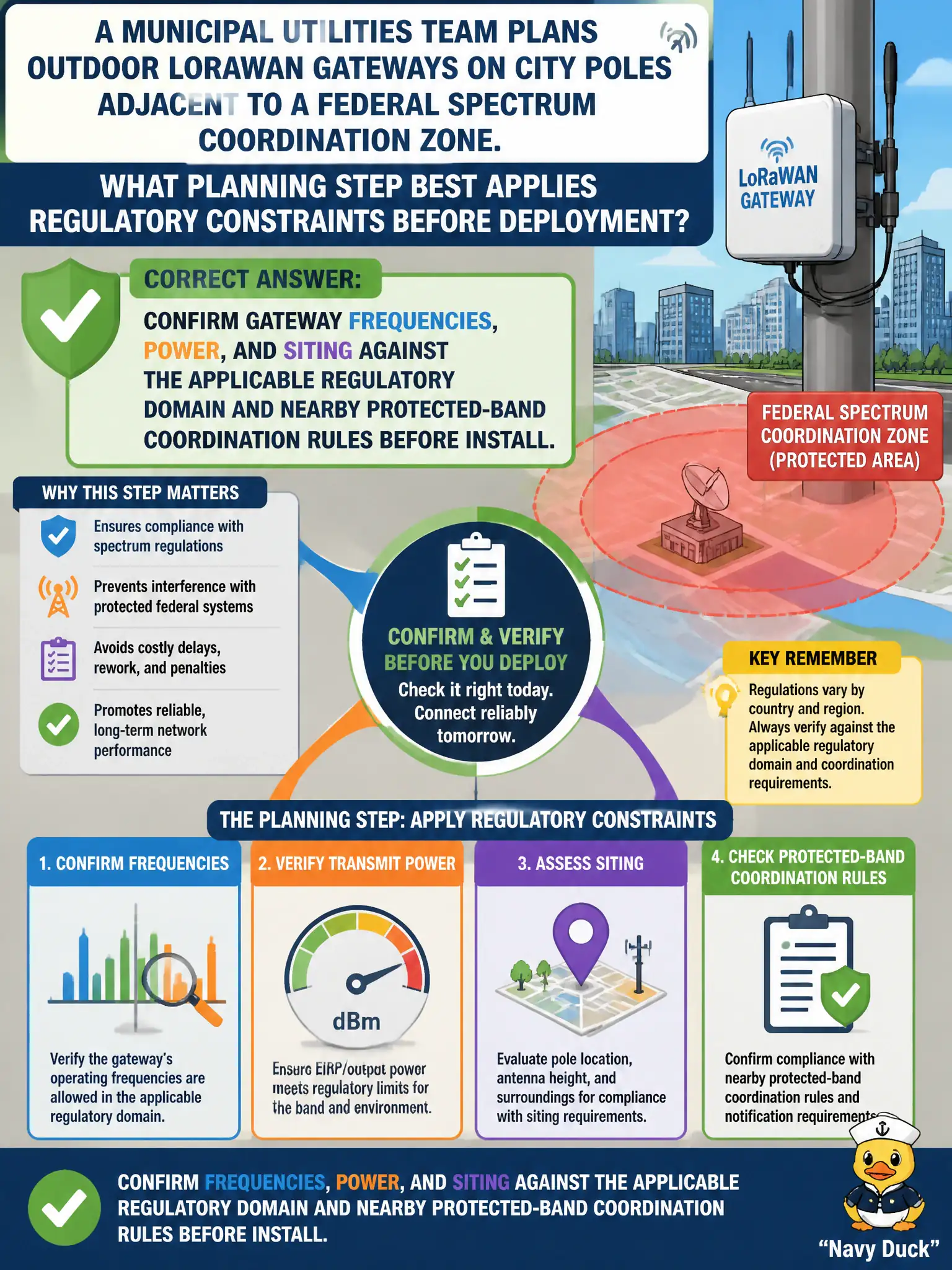
A municipal utilities team plans outdoor LoRaWAN gateways on city poles adjacent to a federal spectrum coordination zone. What planning step best applies regulatory constraints before deployment?
Select an answer to reveal the explanation.
Short Explanation
Outdoor LoRa near federal neighbors is not a 'set power to eleven' exercise. Check the regulatory domain—frequency, power, and siting—before the first bolt goes on the pole. Private NS or consumer kit habits do not waive those rules.
Full Explanation
Before placing outdoor LoRaWAN gateways on city poles near a federal spectrum coordination zone, confirm gateway frequencies, power, and siting against the applicable regulatory domain and nearby protected-band coordination rules. Maximizing ERP and treating federal-neighbor constraints as optional after go-live invites enforcement and interference risk. Ignoring regional radio rules because the network server is private does not waive RF regulation. Copying a consumer smart-home LoRa kit channel plan without checking outdoor licensing or ISM limits is not municipal engineering. Exam caveat: regulatory compliance precedes outdoor IoT RF turn-up. Operational check: complete coordination paperwork, verify configured channels/power against the grant, and archive approvals in the civic utilities project file. In municipal WLAN and IoT operations, record the chosen control and the rejected alternatives in the change ticket so on-call staff understand which failure modes were avoided for city services. Re-validate after the next maintenance window that the same control still holds under the current platform code, device mix, and civic event calendar used by the wireless team. Keep RF, capacity, security, and QoS evidence attached to the municipal runbook entry for auditors and future CWNE-level reviews.