
On a municipal IoT architecture diagram, how should WLAN, WPAN, and WSN roles be classified?
Select an answer to reveal the explanation.
Short Explanation
Name the layers on the city diagram honestly: WLAN is the campus Wi-Fi highway, WPAN is the short Bluetooth sidewalk, WSN is the sensor mesh whispering meter reads.
Full Explanation
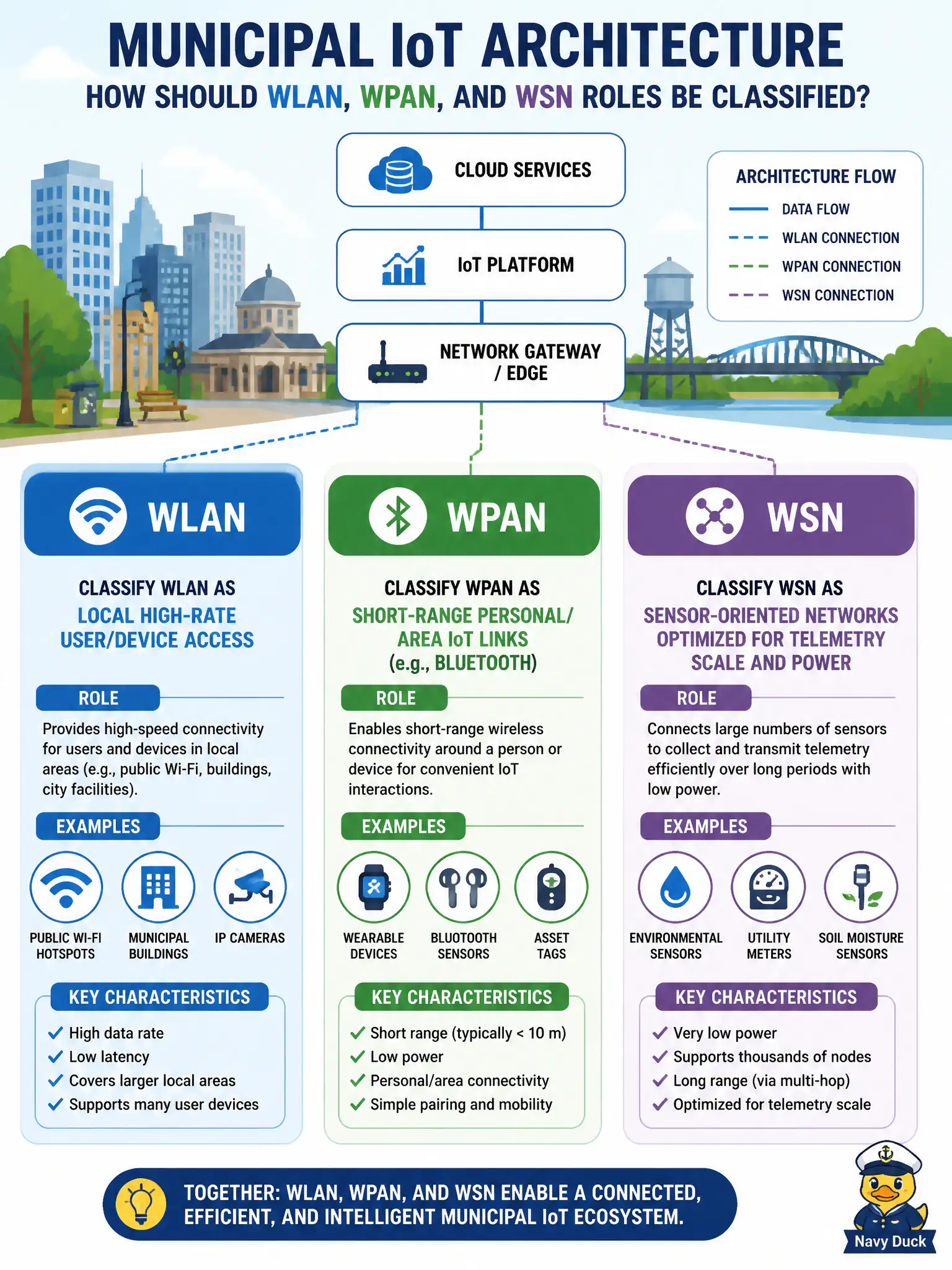
On a municipal IoT architecture diagram, classify WLAN as local high-rate user/device access, WPAN as short-range personal/area IoT links such as Bluetooth, and WSN as sensor-oriented networks—distinct roles, not synonyms. Treating WLAN, WPAN, and WSN as identical synonyms erases design constraints. Using WPAN only for citywide kilometer-scale meter backhaul misassigns short-range tech to LPWAN jobs. Defining WSN as the only permitted access for employee laptops confuses sensor fabrics with enterprise user access. Exam caveat: vocabulary precision drives correct technology selection in civic IoT. Operational check: label each municipal use case with WLAN/WPAN/WSN/LPWAN intentionally in the architecture package before procurement. In municipal WLAN and IoT operations, record the chosen control and the rejected alternatives in the change ticket so on-call staff understand which failure modes were avoided for city services. Re-validate after the next maintenance window that the same control still holds under the current platform code, device mix, and civic event calendar used by the wireless team. Keep RF, capacity, security, and QoS evidence attached to the municipal runbook entry for auditors and future CWNE-level reviews.