
A city wants backhaul from water meters buried in pits where enterprise Wi-Fi coverage is impractical. Which approach best fits?
Select an answer to reveal the explanation.
Short Explanation
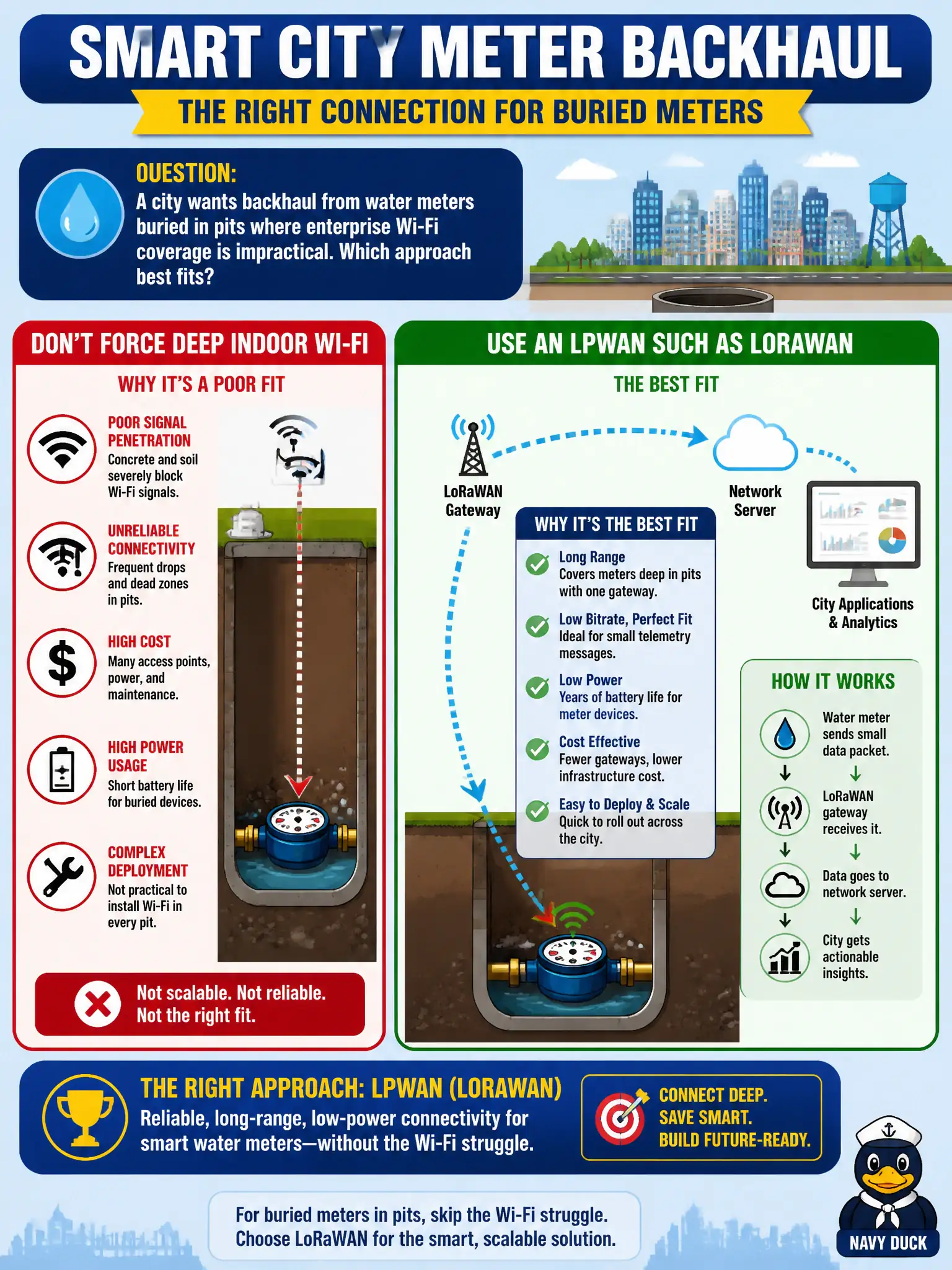
Water meters in pits are terrible Wi-Fi customers. LoRaWAN-style LPWAN carries tiny meter reads a long way without stuffing an AP down every hole.
Full Explanation
For water meters in pits where enterprise Wi-Fi coverage is impractical, use an LPWAN such as LoRaWAN for long-range, low-bitrate meter telemetry instead of forcing deep indoor Wi-Fi to every pit. Installing a Wi-Fi 6E AP inside each pit on 6 GHz only is operationally unrealistic and RF-hostile underground. Requiring every meter to roam on the public library SSID misuses guest WLAN for utility telemetry. Backhauling meters exclusively over NFC taps by field crews abandons continuous telemetry. Exam caveat: choose the wireless class for range and bitrate—do not force every civic IoT onto campus Wi-Fi. Operational check: validate LoRaWAN link budgets from representative pits, confirm duty-cycle and payload needs, and integrate gateways into the municipal utilities network plan. In municipal WLAN and IoT operations, record the chosen control and the rejected alternatives in the change ticket so on-call staff understand which failure modes were avoided for city services. Re-validate after the next maintenance window that the same control still holds under the current platform code, device mix, and civic event calendar used by the wireless team. Keep RF, capacity, security, and QoS evidence attached to the municipal runbook entry for auditors and future CWNE-level reviews.