
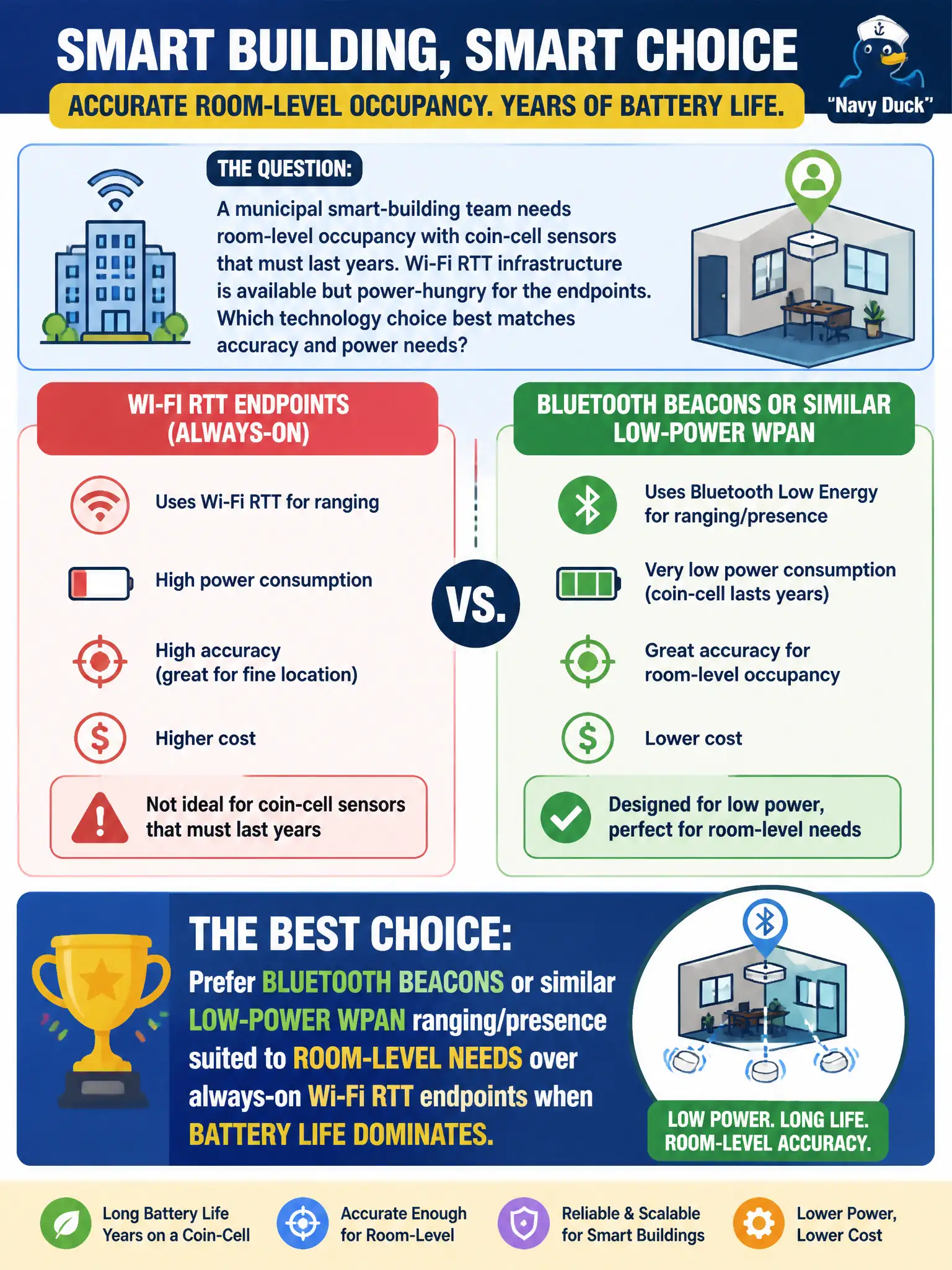
A municipal smart-building team needs room-level occupancy with coin-cell sensors that must last years. Wi-Fi RTT infrastructure is available but power-hungry for the endpoints. Which technology choice best matches accuracy and power needs?
Select an answer to reveal the explanation.
Short Explanation
Tiny battery sensors hate chatting on full Wi-Fi all day. For room-level presence with years of life, lean on Bluetooth-class beacons—not always-on Wi-Fi RTT radios.
Full Explanation
For room-level occupancy with coin-cell sensors that must last years, prefer Bluetooth beacons or similar low-power WPAN ranging/presence suited to room-level needs over always-on Wi-Fi RTT endpoints when battery life dominates—even if Wi-Fi RTT infrastructure exists. Forcing every sensor onto enterprise Wi-Fi with continuous RTT ranging ignores battery constraints. Using only GPS indoors for room-level accuracy fails indoors and is the wrong scale. Replacing occupancy sensing with monthly manual clipboard counts abandons the automation goal. Exam caveat: match sensing technology to battery and accuracy requirements, not to whichever campus WLAN feature is newest. Operational check: pilot BLE presence in representative civic rooms, measure battery and accuracy, then scale the municipal smart-building design accordingly. In municipal WLAN and IoT operations, record the chosen control and the rejected alternatives in the change ticket so on-call staff understand which failure modes were avoided for city services. Re-validate after the next maintenance window that the same control still holds under the current platform code, device mix, and civic event calendar used by the wireless team.