
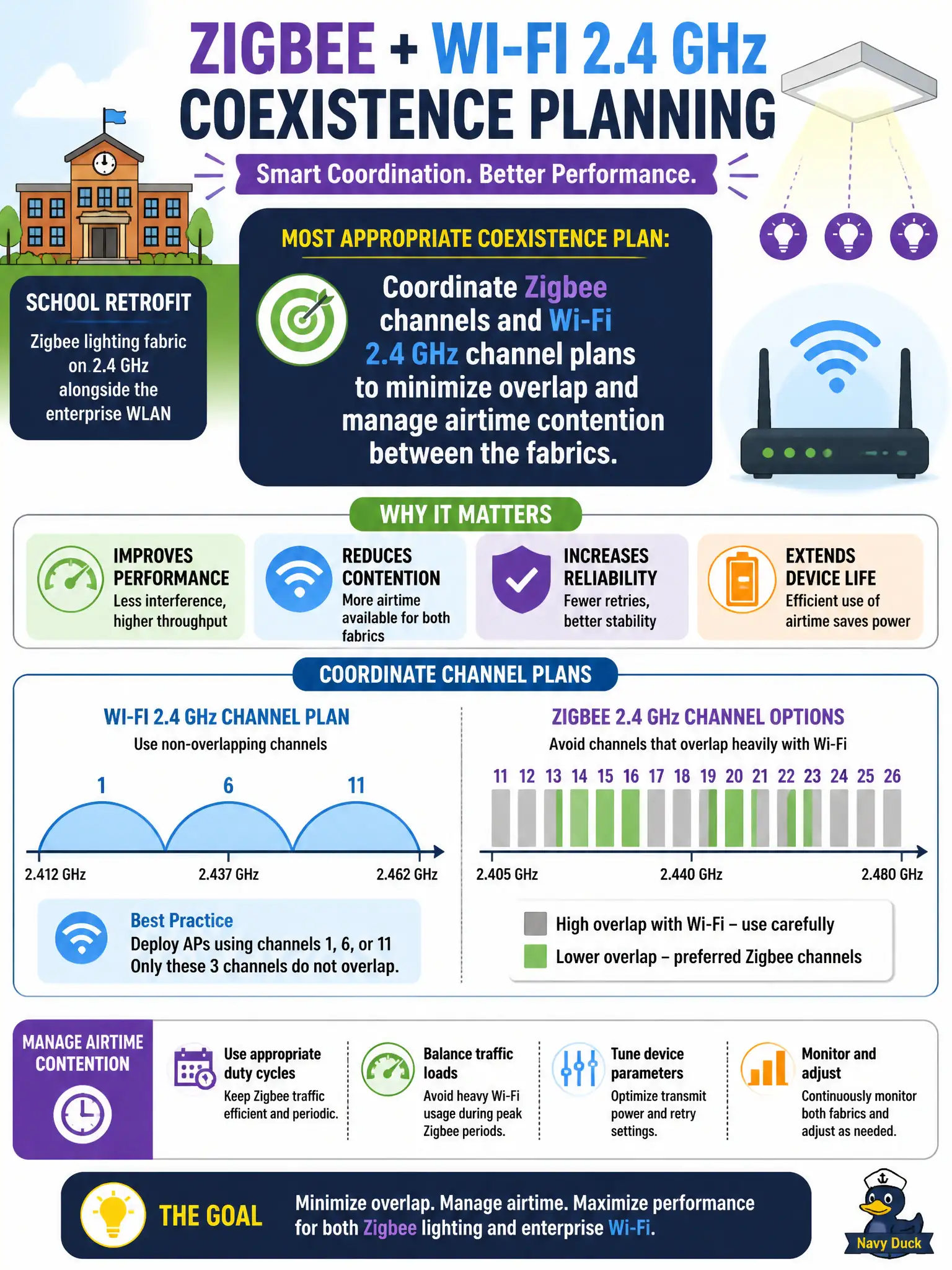
A school retrofit adds a Zigbee lighting fabric on 2.4 GHz alongside the enterprise WLAN. What coexistence planning is most appropriate?
Select an answer to reveal the explanation.
Short Explanation
Zigbee and Wi-Fi share the 2.4 GHz sandbox. Pick channels like assigned play areas so the lights and the laptops are not kicking sand on each other.
Full Explanation
A school retrofit adding Zigbee lighting on 2.4 GHz alongside the enterprise WLAN requires coordinating Zigbee channels and Wi-Fi 2.4 GHz channel plans to minimize overlap and manage airtime contention between the fabrics. Ignoring Zigbee because 802.15.4 never overlaps Wi-Fi channels is false. Disabling all school Wi-Fi so lighting always wins harms educational access. Moving the entire enterprise WLAN permanently to 900 MHz ISM is not how 802.11 campus designs work. Exam caveat: 2.4 GHz coexistence planning is mandatory when WPAN lighting and WLAN share buildings. Operational check: set Zigbee channels away from active Wi-Fi where possible, measure duty cycle, and validate classroom Wi-Fi during lighting storms for the civic school district. In municipal WLAN and IoT operations, record the chosen control and the rejected alternatives in the change ticket so on-call staff understand which failure modes were avoided for city services. Re-validate after the next maintenance window that the same control still holds under the current platform code, device mix, and civic event calendar used by the wireless team. Keep RF, capacity, security, and QoS evidence attached to the municipal runbook entry for auditors and future CWNE-level reviews.