
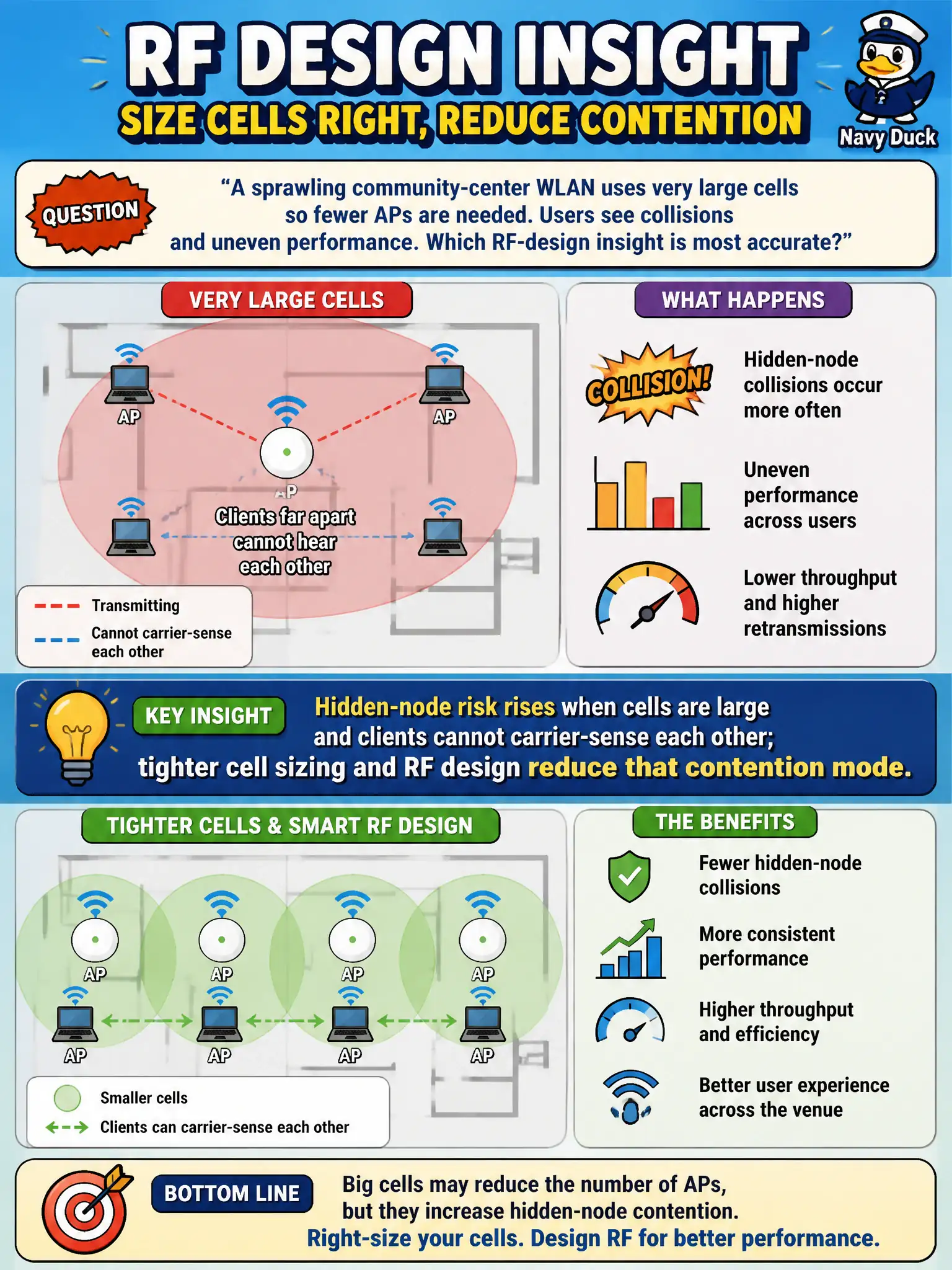
A sprawling community-center WLAN uses very large cells so fewer APs are needed. Users see collisions and uneven performance. Which RF-design insight is most accurate?
Select an answer to reveal the explanation.
Short Explanation
When the cell is the size of a football field, laptops on opposite ends can't hear each other talk — classic hidden node, more collisions. Smaller, better-planned cells fix that better than celebrating 'fewer APs.'
Full Explanation
A sprawling community-center WLAN that uses very large cells to save AP count often sees collisions and uneven performance because hidden-node risk rises when clients cannot carrier-sense each other across a large cell. Tighter cell sizing, appropriate power, and RF design reduce that contention mode. Expert insight: fewer APs is not free capacity if hidden nodes and retries explode.
Claiming larger cells always eliminate hidden nodes because more clients share one BSSID reverses the problem. Saying hidden-node risk is unrelated to cell size and carrier sensing denies basic CSMA/CA geometry. Asserting oversized cells only cause problems on wired STP, never on Wi-Fi airtime, relocates an RF issue to spanning tree.
Exam caveat: AP-count minimization without RF reuse design creates civic WLAN performance debt. Operational check: measure client distribution and retry/collision symptoms at the community center, reduce cell size with more APs or lower power/directional antennas, and confirm hidden-node indicators (RTS/CTS efficacy, retry maps) improve. Present collision/retry maps to community-center leadership when requesting additional APs so “more hardware” is framed as hidden-node remediation, not spend for its own sake.