
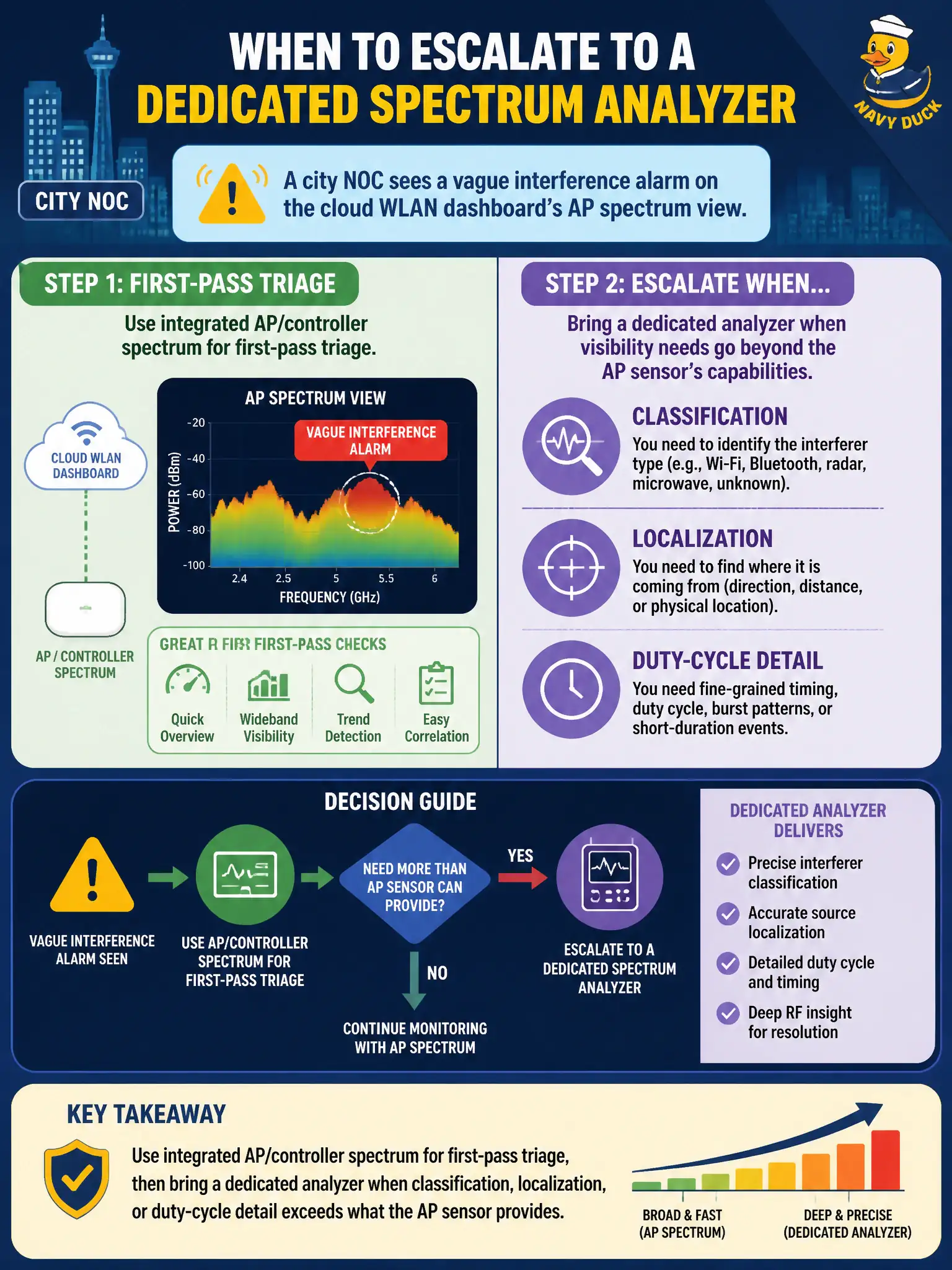
A city NOC sees a vague interference alarm on the cloud WLAN dashboard's AP spectrum view. When should engineers escalate to a dedicated spectrum analyzer?
Select an answer to reveal the explanation.
Short Explanation
Cloud AP spectrum is a great smoke alarm; a dedicated analyzer is the fire investigator. Start with the dashboard, then haul out the serious tool when you need finer classification or a walk-around hunt.
Full Explanation
When a city NOC sees a vague interference alarm on a cloud WLAN dashboard’s AP spectrum view, engineers should use integrated AP/controller spectrum for first-pass triage, then bring a dedicated analyzer when classification, localization, or duty-cycle detail exceeds what the AP sensor provides. Both tool classes have roles; neither universally replaces the other. Expert escalation is evidence-driven, not ideology-driven.
Never using dedicated analyzers because cloud dashboards always fully replace handheld tools fails when localization and fine spectral detail are needed on-site. Using only dedicated analyzers and declaring integrated AP spectrum never valid for any triage wastes always-on civic sensor data. Escalating to a dedicated analyzer only after deleting all APs from the controller inventory is unrelated vandalism, not triage.
Exam caveat: layered spectrum tooling—AP sensors then handheld—is standard CWNE operational practice. Operational check: acknowledge the cloud alarm, review AP FFT/duty-cycle history, and if the signature remains ambiguous, dispatch a dedicated analyzer to the alarmed civic site for classification and localization. Document the decision threshold in the NOC runbook: which dashboard signatures stay remote versus which trigger a handheld dispatch to the civic site.