
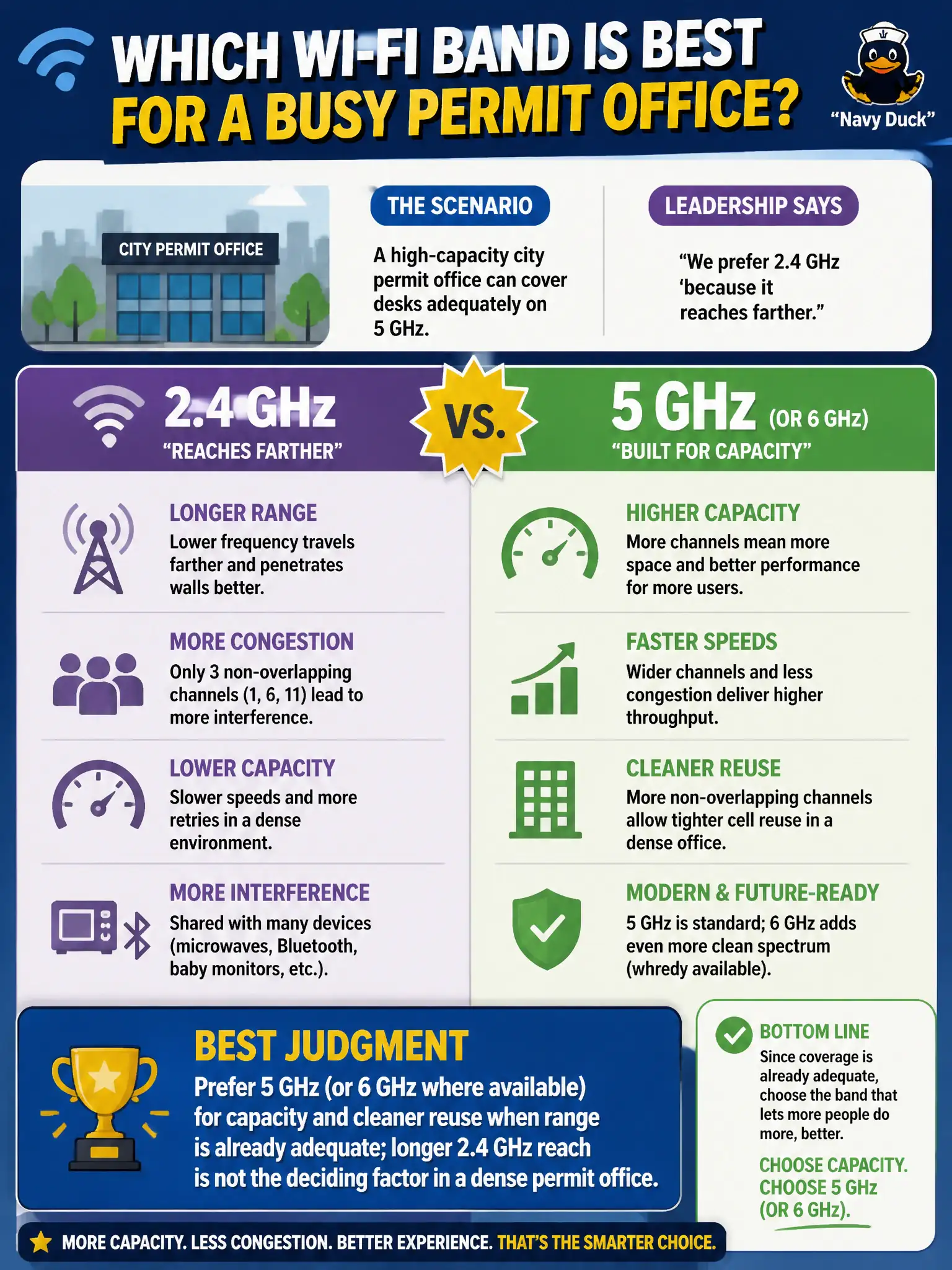
A high-capacity city permit office can cover desks adequately on 5 GHz. Leadership prefers 2.4 GHz 'because it reaches farther.' Which band-selection judgment is best?
Select an answer to reveal the explanation.
Short Explanation
Farther isn't better when the room is already covered and crowded — 5 GHz gives you more clean lanes for a busy permit counter. Clinging to 2.4 for 'reach' in a dense office just invites a traffic jam.
Full Explanation
When a high-capacity city permit office already covers desks adequately on 5 GHz but leadership prefers 2.4 GHz “because it reaches farther,” the better band-selection judgment is to prefer 5 GHz (or 6 GHz where available) for capacity and cleaner reuse. Longer 2.4 GHz reach is not the deciding factor when range is already adequate in a dense office; 2.4 GHz often brings more CCI and legacy contention. Expert advice aligns band choice with capacity goals, not folklore about reach.
Always preferring 2.4 GHz for capacity because it supposedly has more non-overlapping 80 MHz channels is factually wrong and capacity-hostile. Disabling 5 GHz whenever any client still supports 2.4 GHz forces everyone onto the most congested band. Using only 2.4 GHz voice SSIDs in dense offices to maximize reuse typically worsens voice airtime contention.
Exam caveat: reach is not capacity—dense civic offices default to mid/high band when SNR is already sufficient. Operational check: show leadership desk SNR on 5 GHz meeting targets, compare airtime and retries on 2.4 versus 5 GHz during peak permitting, and keep 2.4 GHz for IoT/legacy exceptions rather than primary staff capacity. Offer a small 2.4 GHz IoT/legacy SSID if needed, but keep staff permitting capacity on 5/6 GHz in the written architecture decision record.