
A city library AP still beacons, but clients report a 'slow AP' after a suspected MIMO radio-chain fault. What expert diagnosis fits?
Select an answer to reveal the explanation.
Short Explanation
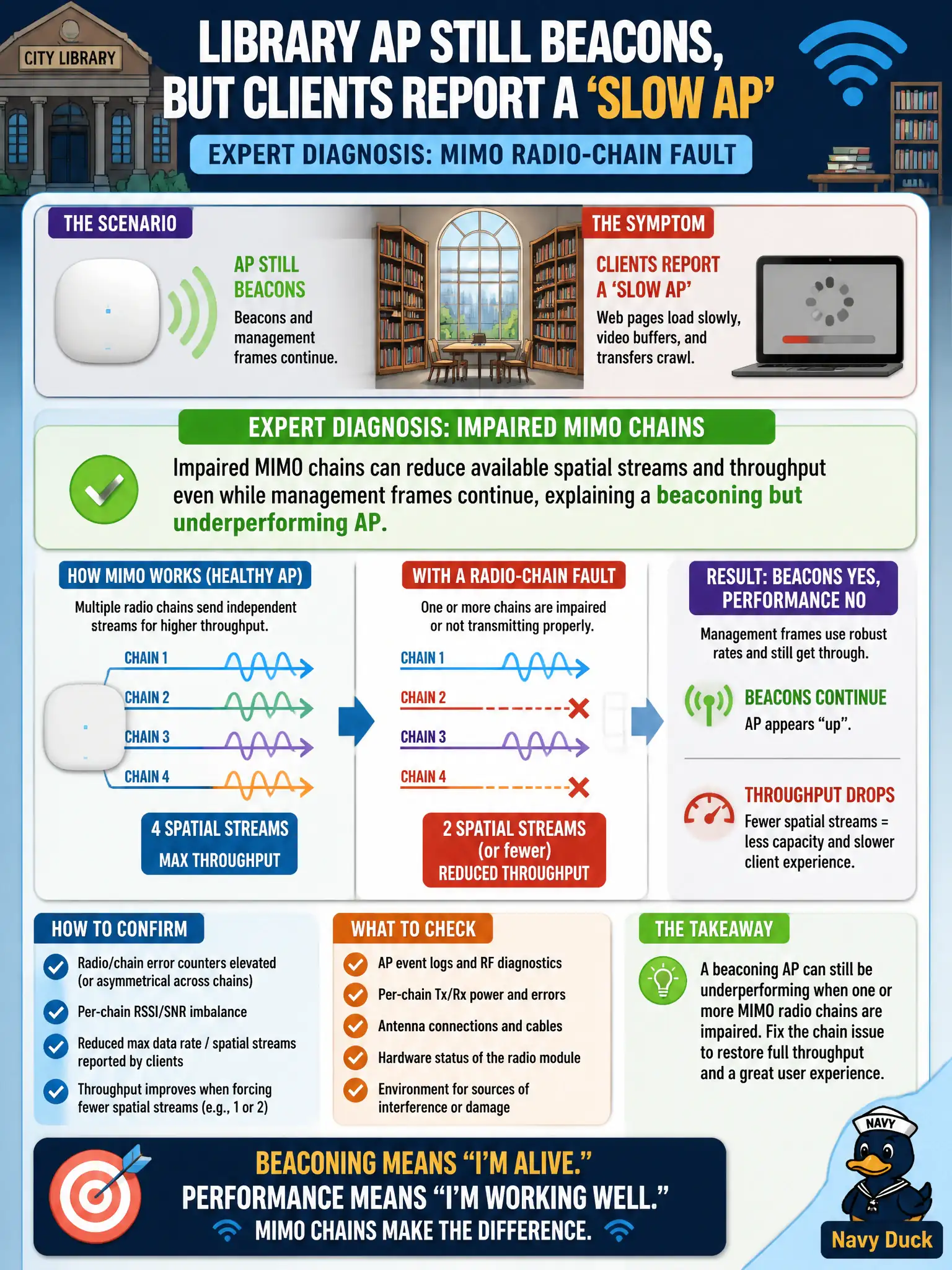
The AP can still say 'hello' with beacons while half its MIMO arms are in a cast — fewer spatial streams means slower data even though the SSID is visible. Don't assume beacons equal full radio health, and don't blame DNS by default.
Full Explanation
A city library AP that still beacons while clients report a “slow AP” after a suspected MIMO radio-chain fault fits impaired MIMO chains reducing available spatial streams and throughput even though management frames continue. Beaconing proves the BSS is advertised, not that all chains and streams remain at full capability. Expert diagnosis inspects chain status, negotiated NSS/MCS, and throughput under load rather than trusting beacon presence alone.
Claiming beaconing proves all MIMO chains and spatial streams remain at full capability over-reads a management advertisement. Saying a single failed chain always disables the entire BSS SSID advertisement is stronger than typical failure modes where beacons persist with degraded data. Asserting slow performance with beacons present can only mean DNS failure on the wired side ignores PHY spatial-stream loss.
Exam caveat: separate management-plane liveness from data-plane MIMO capacity in civic performance tickets. Operational check: check AP radio/chain health LEDs or controller chain stats, run an iperf-style test near the library AP comparing NSS/MCS to baseline, and RMA/repair chains if streams are missing while beacons continue.