
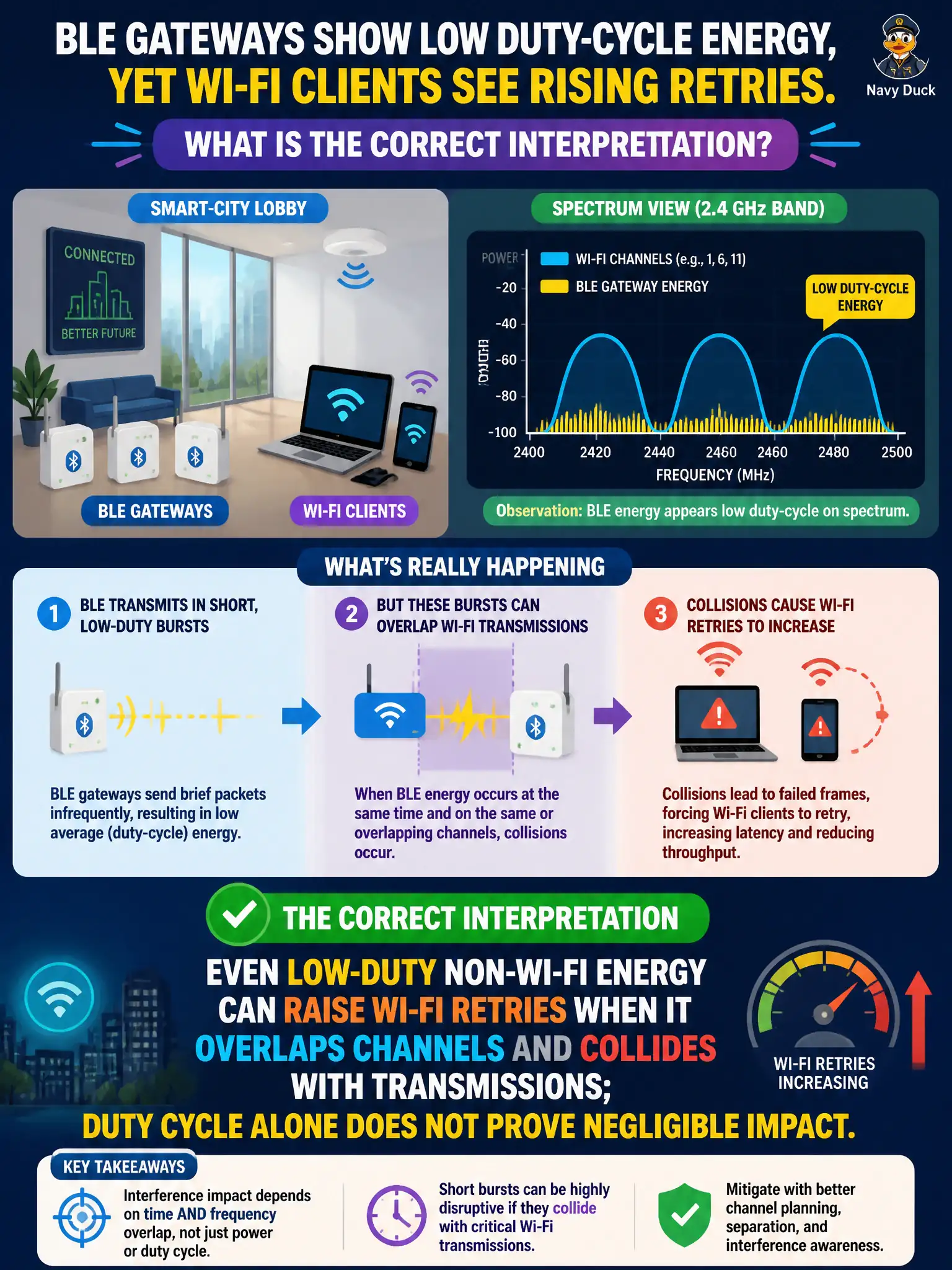
BLE gateways in a smart-city lobby show only low-duty-cycle energy on spectrum, yet adjacent Wi-Fi clients see rising retries. What is the correct interpretation?
Select an answer to reveal the explanation.
Short Explanation
A quiet-looking BLE chatter can still poke Wi-Fi right when a frame is in the air — low duty cycle isn't the same as 'harmless.' Watch overlap and retries, not just a pretty low percentage on the graph.
Full Explanation
BLE gateways in a smart-city lobby that show only low-duty-cycle energy on spectrum can still raise adjacent Wi-Fi retries when transmissions overlap in frequency and collide in time. Duty cycle alone does not prove negligible impact: short bursts that hit Wi-Fi PPDUs still cause errors and retries. Expert interpretation treats low-duty non-Wi-Fi as a coexistence variable to measure, not dismiss.
Claiming low-duty BLE energy can never affect Wi-Fi retries under any overlap condition overstates safety. Blaming retries solely on RADIUS misconfiguration ignores RF coexistence evidence next to BLE gateways. Saying BLE always forces Wi-Fi to 160 MHz channels invents a causal link that does not exist.
Exam caveat: coexistence impact ≠ average duty cycle; timing collisions matter for civic lobby Wi-Fi. Operational check: correlate Wi-Fi retry counters with BLE gateway activity windows, test with BLE advertising reduced or moved, and retain spectrum-plus-protocol evidence before declaring BLE “too quiet to matter.” When retries fall after relocating a BLE gateway a few meters, keep that before/after retry chart with the smart-city lobby RF notes. Retries that track BLE advertising intervals are coexistence evidence even when average duty cycle looks small on the lobby spectrum plot.