
In a design review with facilities, a contractor claims a higher-dBi antenna 'adds free amplification like an amplifier in the antenna.' How should the wireless expert respond?
Select an answer to reveal the explanation.
Short Explanation
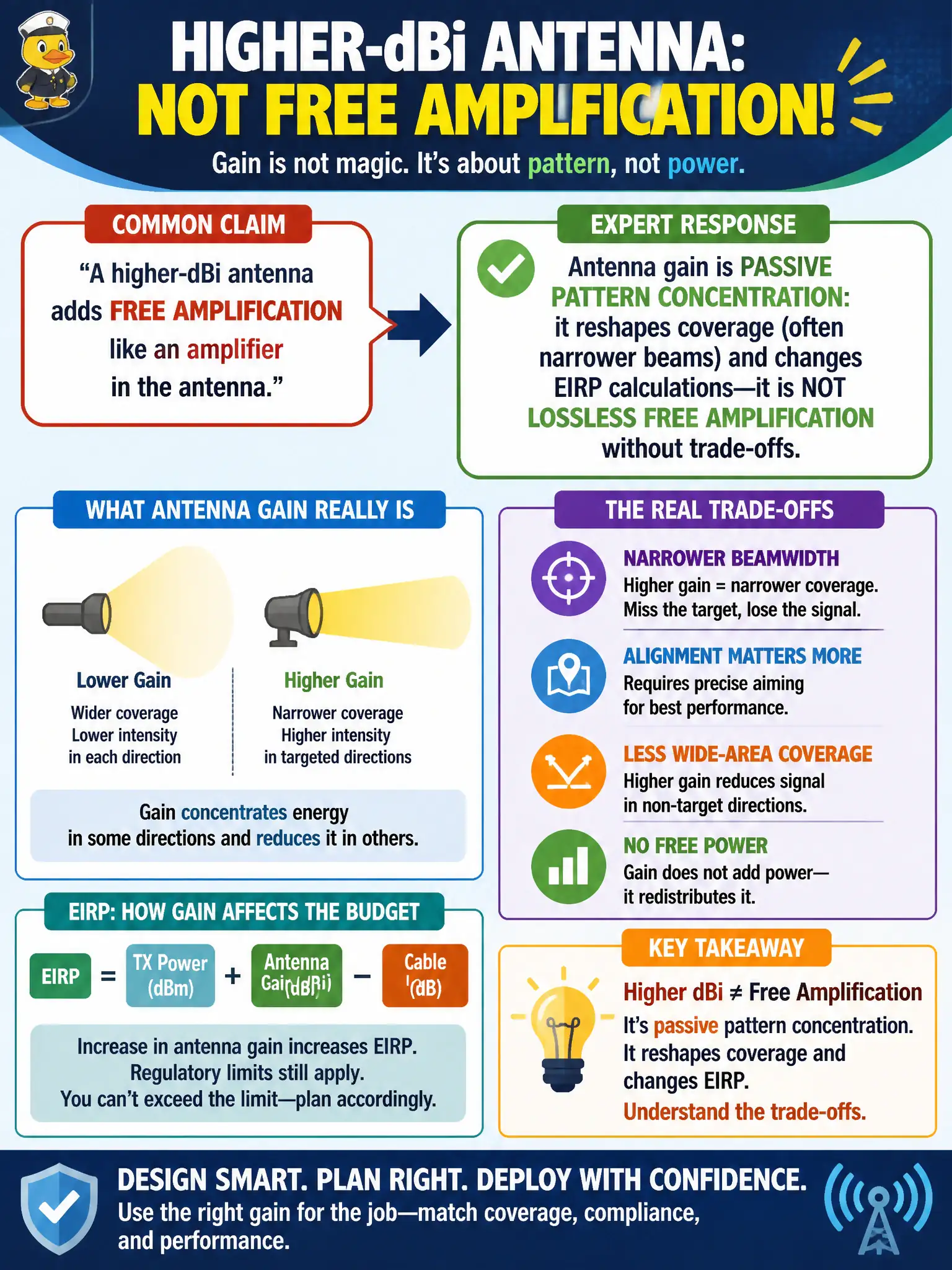
Antennas don't print free watts — they squeeze the same energy into a tighter beam, like a flashlight reflector. Higher dBi usually means skinnier coverage and careful EIRP math, not a magic amp inside the radome.
Full Explanation
In a facilities design review, when a contractor claims a higher-dBi antenna “adds free amplification like an amplifier in the antenna,” the wireless expert must clarify that antenna gain is passive pattern concentration. Higher gain reshapes coverage—often into narrower beams—and changes EIRP calculations; it does not create power from nowhere without coverage trade-offs. Civic designs must account for both the link-budget benefit on boresight and the coverage holes off-axis.
Agreeing that dBi gain creates power from nowhere with no coverage trade-offs endorses a dangerous misconception for EIRP and cell shaping. Stating that dBi only applies to Bluetooth and never to Wi-Fi antennas is false. Recommending removal of all antennas so APs radiate more evenly in every direction ignores that connectors need antennas and that pattern control is intentional.
Exam caveat: gain is not an amplifier; always recompute EIRP and redraw coverage when dBi changes on municipal APs. Operational check: compare the proposed higher-dBi pattern to the required courthouse coverage polygon, recompute EIRP, and survey boresight versus off-axis seats before approving the antenna swap. Show facilities a simple coverage plot before/after the higher-dBi swap so the narrower beam trade-off is visible on the courthouse floor plan.