
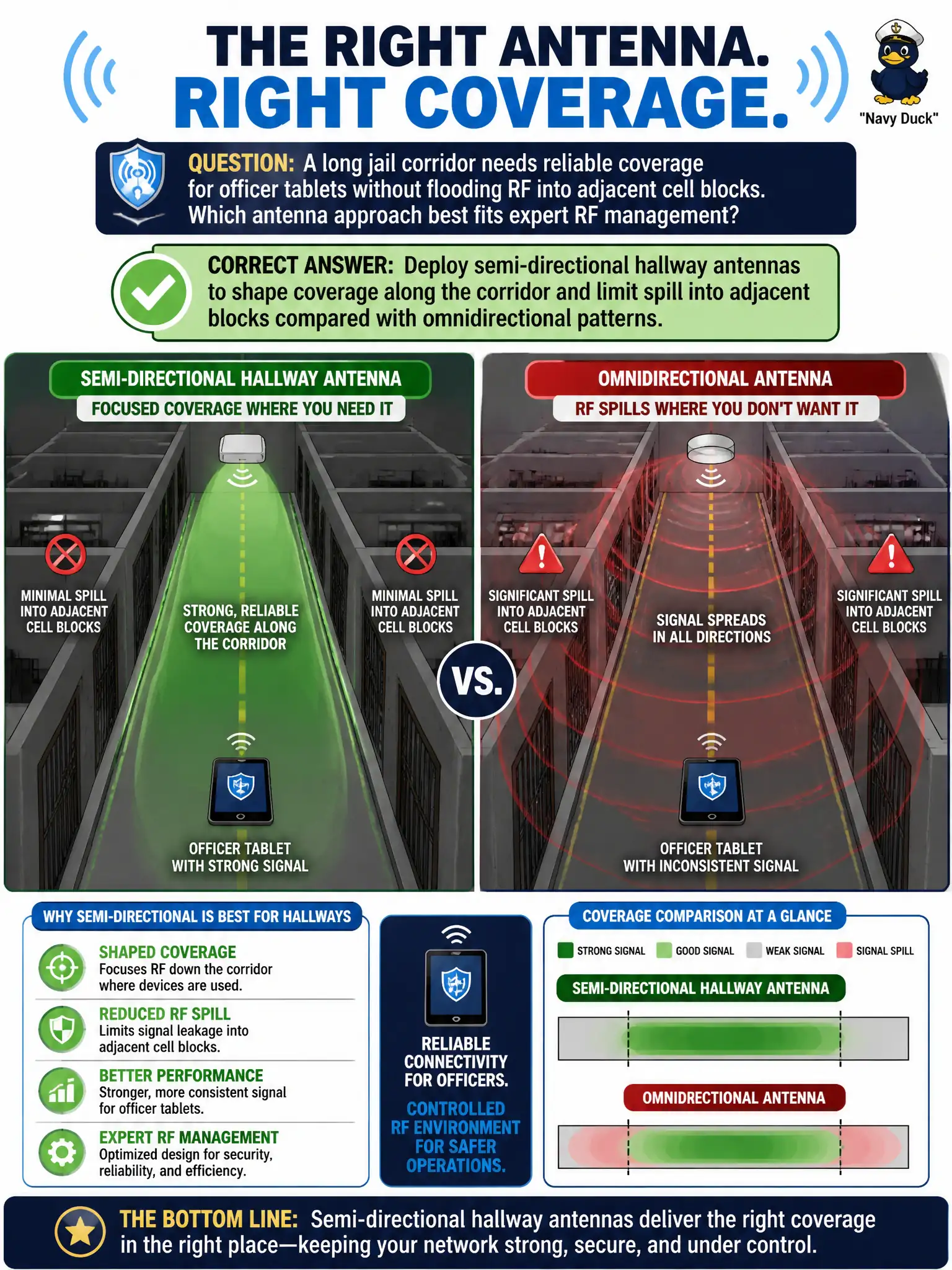
A long jail corridor needs reliable coverage for officer tablets without flooding RF into adjacent cell blocks. Which antenna approach best fits expert RF management?
Select an answer to reveal the explanation.
Short Explanation
Hallways want a flashlight beam down the lane, not a lighthouse blasting every cell block. Semi-directional antennas aim energy along the corridor and cut sideways spill. Giant omnis at full power are how you light up the wrong wings.
Full Explanation
A long jail corridor needing reliable officer-tablet coverage without flooding adjacent cell blocks calls for semi-directional hallway antennas that shape energy along the corridor and limit spill compared with omnidirectional patterns. Pattern control is an RF-management tool for secure civic facilities where over-coverage creates both CCI and unwanted coverage in sensitive areas. Expert design prefers hallway antennas and calibrated power over maximum omni flood.
Using high-gain omni antennas at maximum power so every block hears the same BSSID equally maximizes spill and CCI, opposite of the containment goal. Removing all antennas and relying on an internal patch at full power facing only the sally port under-serves the corridor and still lacks controlled hallway shaping. Placing a single omni AP in the facility center and disabling RRM to keep cells huge increases hidden-node and spill problems.
Exam caveat: corrections and other secure venues often prioritize RF containment as highly as coverage. Operational check: install hallway-oriented antennas, survey RSSI/SNR along the corridor and inside adjacent blocks, and tune downtilt/power until tablets are solid in-corridor while spill into blocks meets the facility’s RF policy.