
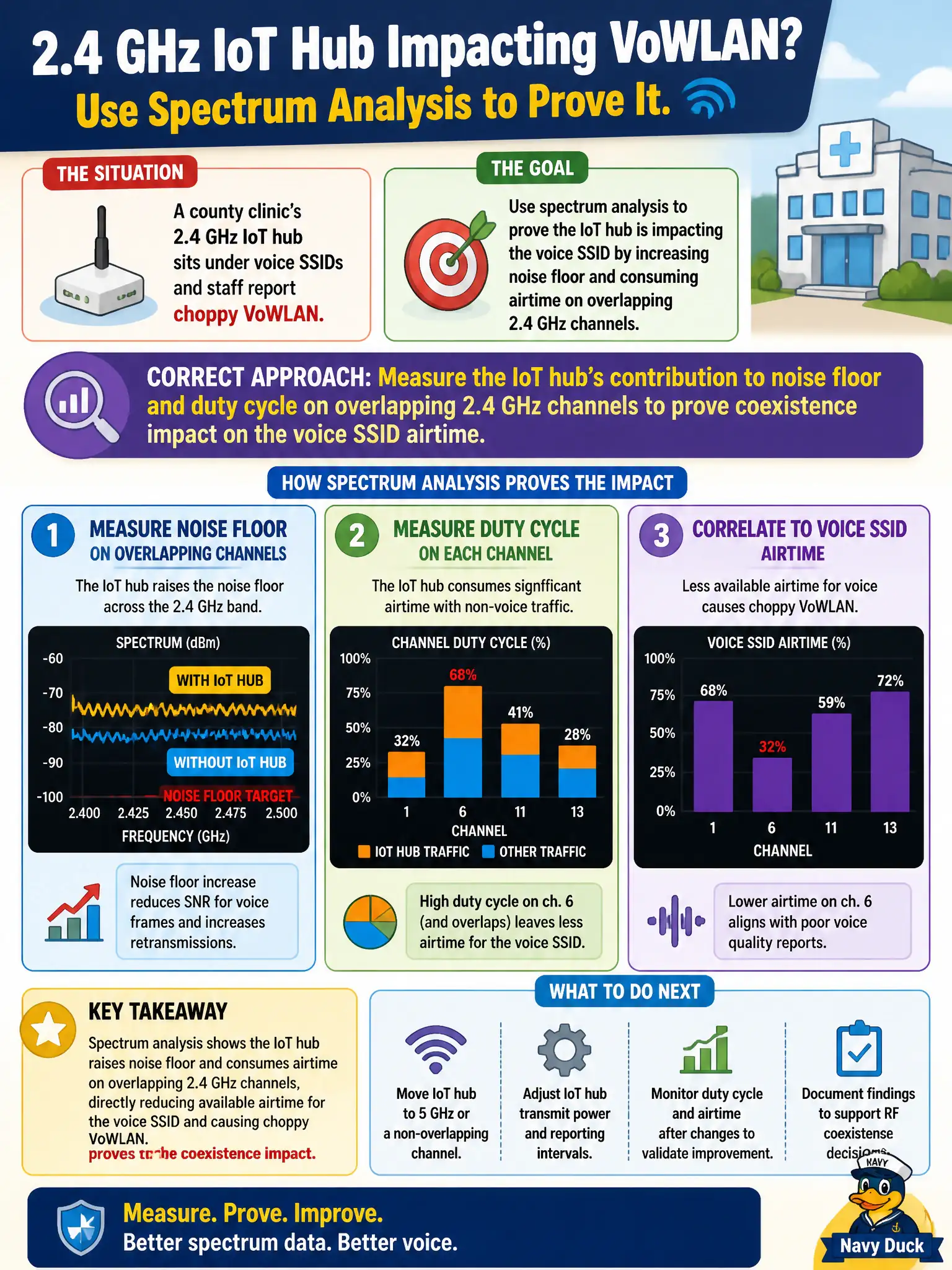
A county clinic's 2.4 GHz IoT hub sits under voice SSIDs and staff report choppy VoWLAN. How should spectrum analysis be used?
Select an answer to reveal the explanation.
Short Explanation
If the IoT hub is yelling on 2.4 under the nurses' voice SSID, spectrum is how you prove it's eating airtime — noise floor and duty cycle don't lie. Cranking TXOP or killing QoS without evidence is guessing. And lots of clinic IoT still loves 2.4 GHz.
Full Explanation
When a county clinic’s 2.4 GHz IoT hub sits under voice SSIDs and staff hear choppy VoWLAN, spectrum analysis should measure the IoT hub’s contribution to noise floor and duty cycle on overlapping 2.4 GHz channels to prove coexistence impact on voice airtime. Voice is airtime- and latency-sensitive; IoT hubs that chatter or raise energy detect degrade calls even when associations look fine. Evidence guides whether to rechannel, relocate, or segregate IoT.
Ignoring spectrum and only increasing WMM Voice AC TXOP until calls clear may help slightly but does not prove or remove the IoT interferer’s airtime cost. Moving all clinic IoT to channel 165 on 5 GHz without measuring assumes devices that may be 2.4 GHz-only and skips evidence. Disabling QoS on the voice SSID so IoT and voice “share equally” removes prioritization voice needs in a clinic.
Exam caveat: coexistence proofs are spectrum-plus-voice-metric exercises, not QoS-only guesswork. Operational check: capture duty cycle and noise floor with the IoT hub on versus off (or shielded), correlate with voice MOS/choppy reports, then remediate channel/placement before changing WMM as a last resort. If voice clears when the IoT hub is powered down during a maintenance window, record that A/B test in the clinic change ticket as coexistence proof for leadership.