
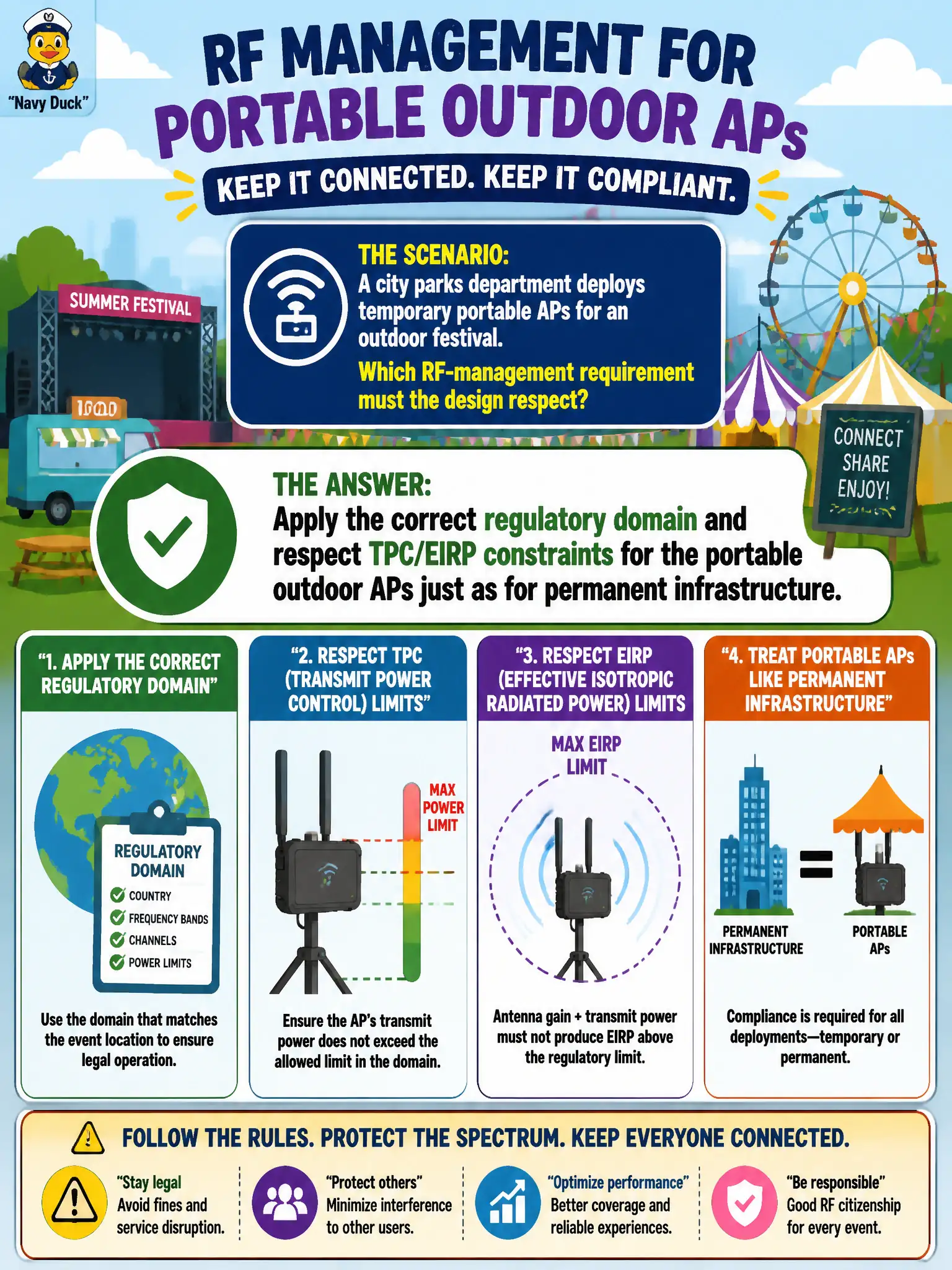
A city parks department deploys temporary portable APs for an outdoor festival. Which RF-management requirement must the design respect?
Select an answer to reveal the explanation.
Short Explanation
A pop-up festival WLAN still has to play by the same power and domain rules as the permanent city network — temporary isn't a get-out-of-regulation card. Cranking past EIRP or dumping DFS to 'reach the fence' is how you create legal and interference headaches.
Full Explanation
Temporary portable APs for a city parks outdoor festival must still apply the correct regulatory domain and respect TPC/EIRP constraints just as permanent infrastructure does. Festival deployments are not exempt from power and domain rules; portable gear often needs explicit domain and power configuration before booths open. Expert RF management treats temporary civic Wi-Fi as regulated RF, not a carnival exception.
Claiming temporary outdoor APs may ignore regulatory power limits because festivals are exempt from EIRP rules is incorrect and creates compliance risk. Saying TPC and max power settings only apply indoors so outdoor portable APs should always run absolute maximum ignores outdoor limits and coexistence. Disabling DFS and raising power above the domain limit so far-fence booths associate violates regulatory constraints and can worsen interference.
Exam caveat: temporary ≠ unregulated; document domain, EIRP, and channel plan for every portable civic event WLAN. Operational check: before festival open, set regulatory domain on portable APs, verify conducted power + antenna gain − loss ≤ allowed EIRP, and spot-check far booths for SNR without exceeding limits. Keep a printed domain/EIRP checklist in the festival kit so overnight staff do not “max power” portable APs when a far booth complains.