
A dense municipal permit office needs higher per-client rates but already has many neighboring APs on 5 GHz. Which channel-width judgment is most appropriate?
Select an answer to reveal the explanation.
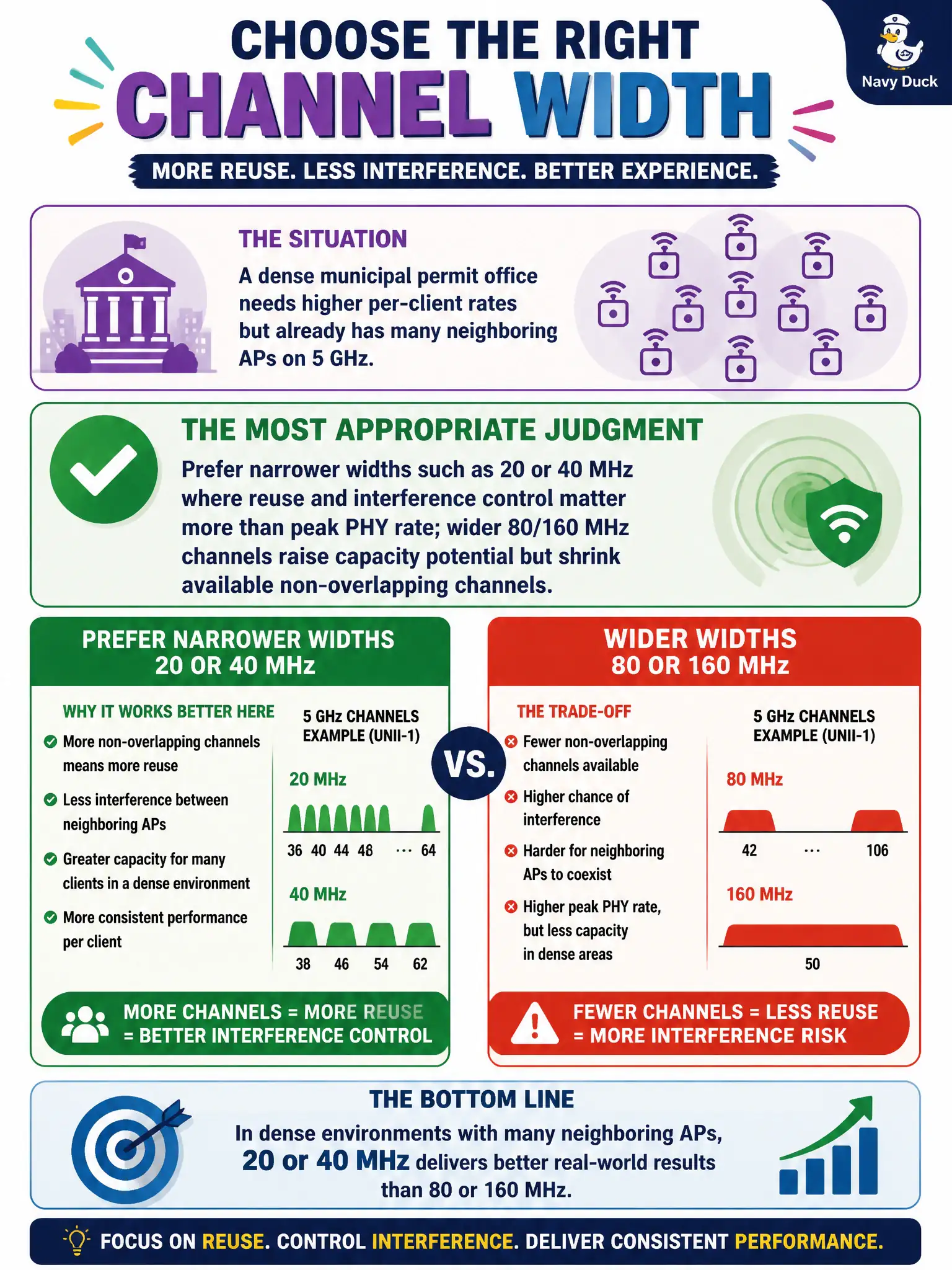
Short Explanation
Wider lanes feel faster until you realize the parking lot only has a few of them — dense offices often need more reusable narrow channels, not every AP hogging 160 MHz. Width is an RF reuse trade, not a switch MTU knob. And 2.4 GHz is the worst place to dream about fat wide channels.
Full Explanation
A dense municipal permit office that needs higher per-client rates but already has many neighboring 5 GHz APs should prefer narrower channel widths such as 20 or 40 MHz when reuse and interference control matter more than peak PHY rate. Wider 80/160 MHz channels raise peak capacity potential but shrink the pool of non-overlapping channels and increase ACI/CCI exposure in dense civic floors. Expert judgment balances MCS opportunity against reusable spectrum.
Using 160 MHz on every AP so “reuse improves” reverses reality: wider channels reduce the number of orthogonal assignments and often increase contention footprints. Saying channel width only affects wired switch MTU denies the RF reuse impact of occupied bandwidth. Forcing 80 MHz on 2.4 GHz only because 2.4 GHz supposedly has more non-overlapping wide channels than 5 GHz is factually inverted and operationally harmful.
Exam caveat: in high-density civic offices, reuse usually beats vanity wide channels unless neighboring inventory is truly sparse. Operational check: inventory neighboring 5 GHz occupancy in the permit office, pilot 40 MHz versus 80 MHz on a subset of APs, and compare retry rates, airtime, and client throughput before standardizing width.