
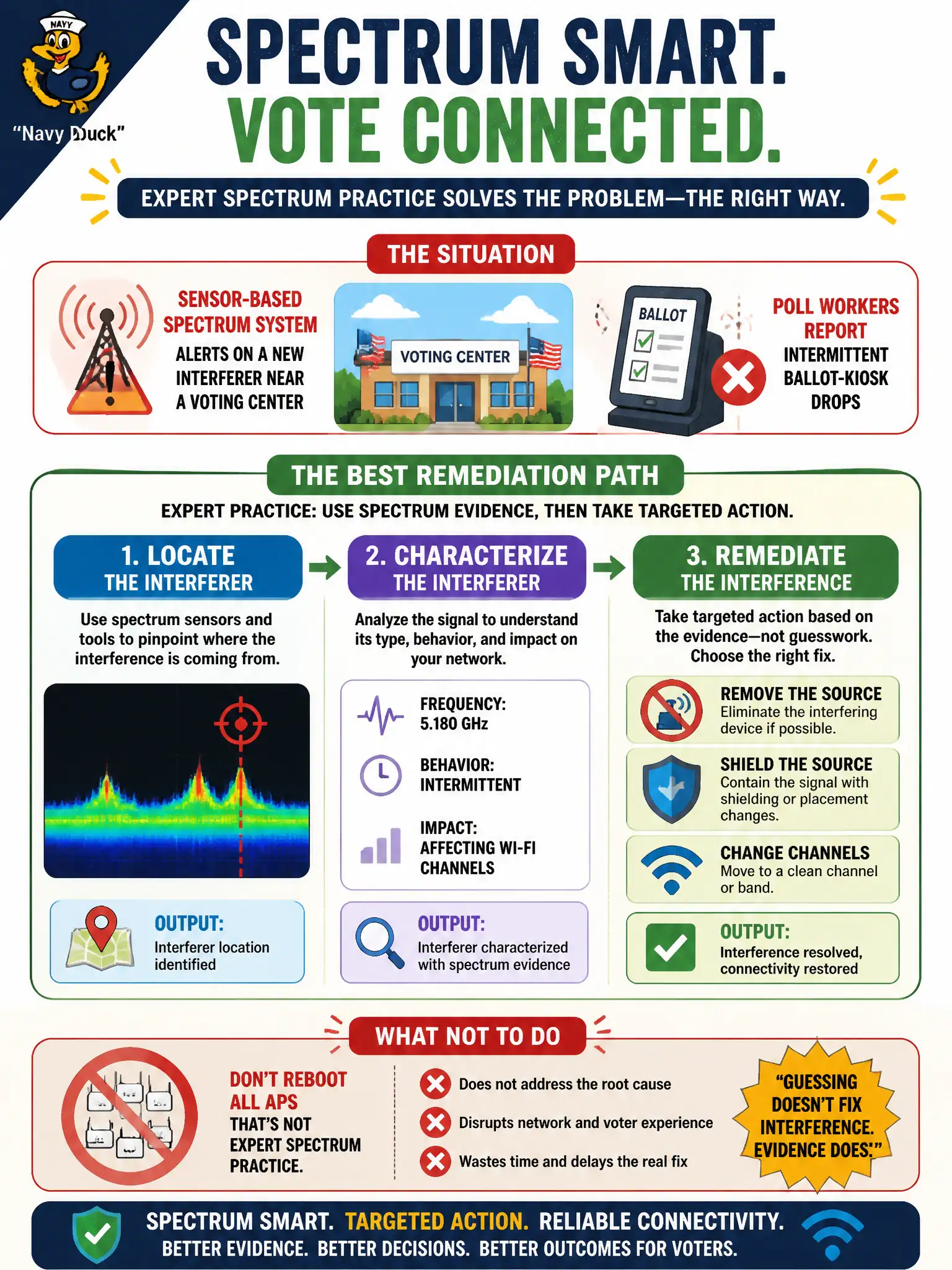
A sensor-based spectrum system alerts on a new interferer near a voting center during early voting. Poll workers report intermittent ballot-kiosk drops. Which remediation path best matches expert spectrum practice?
Select an answer to reveal the explanation.
Short Explanation
Spectrum already pointed at a new noisy neighbor — hunting and fixing that source (or moving off its channel) beats the old 'reboot every AP' reflex. Think of it like chasing a leaf blower outside the polling place instead of power-cycling the PA system. Power blasts and FT toggles don't clear non-Wi-Fi energy.
Full Explanation
When a sensor-based spectrum system alerts on a new interferer near a voting center during early voting and ballot kiosks drop intermittently, expert spectrum practice is to locate and characterize the interferer from spectrum evidence, then remediate by removing or shielding the source or changing channels. Rebooting infrastructure does not remove non-Wi-Fi energy that energy-detect still sees. Civic voting environments need evidence-led RF remediation under time pressure, not ritual AP restarts.
Rebooting every access point in the precinct so clients “forget” the interferer leaves the energy source in place and only creates a brief association storm. Disabling 802.11r Fast Transition citywide because interferers “only affect roaming frames” misattributes broadband or continuous interference to a roaming protocol feature. Doubling AP transmit power on the affected channel tries to shout over non-Wi-Fi energy, raises CCI, and still leaves energy detect elevated.
Exam caveat: during elections and other high-visibility civic events, document spectrum before and after remediation for auditability. Operational check: from the sensor alert, capture FFT/waterfall and duty cycle at the voting center, walk to peak amplitude, identify/remove/shield the source or move the BSS channel, then confirm kiosk stability and cleaner spectrum metrics.