
In a reflective city-hall lobby, clients show rapidly fluctuating SNR and MCS even when they remain near the same AP. Which RF explanation best accounts for that pattern versus simple distance-based path loss?
Select an answer to reveal the explanation.
Short Explanation
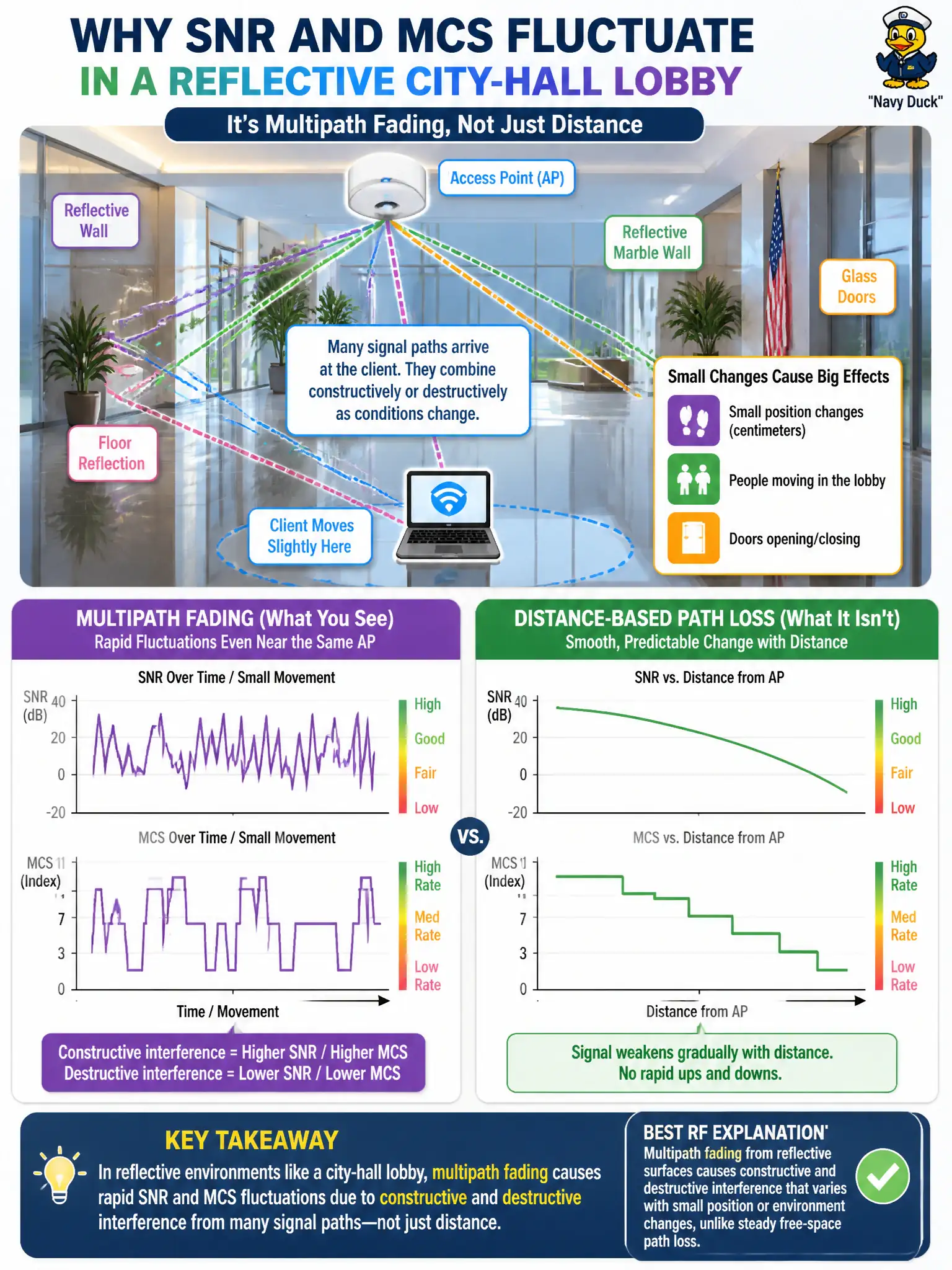
Marble and glass bounce RF around like mirrors in a funhouse — one step left and the echoes stack or cancel, so SNR jitters even when you didn't walk far. That's multipath, not 'you got farther from the AP' path loss. Wrong country codes and DFS chatter aren't the lobby story here.
Full Explanation
In a reflective city-hall lobby, rapidly fluctuating SNR and MCS while clients stay near the same AP are explained by multipath fading: reflective glass, marble, and metal produce constructive and destructive interference that changes with small position or environment shifts. That pattern differs from steady free-space path loss, which varies smoothly with distance. Expert RF awareness treats lobby multipath as an environment design issue (antennas, diversity, placement), not as automatic radio failure.
Claiming SNR always rises smoothly with distance so fluctuations prove the AP radio failed ignores indoor multipath physics. Attributing short-term indoor SNR swings near glass and marble only to DFS radar events confuses regulatory channel moves with fast fading. Blaming fluctuating SNR on an incorrect controller regulatory domain invents a config cause for a propagation phenomenon.
Exam caveat: distinguish slow path-loss trends from fast multipath fades when reading civic lobby surveys and client MCS charts. Operational check: hold a test client fixed in the lobby and log SNR/MCS over seconds; if values swing without walking away from the AP, document multipath, then try alternate AP placement or antenna pattern and retest.