
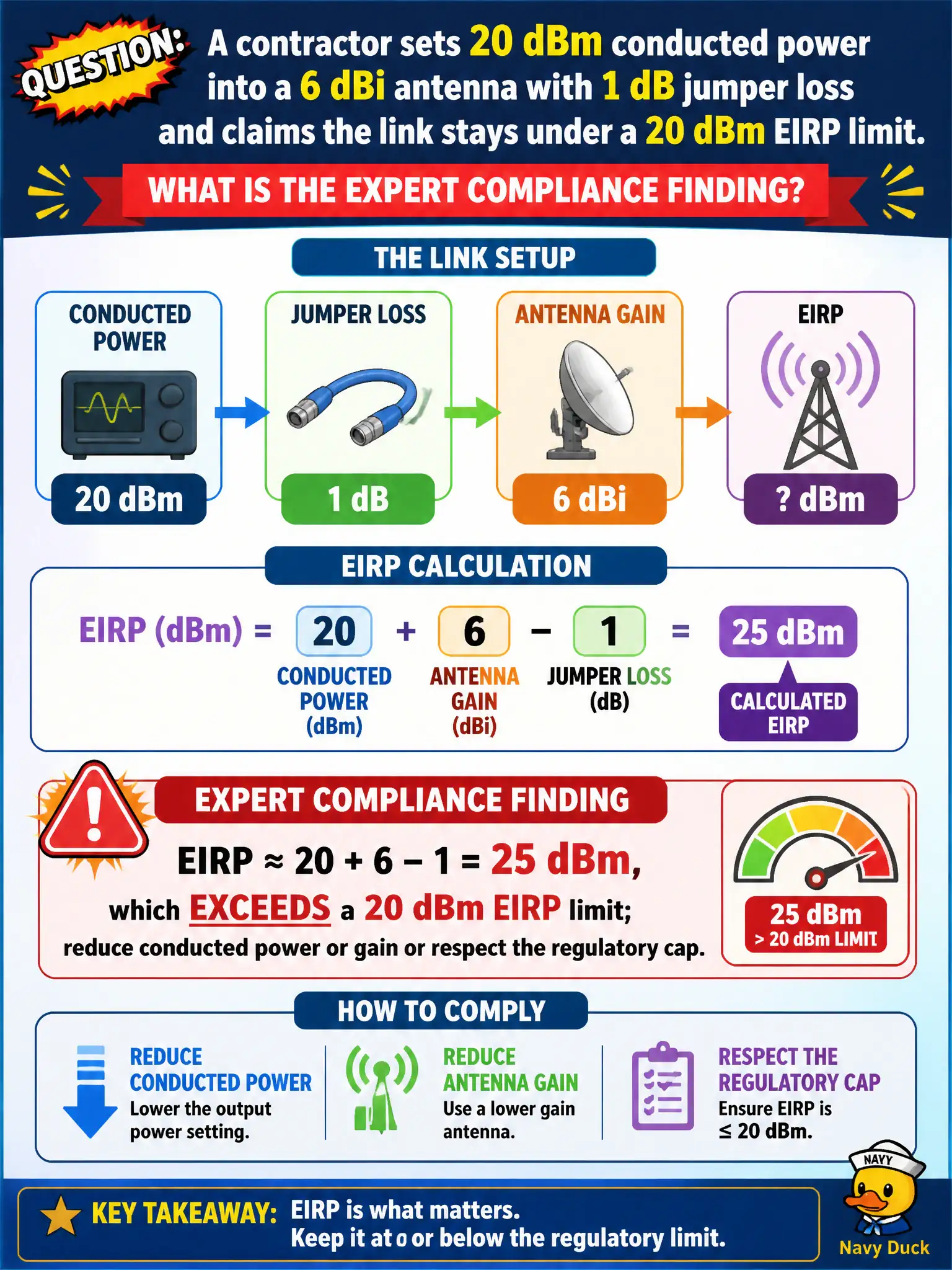
A contractor sets 20 dBm conducted power into a 6 dBi antenna with 1 dB jumper loss and claims the link stays under a 20 dBm EIRP limit. What is the expert compliance finding?
Select an answer to reveal the explanation.
Short Explanation
EIRP is conducted power plus antenna gain minus cable loss — here that's about 25 dBm, over a 20 dBm cap. Turn down the radio or the gain. Antenna gain isn't free money the regulator ignores.
Full Explanation
A contractor setting 20 dBm conducted power into a 6 dBi antenna with 1 dB jumper loss and claiming the link stays under a 20 dBm EIRP limit fails basic EIRP arithmetic. Approximate EIRP = conducted power + antenna gain − feeder loss → 20 + 6 − 1 = 25 dBm, which exceeds a 20 dBm EIRP cap. Compliance requires reducing conducted power and/or gain (or otherwise respecting the regulatory limit), not asserting conducted power alone equals EIRP.
Claiming EIRP ignores antenna gain so 20 dBm conducted always equals 20 dBm EIRP omits gain and loss terms. Adding cable loss to antenna gain when computing EIRP (yielding 27 dBm as a “legal maximum”) reverses the loss sign and invents a compliance ceiling. Saying EIRP limits apply only to Bluetooth beacons, never to 802.11 APs, is incorrect for regulated Wi-Fi operation.
Exam caveat: EIRP compliance is conducted + gain − losses; civic outdoor and indoor limits vary by band and region—math still applies. Operational check: recompute EIRP as 25 dBm for the stated chain, lower conducted power by at least 5 dB (or reduce gain) to meet a 20 dBm EIRP limit, and document the compliant setting in the municipal install record. After lowering conducted power for EIRP compliance, re-survey the target coverage cell to ensure the civic link still meets SNR goals—compliance and coverage must both pass.