
In a design review, a vendor claims 20 dBm equals 50 mW. Using the rules of 10 and 3, what quick sanity check should the municipal RF lead apply?
Select an answer to reveal the explanation.
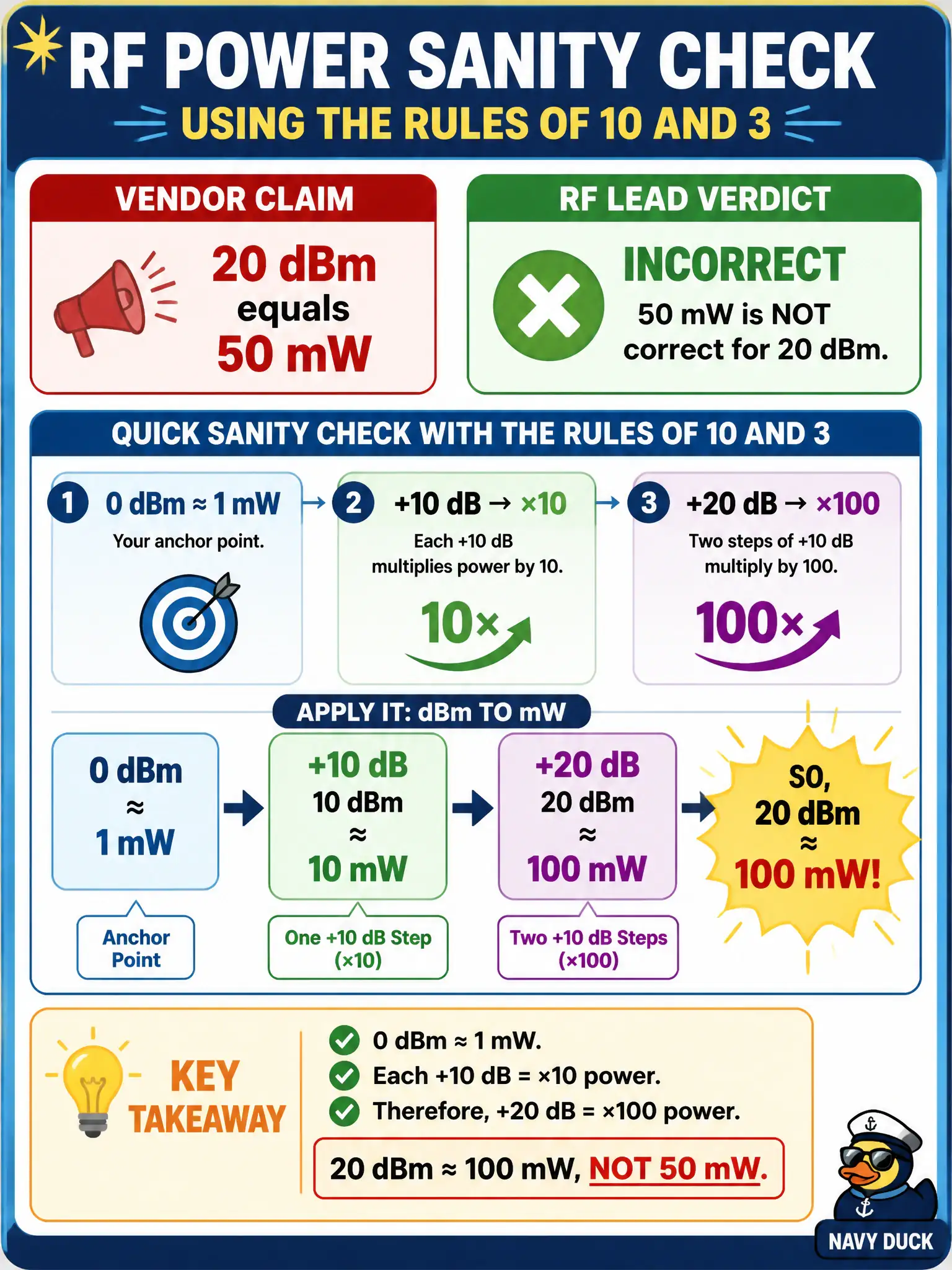
Short Explanation
Remember the coffee-napkin rule: 0 dBm is about 1 mW, each +10 dB is ×10, so 20 dBm is 100 mW — not 50. Catching that in review saves a bad BoM. dBm isn't a mW lookalike, and +3 dB is ×2, not ×10.
Full Explanation
In a municipal design review, a vendor claim that 20 dBm equals 50 mW fails a quick rules-of-10-and-3 sanity check. Starting from 0 dBm ≈ 1 mW, +10 dB → 10 mW and another +10 dB → 100 mW at 20 dBm; therefore 50 mW is incorrect for 20 dBm (50 mW is approximately 17 dBm). Expert RF leads use these mental checks to catch unit conversion errors before they enter civic designs.
Saying 20 dBm always equals 20 mW because dBm and mW share the same numeric scale confuses logarithmic and linear units. Claiming rules of 10 and 3 only apply to antenna gain in dBi, never to conducted power, is false—they apply to power ratios generally. Asserting 50 mW is correct because every +3 dB multiplies power by ten misstates the rule (+3 dB ≈ ×2, +10 dB ≈ ×10).
Exam caveat: CWNE candidates must convert dBm ↔ mW quickly; wrong conversions cascade into illegal EIRP and bad link budgets. Operational check: convert the vendor’s 20 dBm claim with rules of 10/3 (expect ~100 mW), reject 50 mW, and recalculate any dependent EIRP figures for the municipal review package. Keep a one-page dBm/mW cheat sheet in the municipal RF design packet so contractors’ datasheet claims are challenged consistently during courthouse and parks reviews.