
A designer applies a free-space path loss estimate from a rooftop PTP worksheet to predict coverage inside a multi-floor atrium with glass and walkways. What is the expert critique?
Select an answer to reveal the explanation.
Short Explanation
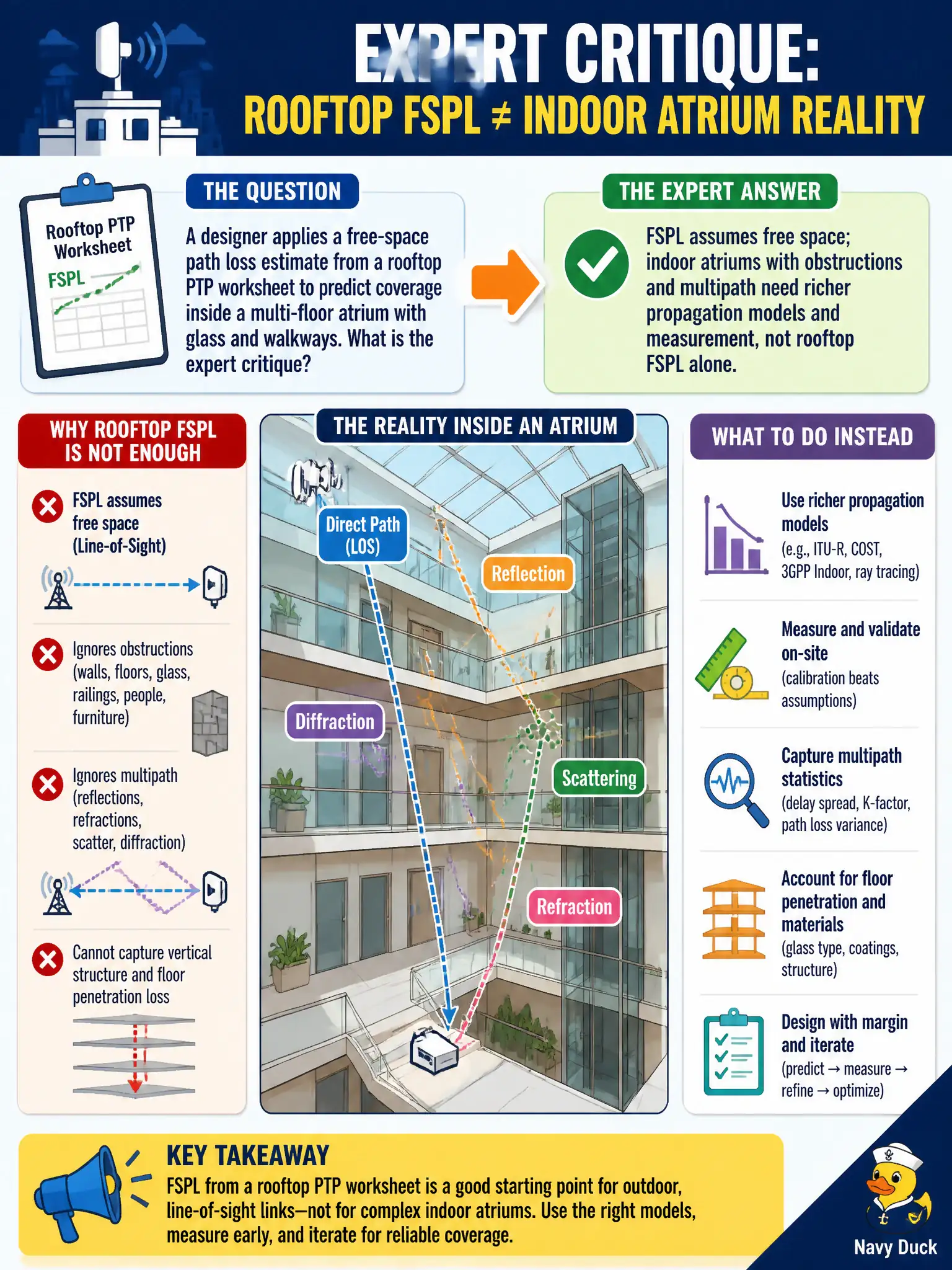
Free-space math is for open sky, not a glass atrium full of floors and railings — that's a different movie. Use indoor models and measurements. Copy-pasting rooftop FSPL into city hall is how designs go sideways.
Full Explanation
Applying a rooftop free-space path loss (FSPL) worksheet to predict coverage inside a multi-floor atrium with glass and walkways is methodologically weak because FSPL assumes unobstructed free space. Indoor atriums introduce material loss, reflection, and multipath that require richer propagation models and measurement validation. Expert critique: use indoor models and surveys; treat rooftop FSPL as an outdoor LOS starting point only.
Claiming FSPL formulas are mandatory indoors and replace all material and multipath models overstates FSPL’s scope. Saying atrium multipath improves FSPL accuracy so rooftop math is preferred for every indoor venue reverses the limitation. Asserting FSPL already includes foil insulation and elevator shafts is false—those are site-specific losses outside basic FSPL.
Exam caveat: know when FSPL applies (clear outdoor LOS) versus when civic indoor venues need empirical RF. Operational check: compare atrium survey RSSI to the rooftop FSPL prediction at several interior points; document the error, then retune the design with indoor modeling and measured loss. For multi-floor atriums, combine a simple indoor model with spot measurements on each balcony level; leadership presentations should show measured-versus-FSPL error to justify survey budget.