
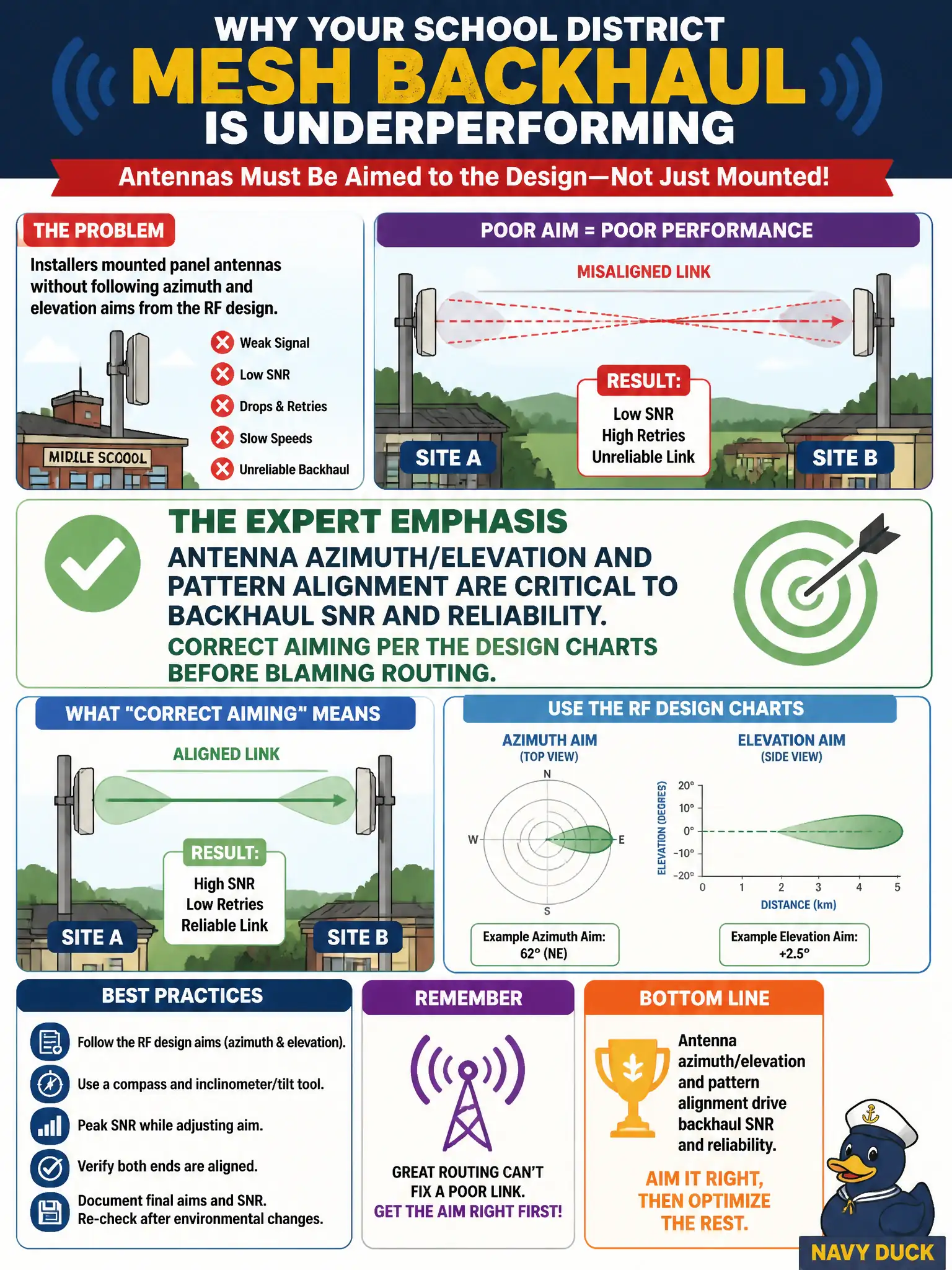
A school district mesh backhaul underperforms after installers mount panel antennas without following azimuth and elevation aims from the RF design. What should the expert emphasize?
Select an answer to reveal the explanation.
Short Explanation
Mesh backhaul panels are like two flashlights that only work if you aim them at each other — azimuth and elevation matter. Fix the aiming before blaming Spanning Tree. Pointing at the dirt is not a multipath strategy.
Full Explanation
A school-district mesh backhaul that underperforms after installers ignore azimuth and elevation aims from the RF design is usually an antenna alignment problem first. Panel antennas have directive patterns; mis-aiming collapses backhaul SNR, MCS, and reliability even when routing is fine. Expert emphasis: correct aiming per design charts before blaming mesh routing protocols.
Claiming mesh backhaul ignores antenna orientation because 802.11 mesh is polarization-agnostic by standard is incorrect—physics still applies. Saying only Spanning Tree timers affect mesh RF backhaul quality relocates an RF SNR problem to wired loop-prevention timers. Aiming backhaul antennas straight at the ground to maximize multipath is contrary to directed backhaul design intent.
Exam caveat: outdoor civic mesh/PTP success is equal parts RF aiming and network configuration; validate RF before deep routing changes. Operational check: restore documented azimuth/elevation on both panels, verify Fresnel clearance, measure SNR/MCS on the backhaul, then revisit mesh metrics only if RF meets design. Record as-built azimuth, elevation, and height on the school-district mesh as-built drawings; drift after wind or pole work is a common civic backhaul regression that looks like “routing flaps.”