
A city CIO asks why Wi-Fi 6E 6 GHz planning differs from legacy 2.4 GHz densification. Which statement is most accurate at expert depth?
Select an answer to reveal the explanation.
Short Explanation
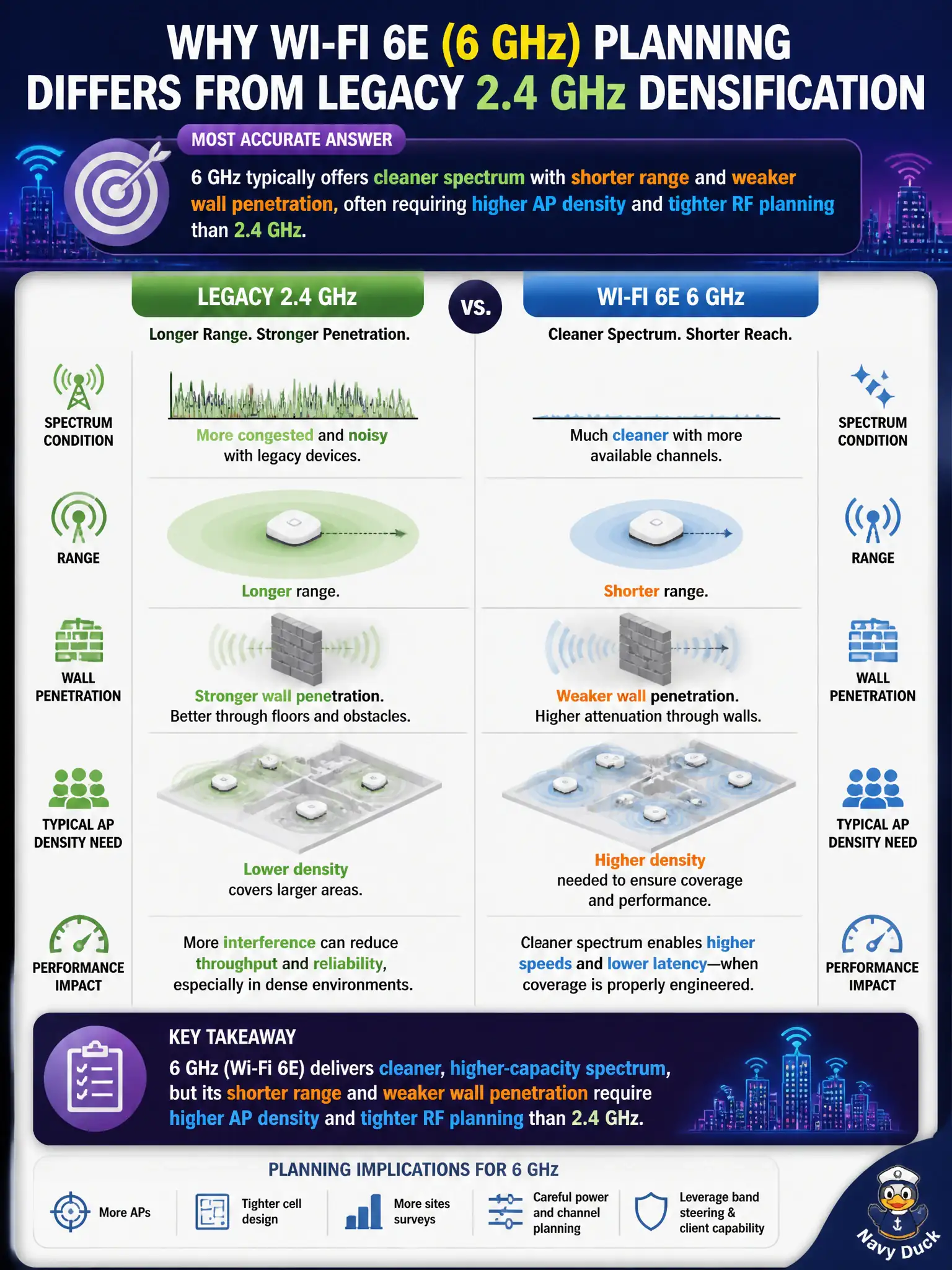
6 GHz is the clean new highway that doesn't travel as far through brick — great lanes, shorter trips. Plan denser APs and don't copy-paste your 2.4 GHz map. It doesn't magically out-punch concrete.
Full Explanation
Wi-Fi 6E 6 GHz planning for a city CIO differs from legacy 2.4 GHz densification because 6 GHz typically offers cleaner spectrum with shorter range and weaker wall penetration. That often requires higher AP density and tighter RF planning than sparse 2.4 GHz coverage cells. Expert messaging: do not reuse 2.4 GHz AP counts or assume identical free-space and through-wall behavior.
Claiming 6 GHz always propagates farther through concrete than 2.4 GHz so fewer APs are required reverses typical frequency-dependent loss. Saying 6 GHz ignores walls entirely so predictive models can reuse 2.4 GHz AP counts unchanged is false. Asserting identical free-space loss at equal distance for 6 GHz and 2.4 GHz contradicts FSPL’s frequency dependence; SSID names are irrelevant to path loss.
Exam caveat: 6 GHz capacity and cleanliness trade against range—civic 6E designs are density designs. Operational check: pilot 6 GHz AP spacing in a representative city floor, measure wall loss and cell edge SNR versus 5 GHz/2.4 GHz, and update the AP count model before enterprise rollout. Brief the CIO that 6 GHz clients still need dual-band fallback plans for elevators and deep interior rooms where 6 GHz cells shrink, while capacity floors get the denser 6E grid.