
A municipal warehouse sees unexpectedly weak links between an AP and vertically polarized clients despite short distance and clear LOS. Antenna documentation shows a horizontally polarized patch on the AP. What is the likely RF cause?
Select an answer to reveal the explanation.
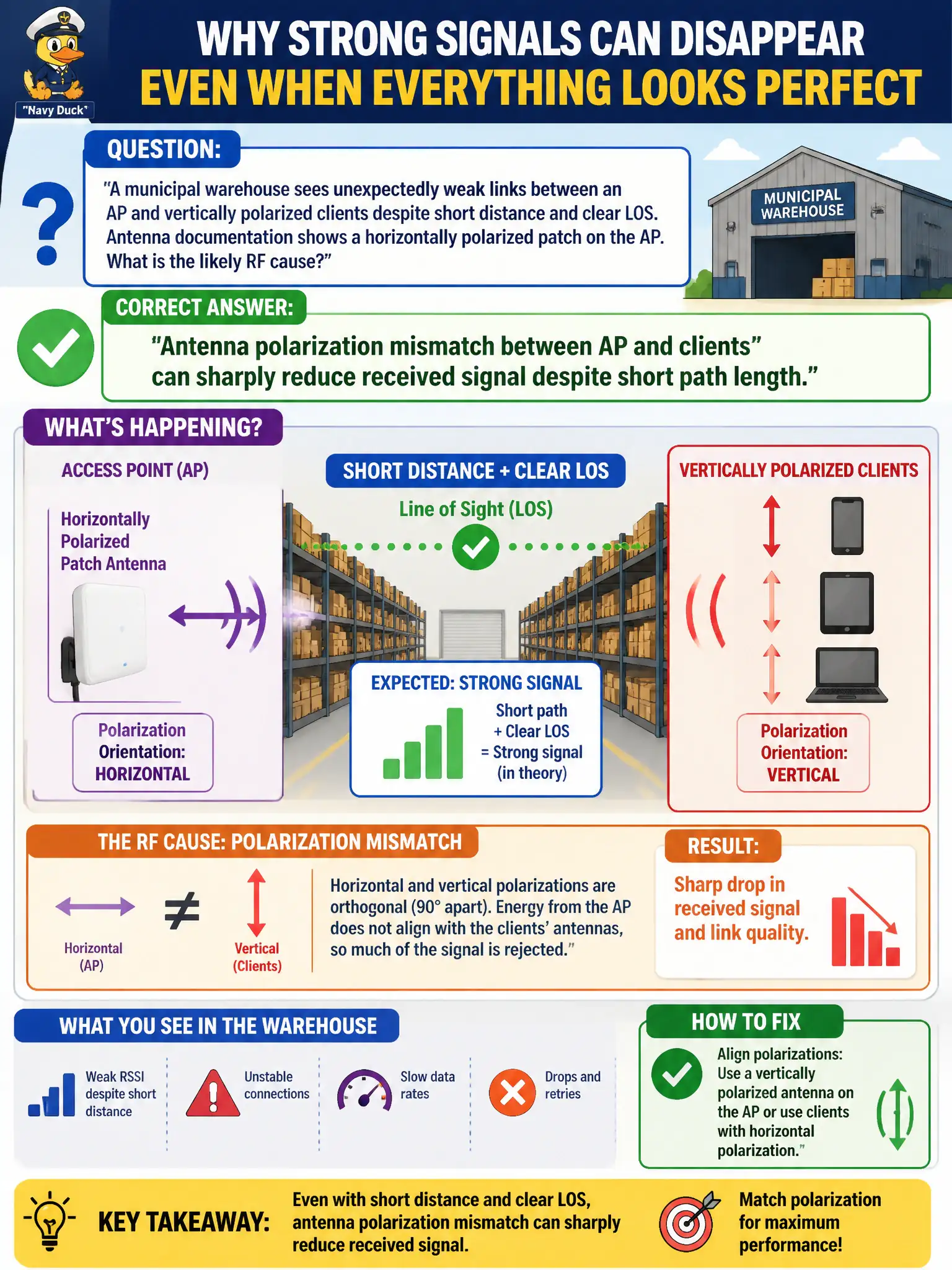
Short Explanation
Mismatched polarization is like trying to high-five through a pane of glass at the wrong angle — lots of energy never couples. Fix orientation or antenna choice. Short distance doesn't erase a cross-pol hit.
Full Explanation
In a municipal warehouse, weak links between an AP and vertically polarized clients despite short distance and clear LOS, when the AP uses a horizontally polarized patch, point to antenna polarization mismatch. Cross-polarization can impose substantial attenuation, collapsing received signal even when path length is short and visually clear. Expert correction is to align polarization (or use antennas tolerant of mixed polarization) per the client population.
Believing short distance always guarantees maximum MCS regardless of antenna orientation ignores polarization loss in the link budget. Claiming polarization is irrelevant indoors because multipath cancels all polarization loss overstates multipath benefits; mismatch still commonly hurts. Blaming weak links on DFS CAC failure on 2.4 GHz non-DFS channels invents a DFS symptom on a band/channel class where DFS does not apply.
Exam caveat: polarization is a first-class antenna parameter in warehouses and industrial civic spaces with patch and client orientation constraints. Operational check: confirm AP antenna polarization documentation, compare to client antenna orientation, measure RSSI/SNR before and after aligning polarization or swapping to a matched antenna.