
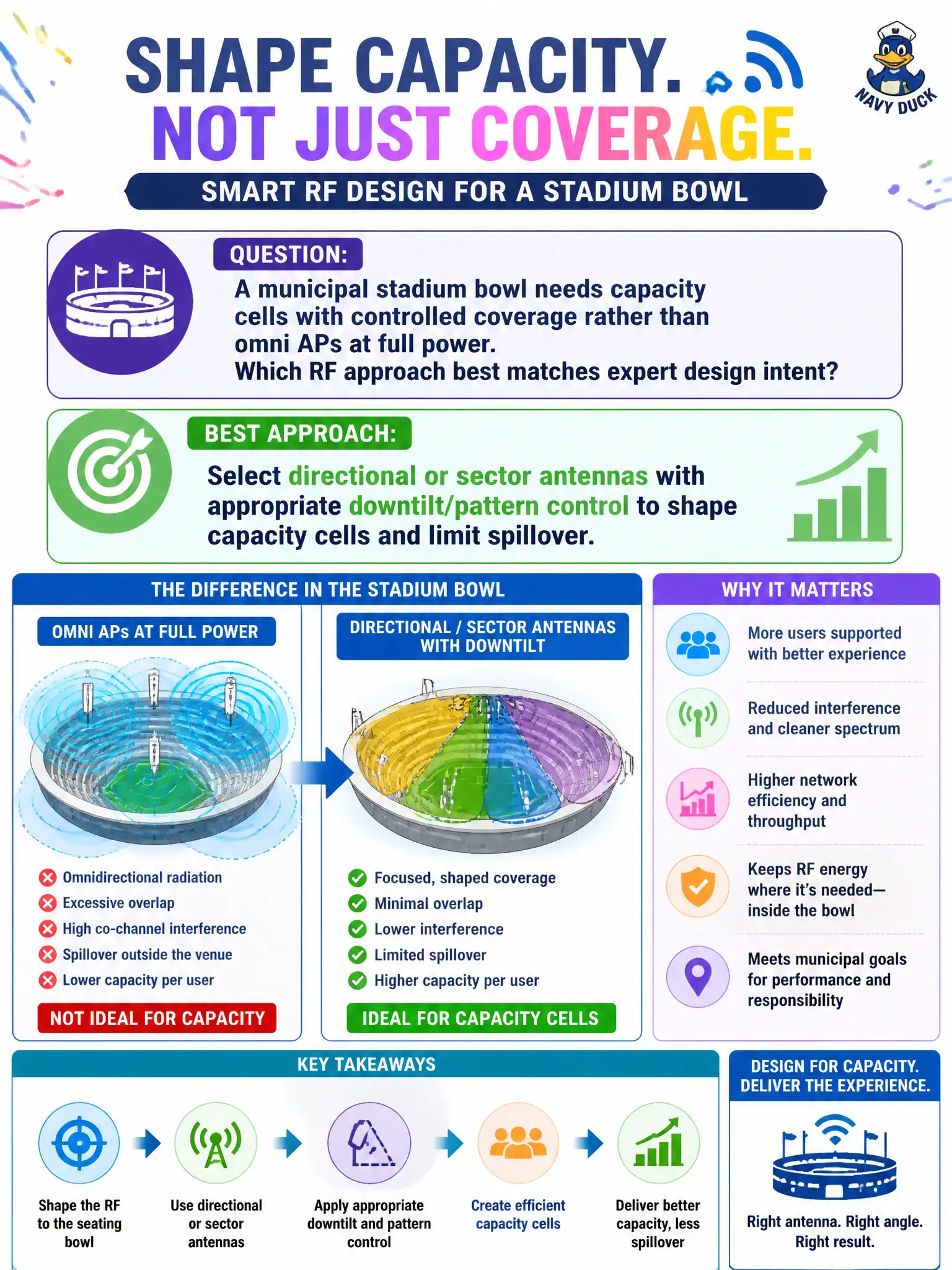
A municipal stadium bowl needs capacity cells with controlled coverage rather than omni APs at full power. Which RF approach best matches expert design intent?
Select an answer to reveal the explanation.
Short Explanation
A stadium bowl needs spotlights, not floodlights on full blast — directional antennas and downtilt paint capacity cells where people sit. Omni at max power just makes one giant CCI soup. Extra SSIDs don't replace pattern control.
Full Explanation
A municipal stadium bowl that needs capacity cells with controlled coverage should use directional or sector antennas with appropriate downtilt and pattern control to shape cells and limit spillover. Omni APs at full power create oversized co-channel footprints in a bowl geometry, destroying reuse. Expert intent is spatial reuse through antenna pattern engineering, not merely more SSIDs or unrelated IoT bands.
Using omni antennas at maximum power so every seat shares one giant CCI cell maximizes interference and minimizes capacity. Relying solely on adding SSIDs to shrink RF cells without changing antennas confuses SSID/BSSID count with RF cell size; SSIDs do not replace pattern control. Disabling all 5 GHz radios because bowl seating “only works on 900 MHz IoT” abandons the capacity band stadiums typically need.
Exam caveat: high-density civic venues are antenna and channel-reuse problems first; SSIDs are service overlays on top of sound RF cells. Operational check: select sector/patch patterns and downtilt per bowl section, validate spillover on adjacent sections with a survey, and confirm CCI maps improve versus the prior omni full-power baseline. Stadium sections should be treated as separate reuse domains: validate that each sector’s first Fresnel and main lobe cover intended seats while adjacent sections remain below harmful ACI/CCI thresholds on shared channels.