
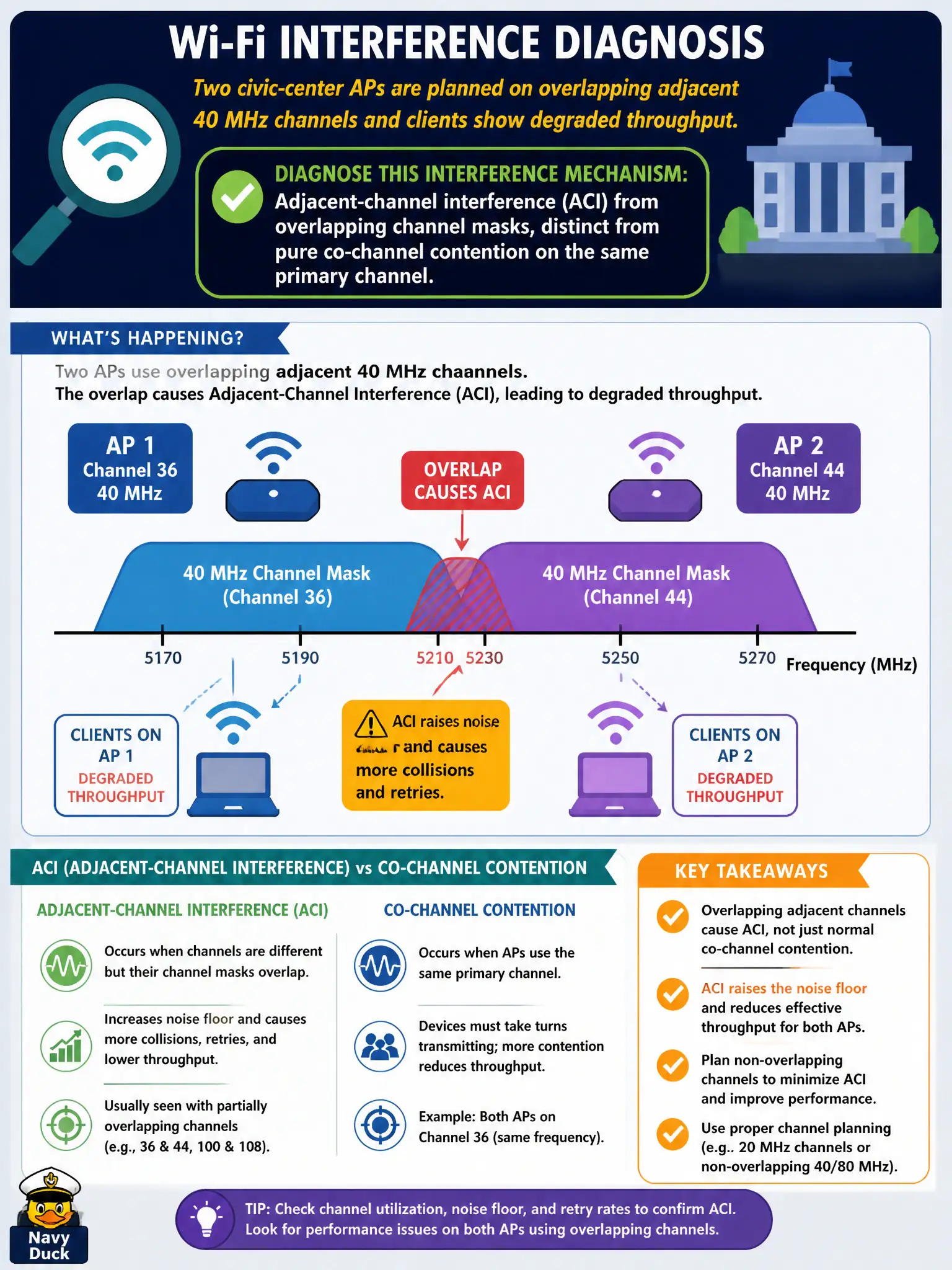
Two civic-center APs are planned on overlapping adjacent 40 MHz channels and clients show degraded throughput. What interference mechanism should the expert diagnose?
Select an answer to reveal the explanation.
Short Explanation
Overlapping 40 MHz neighbors are like two bands playing in half-shared rooms — the leftover splash is ACI, not the same song as classic CCI. Fix the channel plan and widths. More SSIDs or DHCP hunts won't clean the spectrum skirts.
Full Explanation
When two civic-center APs use overlapping adjacent 40 MHz channels and clients show degraded throughput, the expert should diagnose adjacent-channel interference (ACI) from overlapping channel masks. ACI is distinct from pure co-channel contention on the same primary channel: partial spectral overlap still raises energy and error rates for neighbors. Remediation is proper channel width and center-frequency planning so masks do not overlap destructively.
Blaming only insufficient SSID advertising when channels partially overlap misattributes an RF mask problem to discovery frames. Claiming co-channel contention requires identical BSSIDs so overlapping adjacent channels are harmless confuses BSSID identity with spectral overlap physics. Declaring the issue DHCP scope exhaustion unrelated to RF channel width ignores the RF symptom timing tied to 40 MHz adjacency.
Exam caveat: wider channels buy throughput but reduce the number of non-overlapping assignments—ACI is a first-class planning constraint in civic centers. Operational check: plot the two APs’ 40 MHz masks, check for overlap, reproduce throughput loss at the boundary, then move to non-overlapping centers or narrower widths and retest.