
During a civic-center ticket-booth review, an engineer cites a strong RSSI yet ignores a high noise floor. Why is that incomplete for link-quality decisions?
Select an answer to reveal the explanation.
Short Explanation
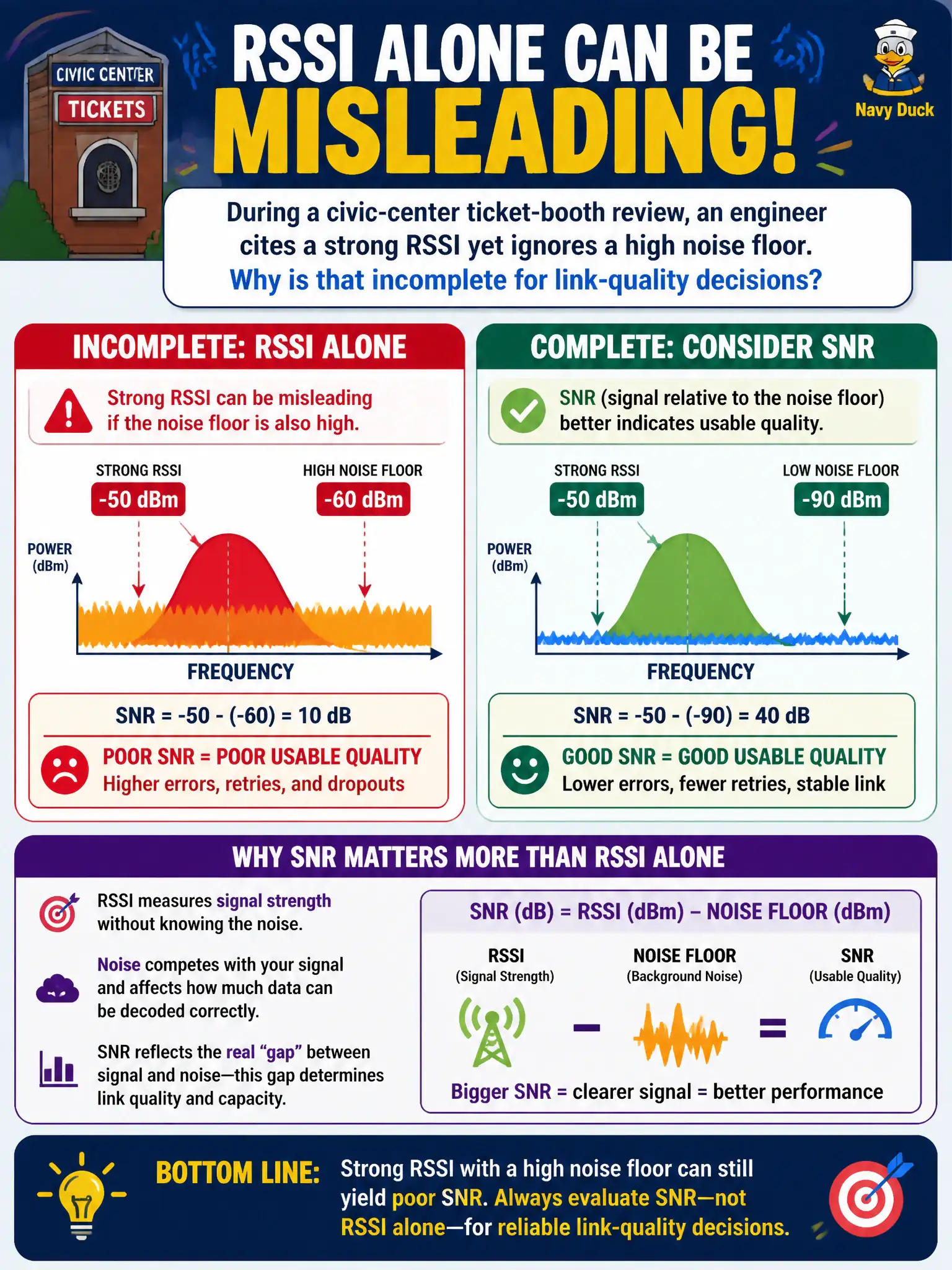
RSSI without SNR is like bragging about a loud radio while a jackhammer runs beside it — loud isn't the same as clear. You need signal relative to the noise floor. Strong RSSI with a filthy noise floor still makes a lousy link.
Full Explanation
At a civic-center ticket booth, citing strong RSSI while ignoring a high noise floor is incomplete because usable link quality depends on signal relative to noise—SNR—not received signal strength alone. A strong RSSI sitting only a few dB above an elevated noise floor still yields poor SNR, lower MCS, and retries. Expert survey and design decisions therefore pair RSSI with noise-floor or SNR readings in the presence of interference or dense RF.
Treating RSSI and SNR as identical metrics so only RSSI is required collapses two different quantities and misses interference-limited links. Claiming noise floor only matters for Ethernet CRC counters relocates an RF metric to the wired domain. Assuming strong RSSI guarantees MCS regardless of interference energy ignores rate adaptation driven by SNR and error performance.
Exam caveat: CWNE-level RF judgment uses SNR/noise context; RSSI-only heatmaps can look “green” while users fail. Operational check: at the ticket booth, record RSSI and noise floor (or SNR) on the working channel during busy hours; if RSSI is high but SNR is poor, pursue interferer mitigation or channel change before adding APs for “more signal.” In civic ticket-booth environments, interference from nearby electronics often elevates the noise floor during peak hours, so survey templates should require SNR or noise-floor columns beside RSSI heatmaps before capacity conclusions are accepted.