
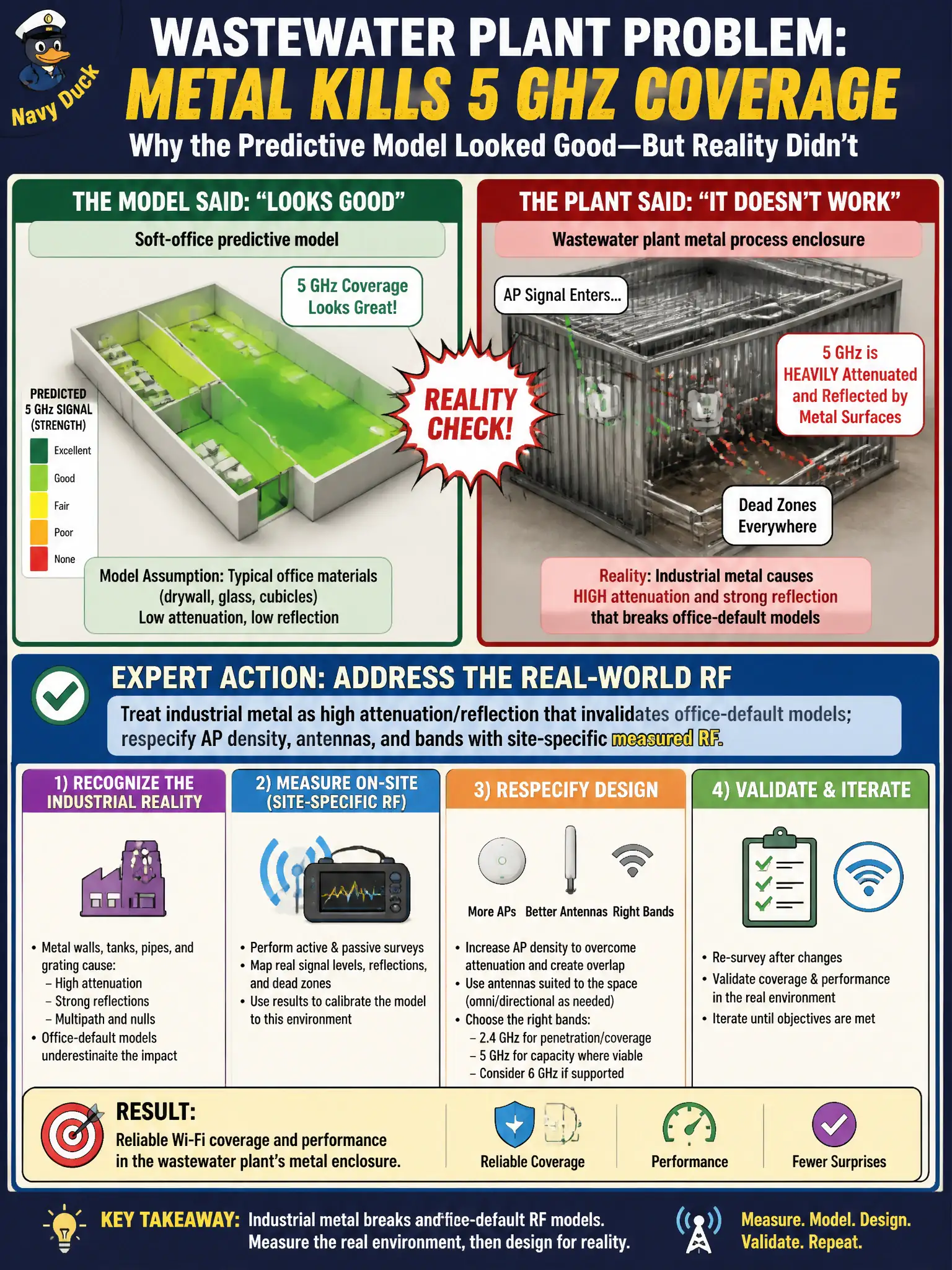
A wastewater plant’s metal process enclosure kills 5 GHz coverage that looked fine in a soft-office predictive model. What expert action best addresses the mismatch?
Select an answer to reveal the explanation.
Short Explanation
Metal tanks and enclosures eat 5 GHz like a Faraday snack bag — the soft-office drawing was wishful thinking. Remeasure, then redesign density, antennas, and bands for that plant. Extra SSIDs won't punch through steel.
Full Explanation
A wastewater plant’s metal process enclosure that kills 5 GHz coverage predicted by a soft-office model is an attenuation and multipath reality check. Industrial metal creates high loss and reflection that invalidate office wall defaults, so expert action is to respecify AP density, antenna types/placement, and band strategy using site-specific measured RF. Often 2.4 GHz or carefully aimed coverage cells inside/around the enclosure outperform simply trusting 5 GHz office contours.
Keeping office wall-attenuation defaults and only adding SSIDs inside the enclosure adds BSSIDs without fixing path loss through metal. Assuming 5 GHz always outranges 2.4 GHz in metal plants so AP count can drop reverses typical propagation behavior in conductive environments. Disabling spectrum analysis because metal “only creates Layer-3 problems” abandons the RF tools needed to quantify the enclosure’s effect.
Exam caveat: verticals with tanks, piping, and Faraday-like spaces need industrial RF design, not recycled office predictive templates. Operational check: measure RSSI/SNR and spectrum inside the process enclosure versus the hallway model prediction; redesign AP count, antennas, and primary band from those measurements before adding SSIDs.