
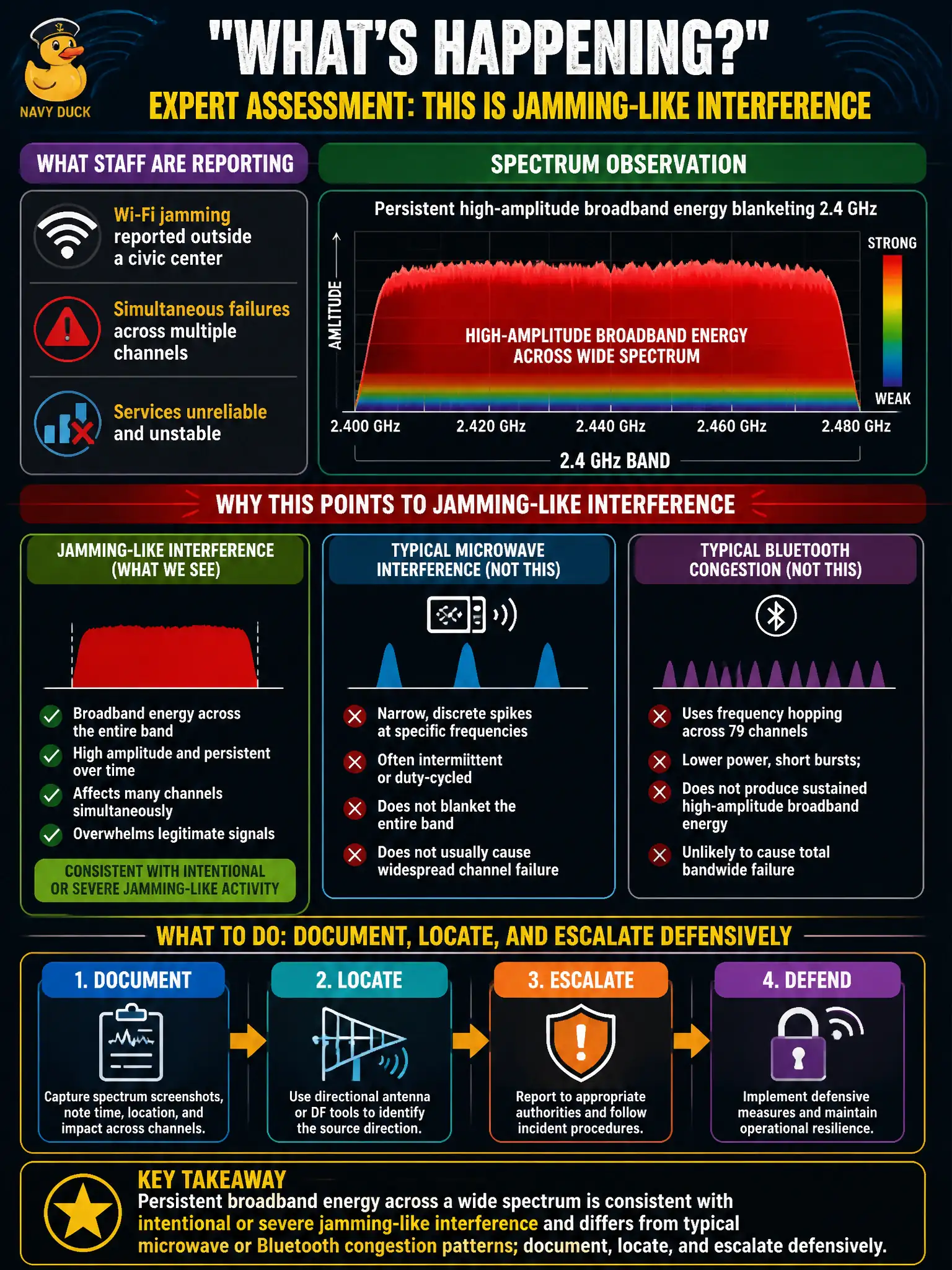
During protests outside a civic center, staff report 'Wi-Fi jamming' and simultaneous failures across multiple channels. Spectrum shows persistent high-amplitude broadband energy blanketing 2.4 GHz. What is the most appropriate expert assessment?
Select an answer to reveal the explanation.
Short Explanation
When the whole band looks like a solid wall of noise, that's not a sticky laptop or a polite Bluetooth mouse — that's jamming-class broadband energy. Document it, hunt the source, escalate. Turning off WPA3 won't unjam the air.
Full Explanation
During protests outside a civic center, simultaneous multi-channel Wi-Fi failures with spectrum showing persistent high-amplitude broadband energy blanketing 2.4 GHz are consistent with intentional or severe jamming-like interference. That pattern differs from typical microwave (often cyclic swept energy) or Bluetooth (narrower, hopping, lower aggregate wipeout) congestion. Expert assessment is to document amplitude, bandwidth, and duration; attempt localization; and escalate defensively with facilities/security rather than treating it as a sticky client or security-mode flip.
Blaming broadband multi-channel wipeouts on a single sticky client ignores that one STA cannot paint persistent high-amplitude energy across the whole band as spectrum shows. Equating the pattern to a quiet Bluetooth mouse understates severity and stops investigation. Disabling WPA3 Enterprise citywide because jammers “only affect open SSIDs” is both false and harmful: jamming is an RF energy problem independent of cipher suite.
Exam caveat: distinguish congestion, unintentional interferers, and jamming-class broadband energy; response paths differ for civic incident handling. Operational check: save spectrum screenshots with timestamps, walk for peak amplitude to localize, note affected channels/bands, and escalate with RF evidence—do not reboot-cycle the entire civic WLAN as the primary “fix.”