
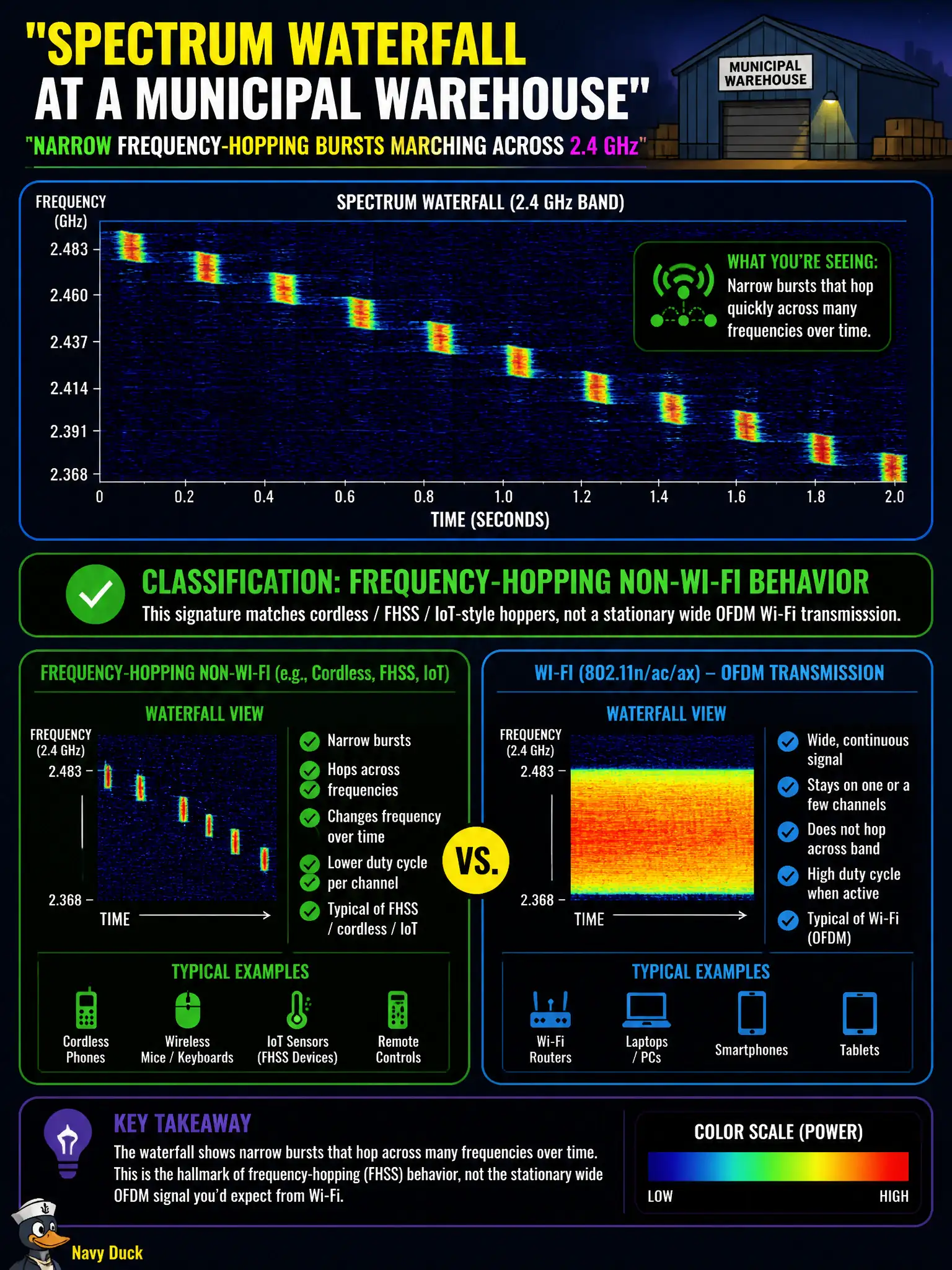
A spectrum waterfall at a municipal warehouse shows narrow frequency-hopping bursts marching across 2.4 GHz. How should the expert classify that signature relative to Wi-Fi?
Select an answer to reveal the explanation.
Short Explanation
Those skinny hops skipping across the band look like a flea circus, not a Wi-Fi billboard parked on one channel. Hopping cordless/FHSS/IoT energy isn't OFDM Wi-Fi. Don't call every 2.4 GHz blip a beacon or an OFDMA trigger.
Full Explanation
A spectrum waterfall at a municipal warehouse that shows narrow frequency-hopping bursts marching across 2.4 GHz should be classified as frequency-hopping non-Wi-Fi behavior—cordless, FHSS, or IoT-style hoppers—not as a stationary wide OFDM Wi-Fi transmission. Wi-Fi OFDM (and wide HT/VHT/HE channel uses) occupy a relatively fixed primary channel bandwidth with characteristic spectral shape; hoppers jump narrow energy across the band over time. Correct classification drives remediation toward locating the hopper rather than chasing a phantom overlapping BSS on one primary channel.
Calling the signature a classic wide OFDM 40 MHz BSS on a fixed primary channel mismatches both bandwidth occupancy and time behavior on the waterfall. Attributing narrow hopping bursts to an 802.11ax OFDMA trigger-frame exchange confuses scheduled multi-user Wi-Fi control with non-Wi-Fi FHSS patterns. Insisting any hopping pattern on 2.4 GHz must be a Wi-Fi beacon on channel 1 only ignores how beacons are periodic on a fixed channel, not narrow hops across the ISM band.
Exam caveat: waterfall morphology (wide stationary vs narrow hopping) is a primary CWNE classification skill before protocol assumptions. Operational check: freeze the warehouse waterfall, note hop rate and bandwidth of each burst, compare to OFDM channel masks, then hunt cordless/FHSS/IoT sources during the hopping windows.