
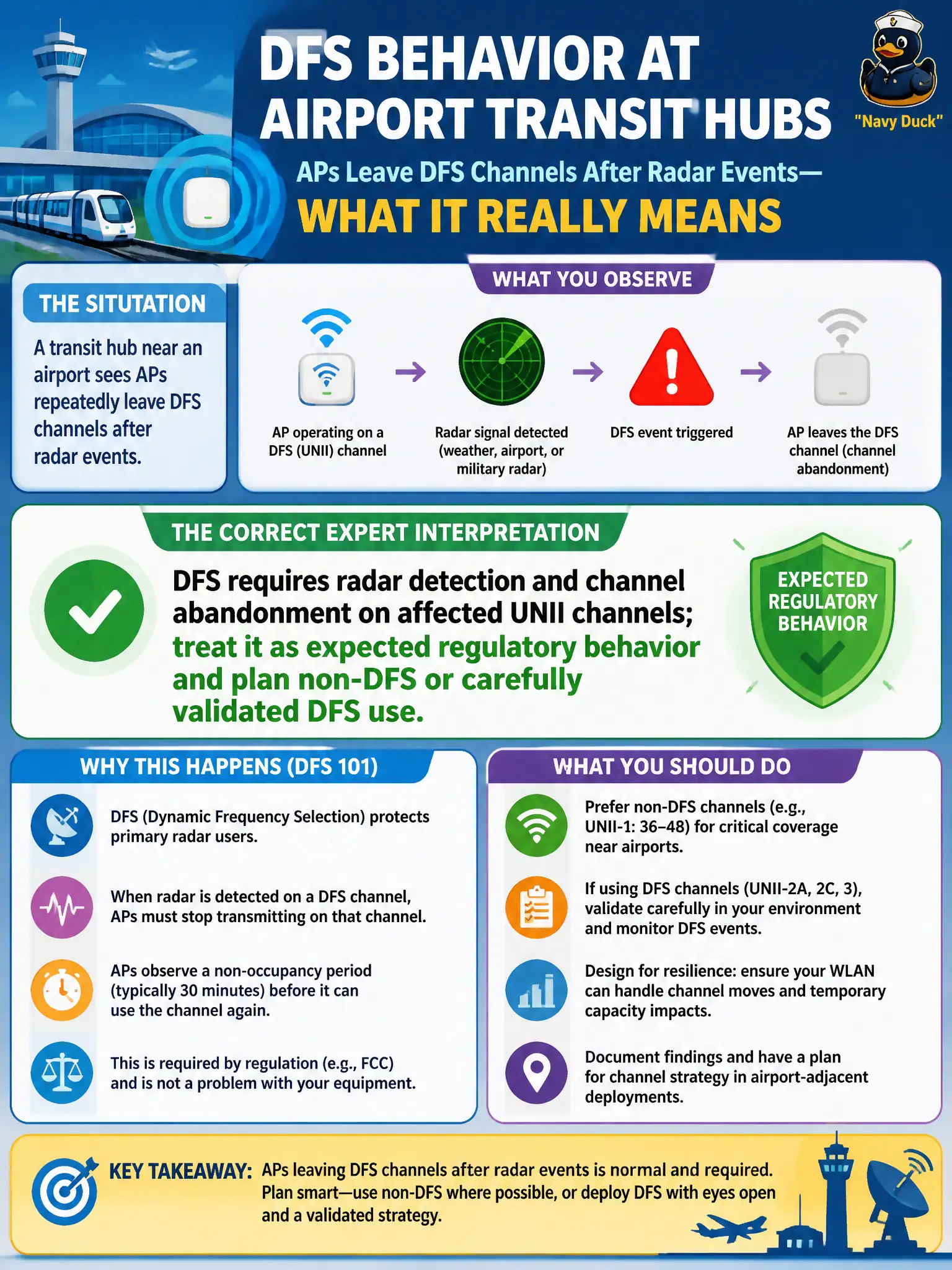
A transit hub near an airport sees APs repeatedly leave DFS channels after radar events. What is the correct expert interpretation?
Select an answer to reveal the explanation.
Short Explanation
Near an airport, DFS is the AP politely leaving the room when radar knocks — that's the rules, not a broken PoE brick. Plan around non-DFS channels or accept validated DFS churn. Blaming SAE or copper misses the regulatory RF behavior.
Full Explanation
Near an airport, a transit-hub WLAN whose APs repeatedly leave DFS channels after radar events is exhibiting expected regulatory Dynamic Frequency Selection behavior, not a PoE or WPA3 defect. On affected UNII DFS channels, APs must detect radar and abandon the channel (with CAC/NOP timing as required). Expert interpretation is to treat exits as compliance, then plan capacity on non-DFS channels or carefully validated DFS use that accepts occasional channel moves.
Blaming a defective PoE injector and swapping copper only misreads spectrum regulation as a power-delivery fault. Linking radar events to WPA3 SAE misconfiguration confuses PHY/regulatory channel behavior with authentication method. Calling DFS a marketing label that never forces channel changes contradicts how enterprise APs enforce radar detection and channel abandonment.
Exam caveat: airport-adjacent civic designs should inventory non-DFS spectrum and contingency channels; DFS is usable but not “set and forget.” Operational check: correlate AP DFS logs with airport proximity and radar events, map which channels are vacated, and redesign the transit hub channel plan around stable non-DFS capacity plus documented DFS overflow.