
A city Wi-Fi team proposes raising AP transmit power to 'fill a coverage hole,' but neighboring cells already share channels. What is the expert risk of that change?
Select an answer to reveal the explanation.
Short Explanation
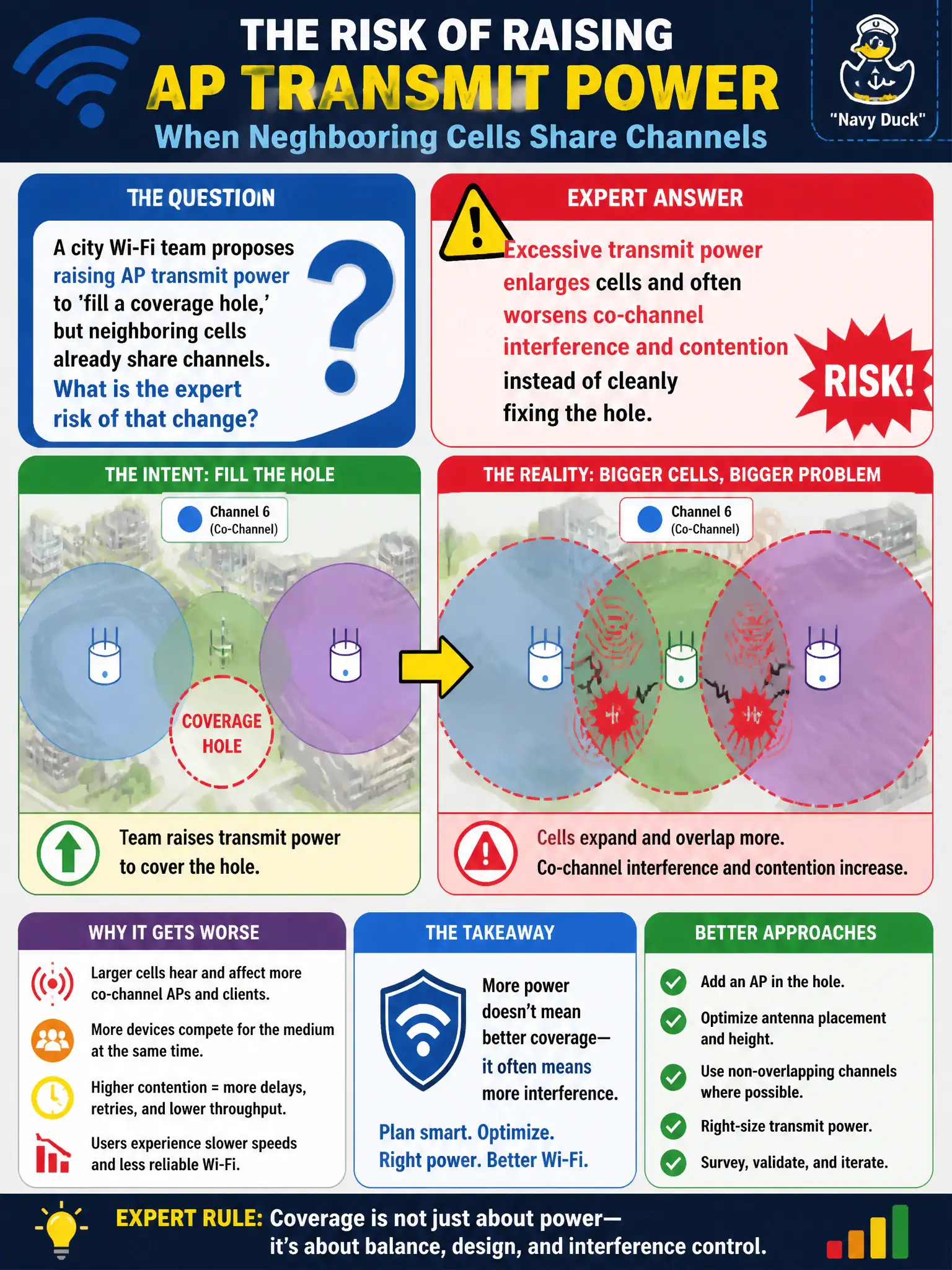
Cranking AP power to fill a hole is like yelling louder in a crowded room — everyone hears you, including the folks who already share your channel. Bigger cells mean more CCI and contention. Placement, channel reuse, and measured design beat a power max-out.
Full Explanation
Raising AP transmit power to “fill a coverage hole” at a city venue where neighboring cells already share channels often enlarges cells and worsens co-channel interference and contention. Higher power increases the distance at which the AP is heard, expanding CCA/busy-medium overlap with co-channel neighbors and inviting clients to stick to a louder far cell. Expert RF design prefers placement, antennas, channels, and power calibrated for reuse—not unilateral power increases that trade a hole for broader CCI.
Believing higher power always eliminates CCI because clients hear only the nearest AP ignores how clients and APs still defer to co-channel energy across a larger footprint. Claiming raising power cannot change cell size on any 802.11 PHY contradicts basic link-budget behavior. Saying higher power only affects Ethernet PoE class and never RF reuse confuses electrical powering with radiated cell size and channel reuse.
Exam caveat: power is a reuse tool; max power is rarely optimal in dense civic deployments with shared channels. Operational check: before raising power on the hole AP, review co-channel neighbor maps and client roam stats; prefer an AP move, downtilt, or channel change, and if power rises, re-measure CCI and retry rates after the change.