
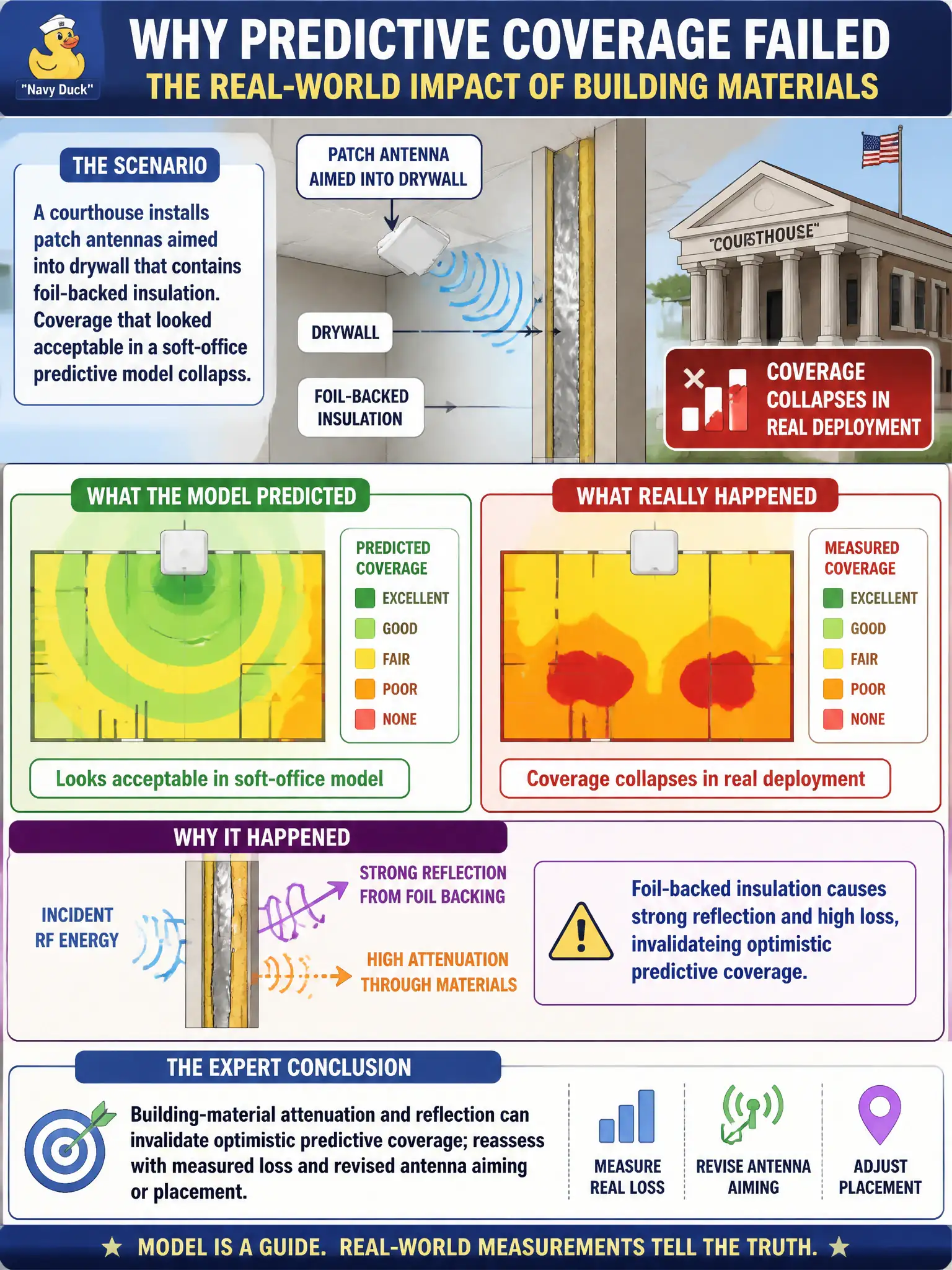
A courthouse installs patch antennas aimed into drywall that contains foil-backed insulation. Coverage that looked acceptable in a soft-office predictive model collapses. What should the expert conclude?
Select an answer to reveal the explanation.
Short Explanation
Foil-backed drywall is like aiming a flashlight into a mirror wrapped in tin foil — a lot of energy never gets where the soft-office drawing said it would. Measure the real loss and rethink aim or placement. Directional patches don't get a free pass through metalized walls.
Full Explanation
When a courthouse aims patch antennas into drywall containing foil-backed insulation, coverage that looked fine in a soft-office predictive model often collapses because building materials dominate attenuation and reflection. Foil-backed assemblies can reflect and absorb mid-band energy far more than gypsum-only assumptions, so optimistic wall defaults invalidate predicted contours. The expert response is to reassess with measured loss, revised antenna aiming or AP placement, and updated model materials—not to trust the soft-office drawing.
Claiming foil-backed materials never affect 5 GHz and blaming licensing ignores well-known conductive attenuation and reflection effects. Saying predictive models always ignore materials so the only fix is more APs without surveying attenuation skips the measurement that should drive density and aiming. Asserting patch antennas ignore wall materials because they are directional is false: directionality shapes energy, but lossy or reflective walls in the beam still destroy the intended coverage.
Exam caveat: predictive models are only as good as their material and antenna assumptions; civic venues with specialty construction need on-site validation. Operational check: measure attenuation through the courthouse foil-backed partitions at operating bands, update the model, and re-aim or relocate patches until surveyed SNR matches design targets.