
A municipal operations center needs overnight monitoring of a council chamber for intermittent RF events. When should AP- or sensor-based spectrum be preferred over a handheld analyzer walk-around?
Select an answer to reveal the explanation.
Short Explanation
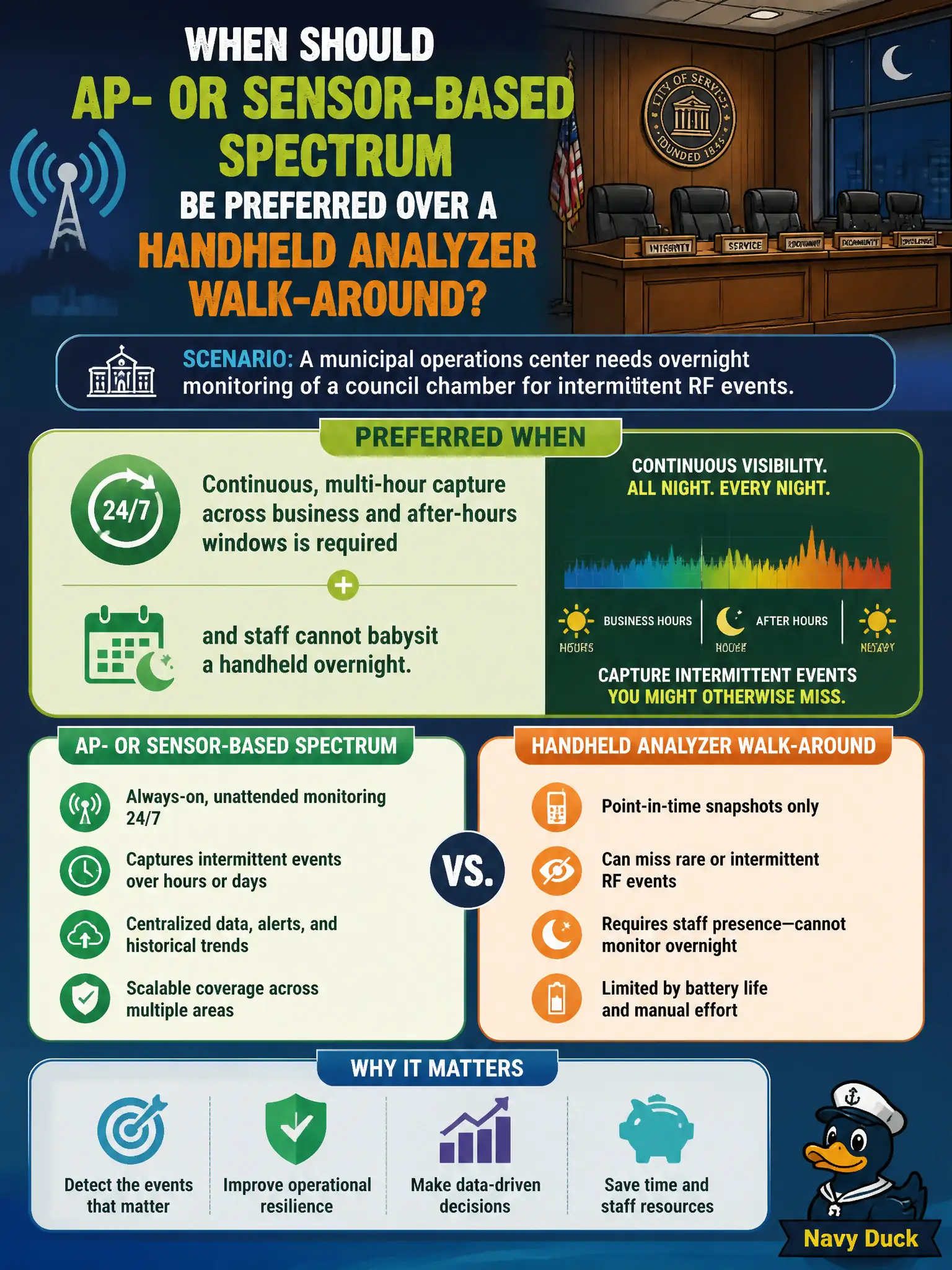
Overnight ghosts in the council chamber need a night watchman, not a thirty-second flashlight peek. AP- or sensor-based spectrum sits there for hours and catches what a walk-around misses. Handhelds are great for hunting once you know when and where to look.
Full Explanation
Intermittent RF events in a municipal council chamber that appear overnight cannot be fully characterized by a short handheld walk-around during business hours. AP- or sensor-based spectrum is preferred when the operations center needs continuous, multi-hour capture across business and after-hours windows and staff cannot babysit a portable analyzer overnight. Infrastructure sensors remain on channel, retain historic or density views, and catch rare spikes that a thirty-second daytime FFT glance will miss.
Preferring infrastructure spectrum only when no APs exist misunderstands the use case: chambers with APs are exactly where continuous sensor data is valuable. Claiming handheld snapshots always replace continuous infrastructure spectrum for overnight issues ignores time-domain coverage: intermittents require dwell, not a single visit. Saying sensors exist only to validate PoE budget is incorrect; modern AP/sensor spectrum commonly exposes FFT, duty cycle, and historic density suitable for RF triage.
Exam caveat: handheld analyzers remain excellent for localization and on-site classification; they complement—not replace—continuous monitoring for overnight civic venues. Operational check: enable sensor or AP spectrum recording on the council-chamber channels for a full night, review density/historic plots in the morning, then use a handheld to pinpoint any recurring signature.