
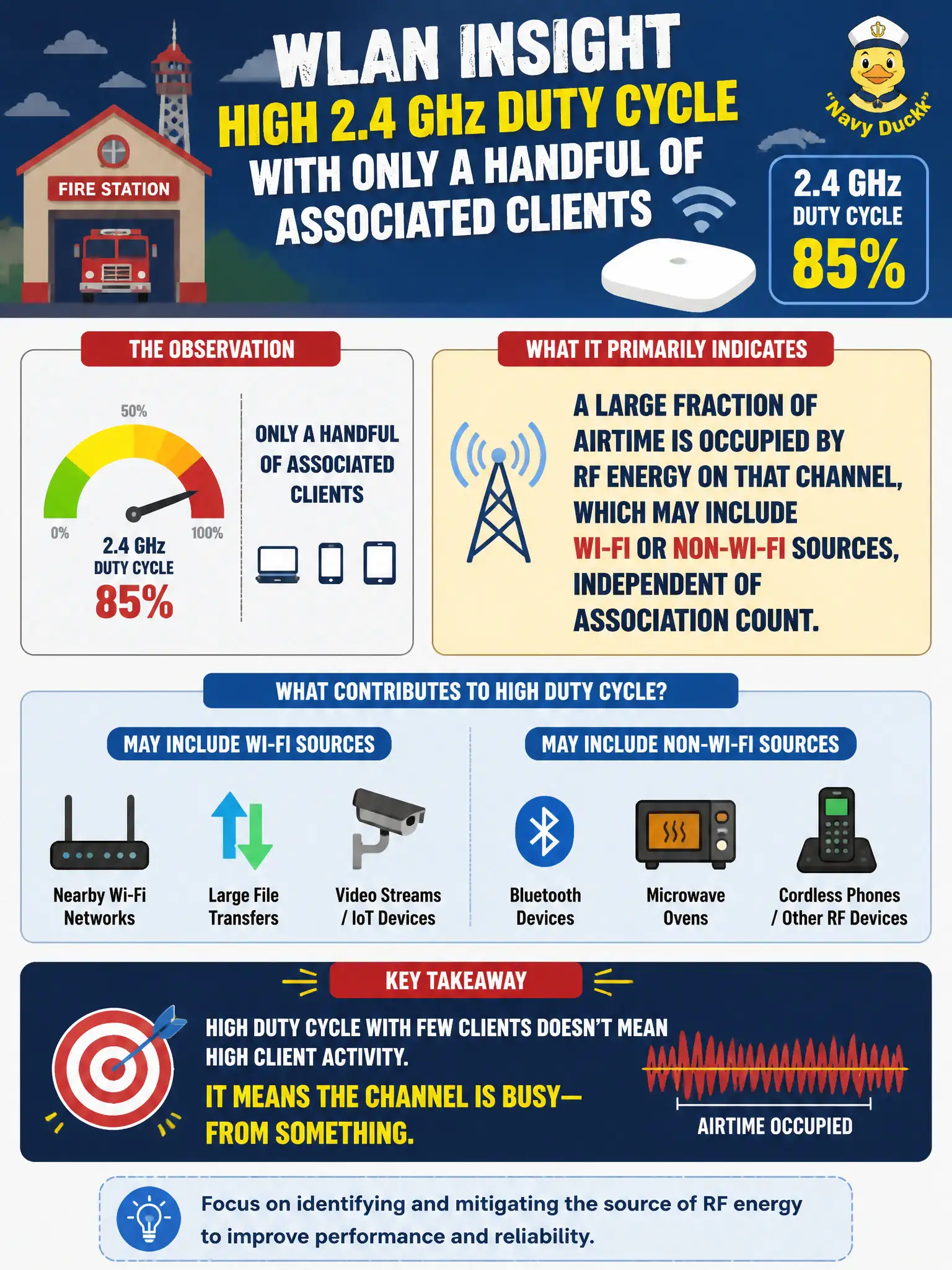
A fire-station WLAN shows high 2.4 GHz duty cycle with only a handful of associated clients. What does that spectrum utilization primarily indicate?
Select an answer to reveal the explanation.
Short Explanation
Duty cycle is like a busy highway meter — it counts how full the lane is, not how many cars are parked in your driveway. Few associations with a packed airtime chart means something else is filling the channel. Don't blame RADIUS or the switch fabric for an RF occupancy number.
Full Explanation
At a fire-station WLAN, high 2.4 GHz duty cycle with only a handful of associated clients primarily means a large fraction of airtime on that channel is occupied by RF energy. Duty cycle and channel utilization measure how busy the medium is; they do not equal association count. The energy may be Wi-Fi (other BSS cells, management chatter, retries) or non-Wi-Fi interferers, so high utilization with few local clients is a prompt to investigate spectrum and neighboring airtime—not to dismiss the meter.
Treating association count as the definition of channel utilization wrongly implies a duty-cycle reading must be a false positive when few clients are listed. Blaming a RADIUS/EAP loop as the only explanation for high duty cycle confuses authentication storms (possible but not universal) with general RF airtime occupancy. Equating duty cycle with Ethernet switch fabric congestion mixes Layer-1 RF airtime with wired backplane metrics that spectrum views do not measure.
Exam caveat: utilization answers “how full is the channel?”—not “how many STAs are associated?” Always separate Wi-Fi and non-Wi-Fi contributors with spectrum and protocol views. Operational check: correlate the fire-station’s high duty-cycle channel with FFT/waterfall and a frame capture; if few local frames explain the airtime, hunt non-Wi-Fi or neighboring BSS energy before changing AAA.