
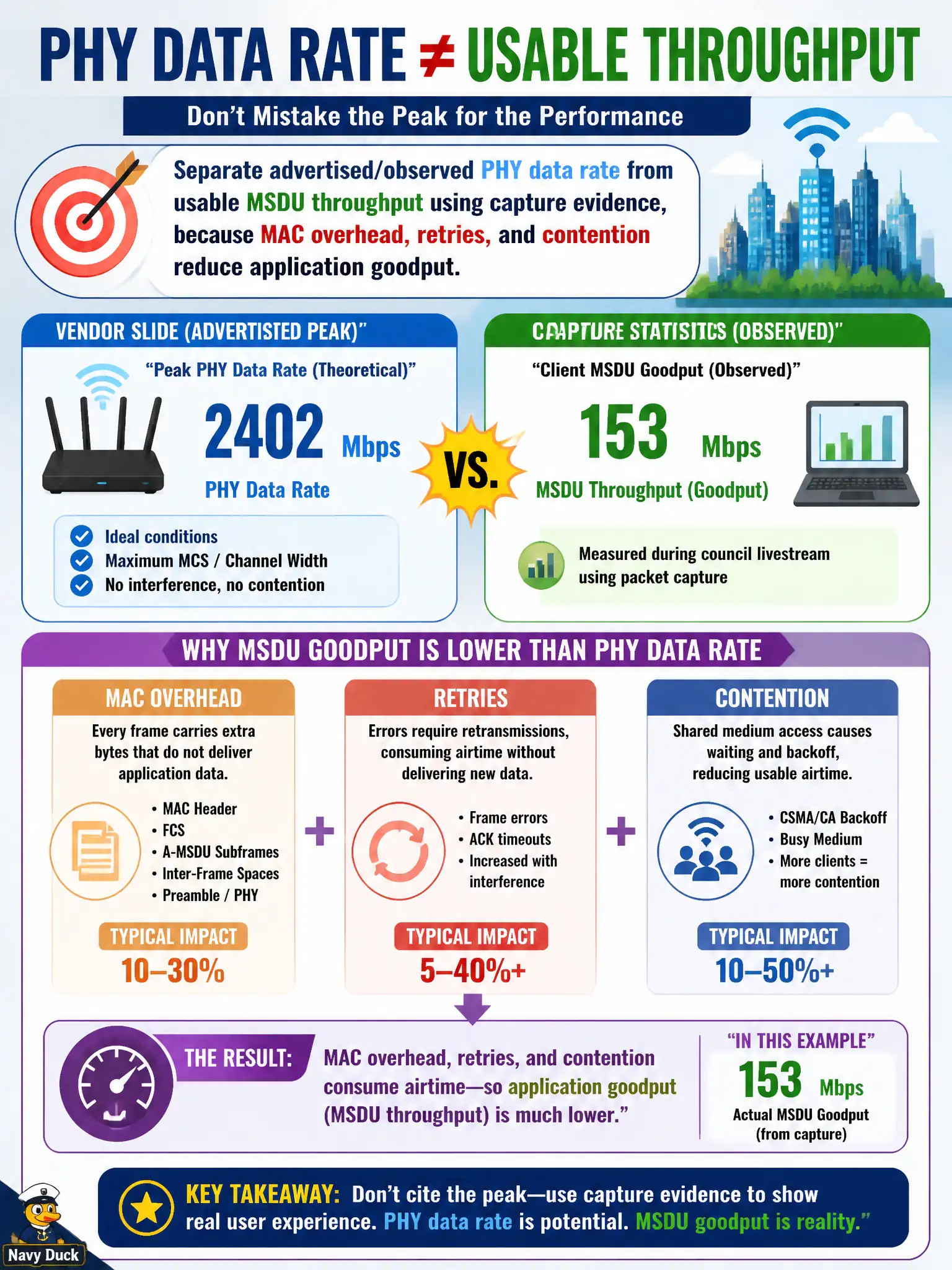
City leadership cites a client's peak PHY data rate from a vendor slide, but capture statistics show much lower MSDU goodput during a council livestream. What distinction should the CWNE present?
Select an answer to reveal the explanation.
Short Explanation
PHY rate is the speedometer's fantasy highway number; MSDU throughput is what actually arrives at the livestream. Capture stats keep leadership honest when the slide deck oversells the air.
Full Explanation
PHY data rate is the instantaneous air rate for symbols on the medium; MSDU throughput is what remains after MAC overhead, aggregation limits, retries, contention, and protocol inefficiencies. When city leadership cites a client's peak PHY rate from a vendor slide but capture statistics show much lower MSDU goodput during a council livestream, the CWNE should separate advertised or observed PHY rate from usable MSDU throughput using capture evidence. That distinction prevents treating marketing peak rates as application capacity.
Claiming PHY data rate and MSDU throughput become identical once WPA3 is enabled fails by concept: security mode does not erase MAC overhead, retries, or contention that separate PHY rate from goodput. Asserting MSDU throughput always exceeds PHY rate because aggregation creates free capacity fails by concept: aggregation improves efficiency but cannot make Layer-2 goodput exceed the underlying PHY service rate in a lasting way. Treating marketing PHY rates as authoritative against capture stats fails by concept: OTA statistics are the operational truth for the livestream window.
Exam caveat: CWNE performance communication with non-technical stakeholders hinges on PHY-versus-throughput literacy; exams reward capture-backed goodput over slide-deck peak MCS claims.
Operational check: For the council livestream client, record observed MCS/PHY rate, frame retry percentage, airtime, and MSDU bytes-per-second from the capture, then present both PHY and goodput numbers side by side to leadership.