
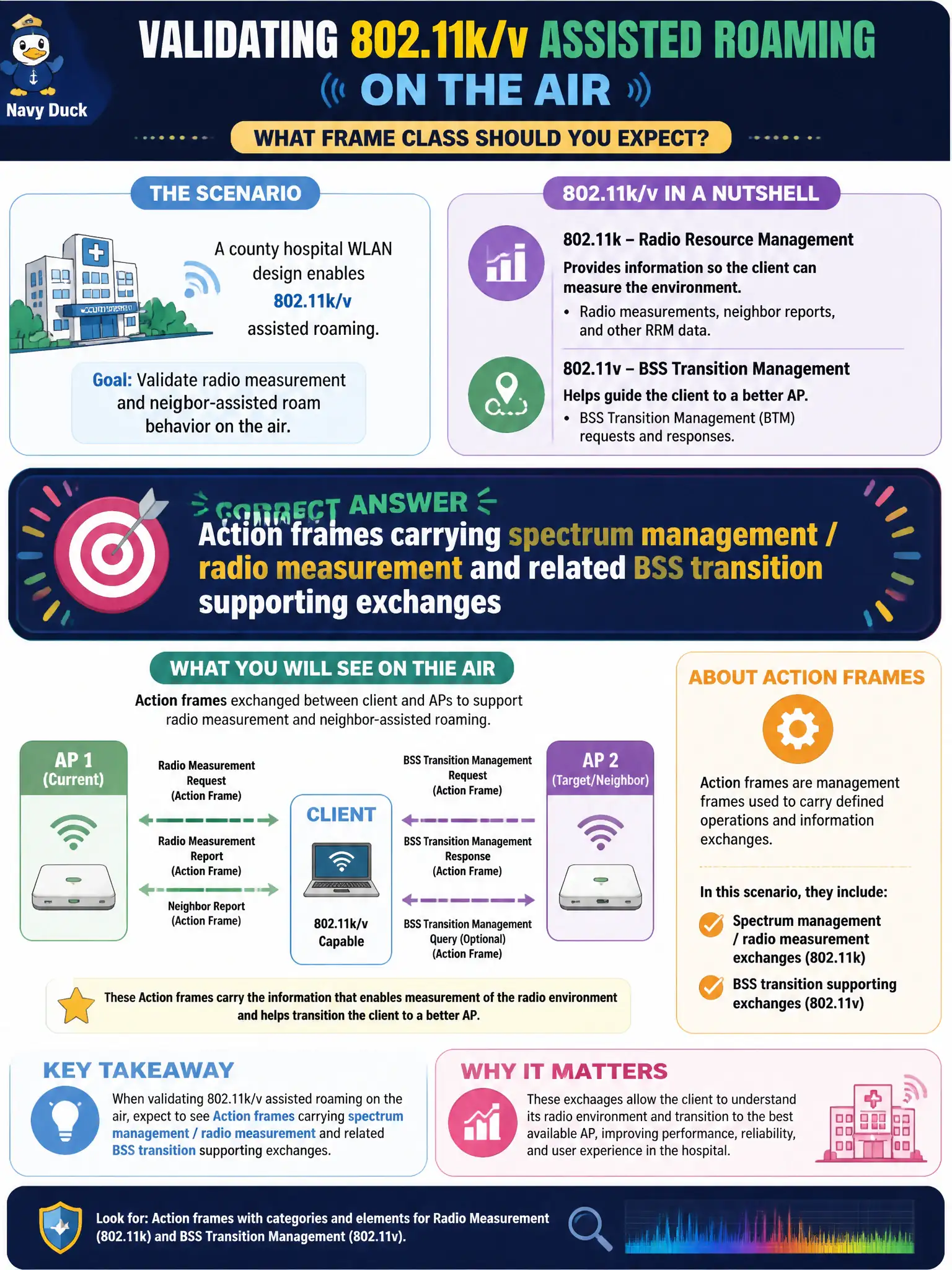
A county hospital WLAN design enables 802.11k/v assisted roaming. Which frame class should the analyst expect when validating radio measurement and neighbor-assisted roam behavior on the air?
Select an answer to reveal the explanation.
Short Explanation
Assisted roaming isn't telepathy—it rides Action frames. Measurement reports and neighbor coaching show up in that management class, so validate 11k/v by hunting Actions, not by staring at RTS/CTS.
Full Explanation
802.11k radio measurement and 802.11v BSS transition assistance exchange information primarily through Action frames in spectrum management / radio measurement and related BSS transition categories. When a county hospital WLAN enables 802.11k/v assisted roaming, the analyst validating those behaviors on the air should expect Action frames carrying those measurement and neighbor-assisted roam exchanges—not a substitute control-frame class.
Expecting only RTS/CTS pairs because 802.11k/v supposedly reuse protection frames exclusively fails by concept: RTS/CTS are protection/control mechanisms, not the measurement and BSS-transition Action exchanges k/v use. Claiming DHCP Inform encapsulated as QoS Null carries neighbor reports fails by concept: neighbor and measurement reports are 802.11 Action content, not DHCP Inform inside Null frames. Relying on Beacon-only TIM bits without Action categories fails by concept: TIM bits signal buffered delivery; they do not replace radio measurement or BSS transition Action frames.
Exam caveat: Assisted-roaming validation is a management/Action decode task; CWNE candidates should filter Action categories rather than hunting DHCP or RTS/CTS for k/v proof.
Operational check: On the hospital SSID, filter Action frames for radio measurement and BSS transition categories during a roam, confirm neighbor report or measurement request/response pairs, and correlate with the client's next AP choice.