
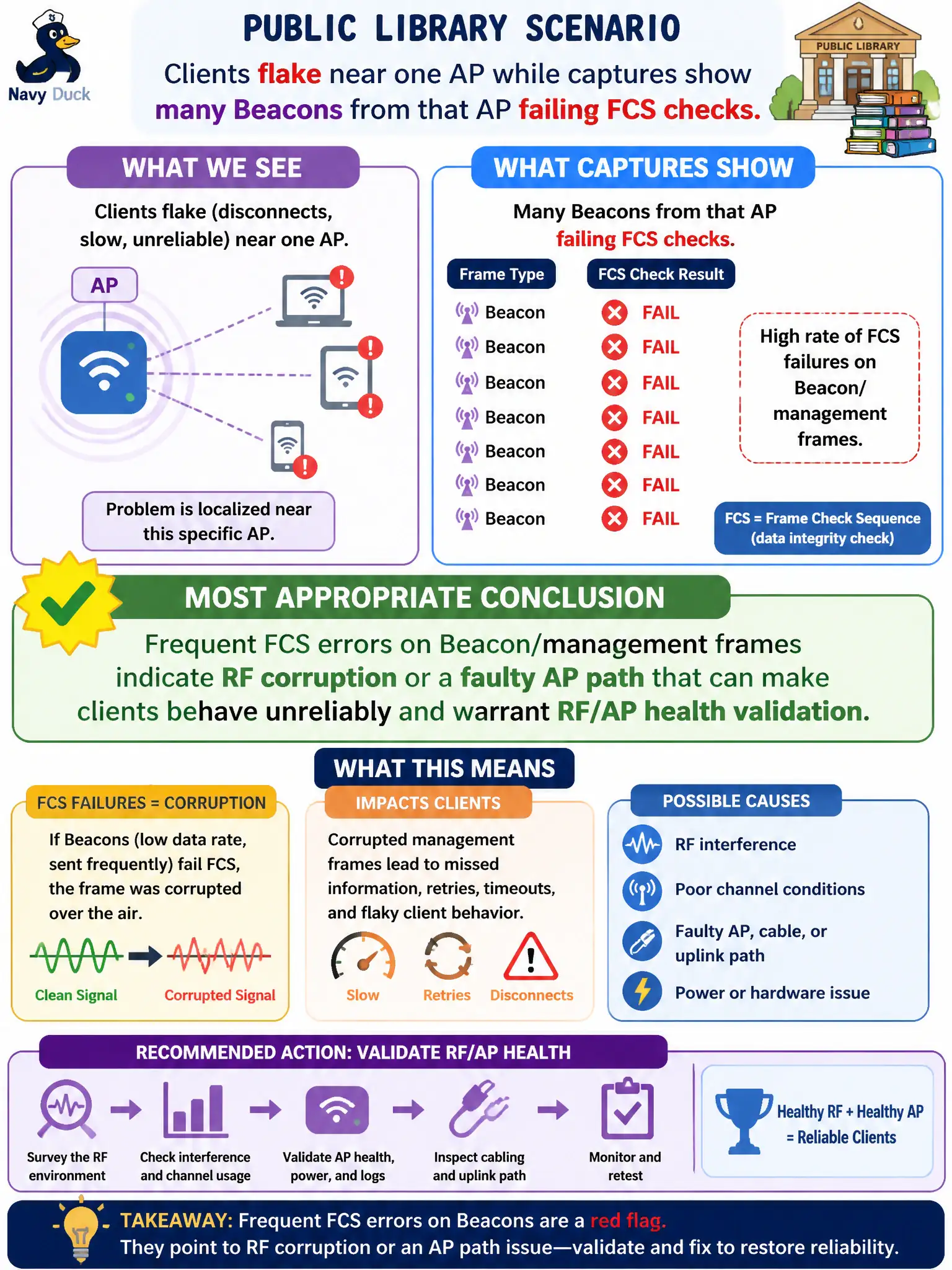
Public library clients flake near one AP while captures show many Beacons from that AP failing FCS checks. What is the most appropriate conclusion?
Select an answer to reveal the explanation.
Short Explanation
Beacons are the AP's business card—if half of them fail the checksum, the card is smudged by bad RF or a sick radio. Don't blame the sniffer's battery; validate the air and the AP.
Full Explanation
Frame Check Sequence failures on Beacons mean the sniffer could not validate those management frames as intact—commonly because of RF corruption, overload, or a faulty AP transmit path. When public library clients flake near one AP while many Beacons from that AP fail FCS checks, the most appropriate conclusion is that frequent FCS errors on Beacon/management frames indicate RF corruption or a faulty AP path that can make clients behave unreliably and warrant RF/AP health validation.
Blaming FCS errors solely on low sniffer laptop battery fails by concept: battery state is not the primary diagnostic for systematic Beacon FCS failure from one AP. Treating Beacon FCS failures as required for WMM admission control fails by concept: WMM admission control does not depend on corrupting Beacons. Claiming malformed Beacons prove PMK caching works fails by concept: PMK caching is a key management optimization unrelated to CRC failures on management frames.
Exam caveat: Localized management FCS loss is an RF/AP health signal; do not dismiss it as sniffer trivia when clients near that municipal AP are unstable.
Operational check: Capture beside the flaky library AP with a known-good adapter, quantify Beacon FCS error rate versus neighboring APs, inspect AP radios/cabling, and walk RSSI/noise before reimaging client drivers alone.