
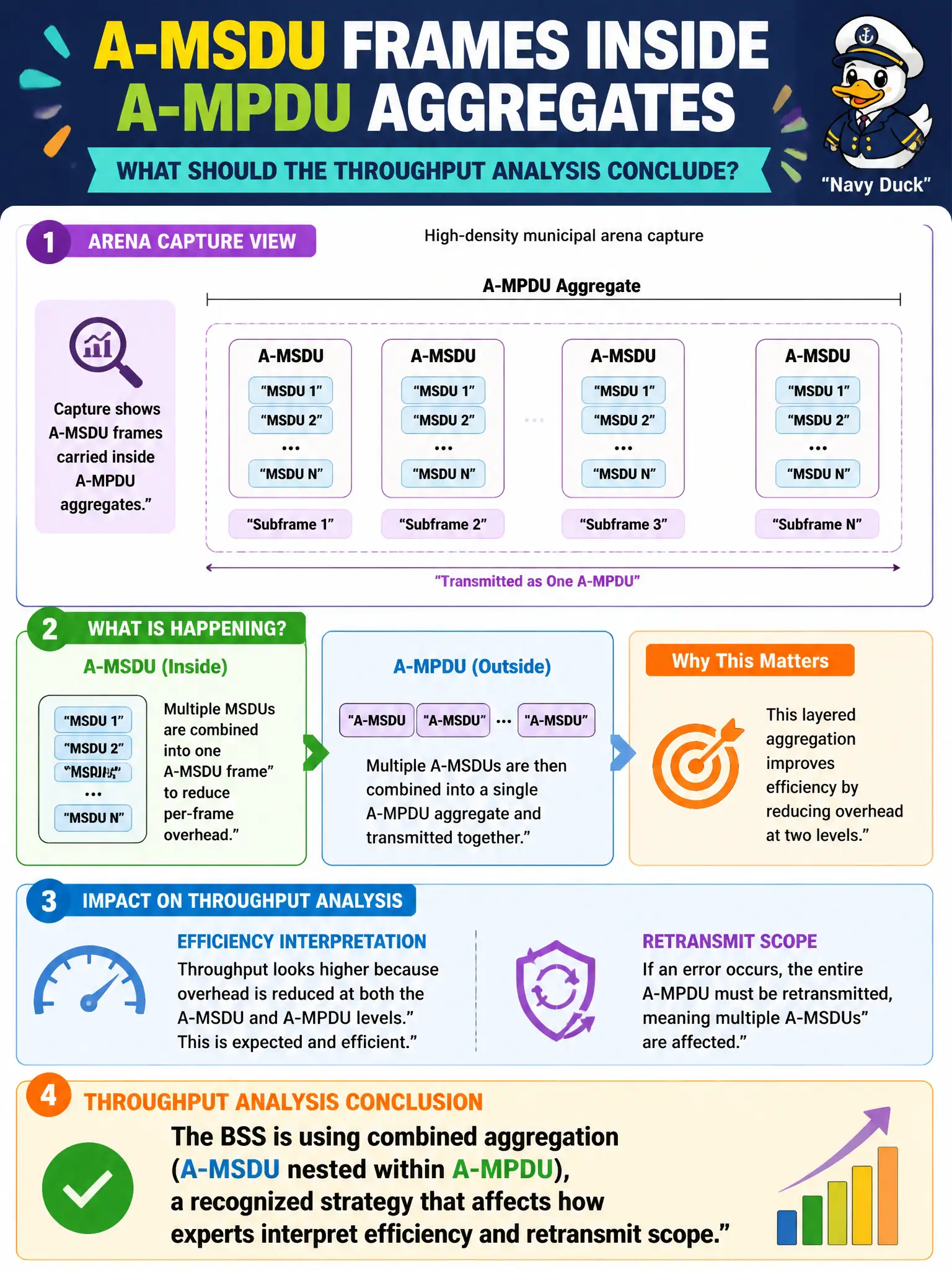
A high-density municipal arena capture shows A-MSDU frames carried inside A-MPDU aggregates. What should the throughput analysis conclude?
Select an answer to reveal the explanation.
Short Explanation
Think packing peanuts (A-MSDU) inside a shipping pallet (A-MPDU). Seeing both nested means the arena link is using combined aggregation—not a broken decoder. Read efficiency with that nesting in mind.
Full Explanation
Combined aggregation nests A-MSDU packing inside A-MPDU aggregates so multiple MSDUs ride as one MPDU within a larger Block Ack-protected aggregate. In a high-density municipal arena capture that shows A-MSDU frames carried inside A-MPDU aggregates, throughput analysis should conclude the BSS is using that recognized combined strategy, which changes how experts interpret efficiency and retransmit scope: an MPDU failure can discard nested MSDUs differently than pure A-MPDU or pure A-MSDU alone. Arena capacity math must account for that nesting, not treat every aggregate as a single opaque blob.
Declaring A-MSDU inside A-MPDU illegal and always an FCS corruption artifact fails by concept: nested aggregation is a valid efficiency technique, not proof the sniffer corrupted FCS. Claiming nested aggregation is impossible on HE PHYs fails by concept: HE continues aggregation concepts and does not forbid A-MSDU within A-MPDU as a decode impossibility. Asserting A-MPDU permanently disables MSDU packing once Block Ack is negotiated fails by concept: Block Ack supports aggregated exchanges that can still include A-MSDU packing inside MPDUs.
Exam caveat: CWNE throughput items expect you to read aggregation structure, not only headline PHY rates; misreading nested aggregates leads to wrong retry and goodput conclusions in dense civic venues.
Operational check: Decode arena A-MPDU boundaries and nested A-MSDU subframe headers for a busy client, note Block Ack bitmap scope, and document how a single MPDU loss would affect packed MSDUs before recommending aggregation policy changes.