
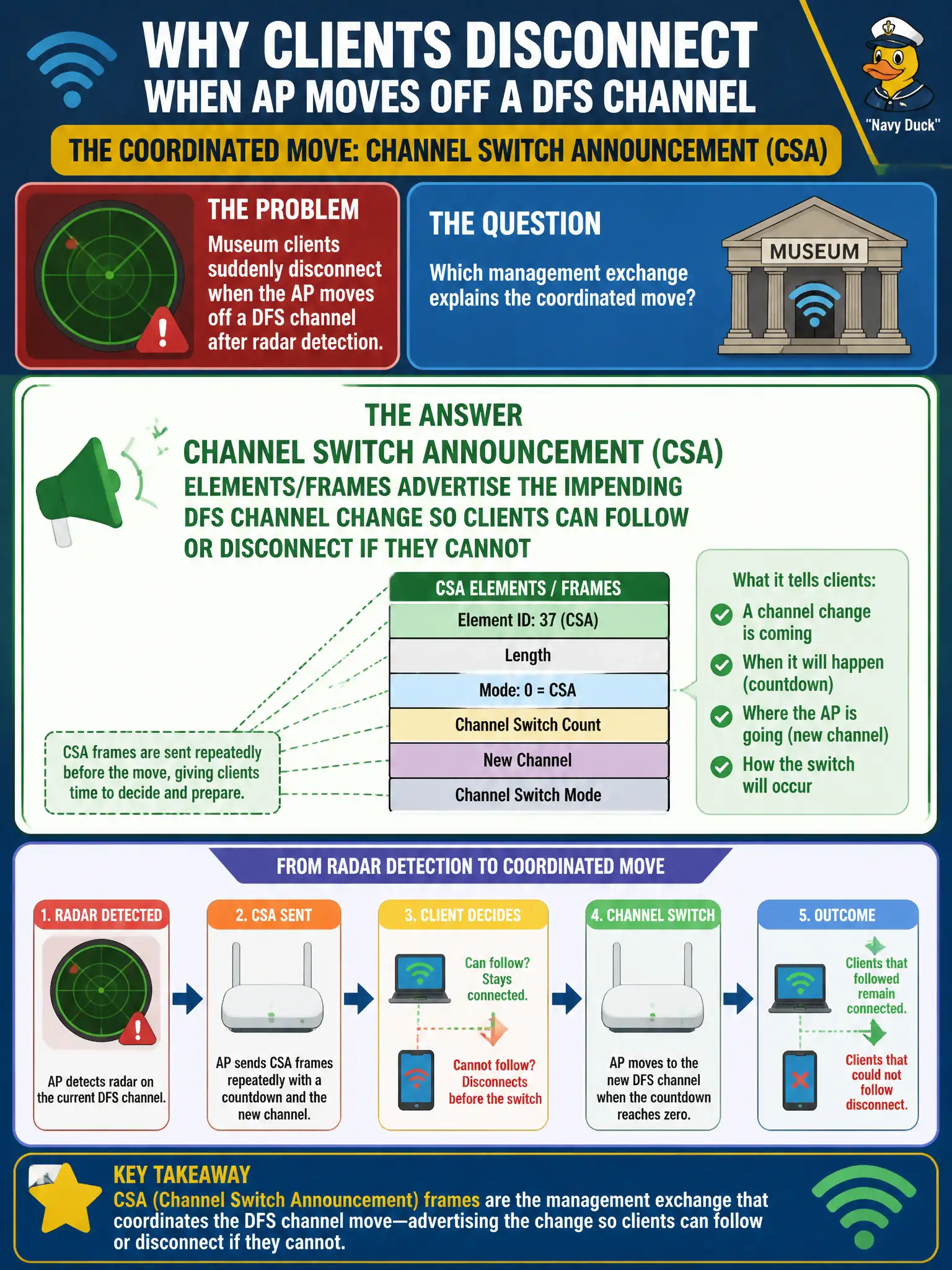
Museum clients suddenly disconnect when the AP moves off a DFS channel after radar detection. Which management exchange explains the coordinated move?
Select an answer to reveal the explanation.
Short Explanation
When radar says "vacate," the AP doesn't ghost the museum—it posts a Channel Switch Announcement. That CSA is the moving van notice so clients can follow (or drop if they can't).
Full Explanation
When radar detection forces a DFS channel change, access points advertise the move so clients can follow. Museum clients that suddenly disconnect when the AP leaves a DFS channel are explained by Channel Switch Announcement elements or frames that advertise the impending DFS channel change; clients that cannot follow may disconnect. CSA is the coordinated management exchange for that move, not a silent association status trick.
Claiming Association Response status 0 alone relocates every client to a new primary channel fails by concept: status 0 accepts association; it does not announce a BSS-wide DFS channel move. Asserting GTK rekey frames encode the next DFS channel fails by concept: GTK distribution protects group traffic and does not carry DFS channel-switch scheduling. Saying only Probe Requests announce DFS moves and Beacons never carry channel switch information fails by concept: CSA is carried in Beacons/Action frames from the infrastructure side, not via client Probe Requests as the announcement mechanism.
Exam caveat: CWNE DFS items expect recognition of CSA as the client-visible signal of a regulatory channel move; disconnect storms after radar events should drive CSA decoding before redesigning coverage.
Operational check: In the museum capture around the disconnect window, locate CSA IEs or Channel Switch Action frames, note old versus new channel and count/mode fields, and verify whether clients followed or dropped when the AP vacated the DFS channel.