
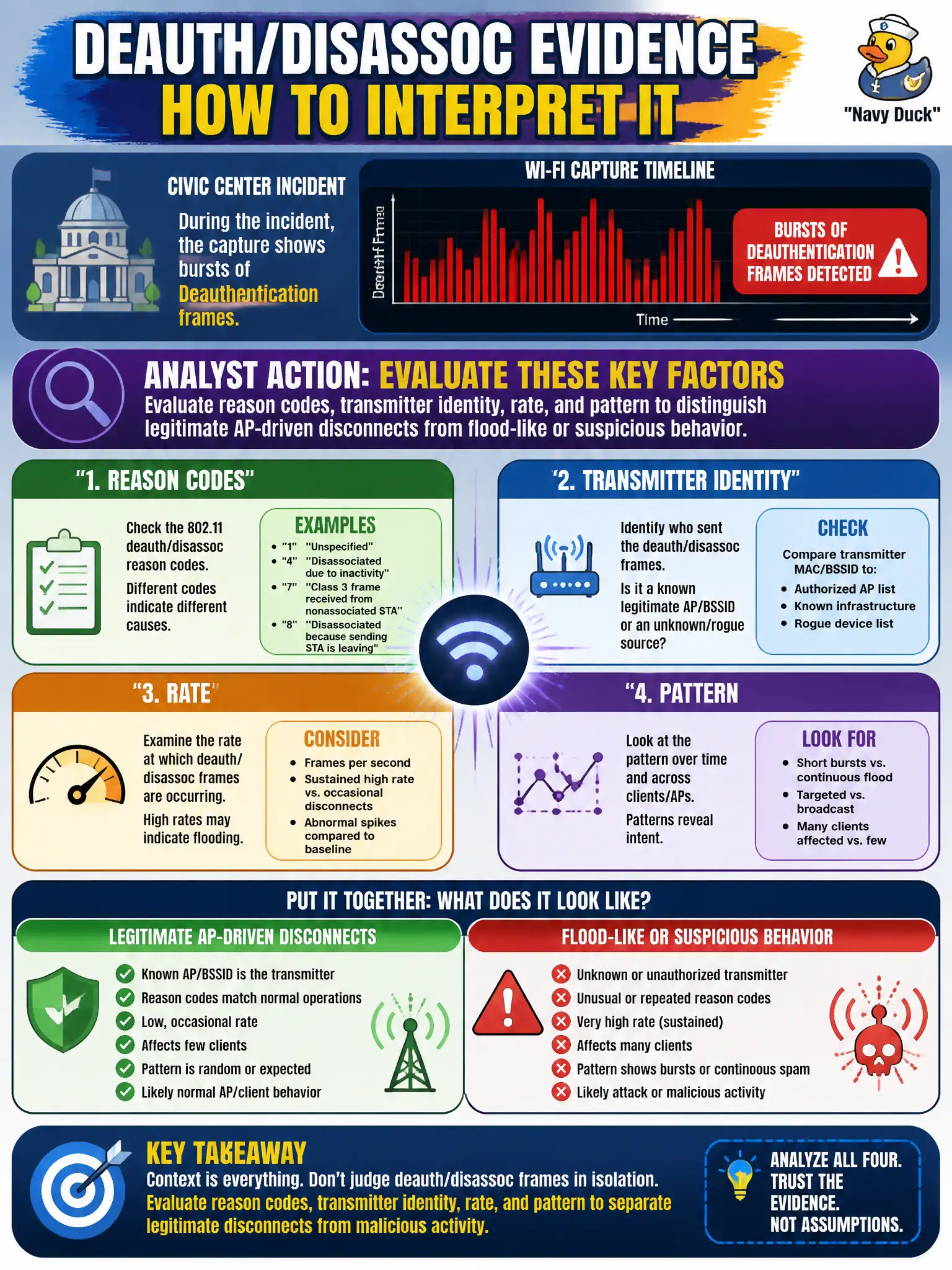
During a civic center incident, the capture shows bursts of Deauthentication frames. How should the analyst interpret deauth/disassoc evidence at this stage?
Select an answer to reveal the explanation.
Short Explanation
One polite "please leave" from the AP isn't the same as a megaphone screaming deauths across the civic center. Read who sent them, why (reason code), and how often before you call it an attack.
Full Explanation
Deauthentication and disassociation frames tear down 802.11 connectivity, but their meaning depends on reason codes, transmitter identity, rate, and pattern. During a civic center incident with bursts of Deauthentication frames, the analyst should evaluate those attributes to distinguish legitimate AP-driven disconnects from flood-like or suspicious deauth/disassoc behavior rather than treating any single frame as proof of jamming.
Treating any single Deauth as proof of intentional jamming that requires replacing the spectrum analyzer fails by concept: one management frame is not jamming evidence, and swapping spectrum tools does not interpret 802.11 reason codes. Claiming Deauth frames are obsolete under WPA3 and can be ignored fails by concept: deauthentication/disassociation still appear in modern networks for legitimate and abusive reasons. Saying disassociation frames only appear on mesh portals fails by concept: infrastructure BSS SSIDs routinely use disassoc/deauth for client management and roam teardown.
Exam caveat: Management-frame floods are a CWNE security/protocol topic; protected management frames change spoofability but do not license ignoring reason-code and rate analysis.
Operational check: Filter civic-center deauth/disassoc by SA/DA, tabulate reason codes and frames-per-second, correlate with AP logs and client MAC inventory, and escalate only when patterns indicate spoofed or abusive floods rather than controlled BSS disconnects.