
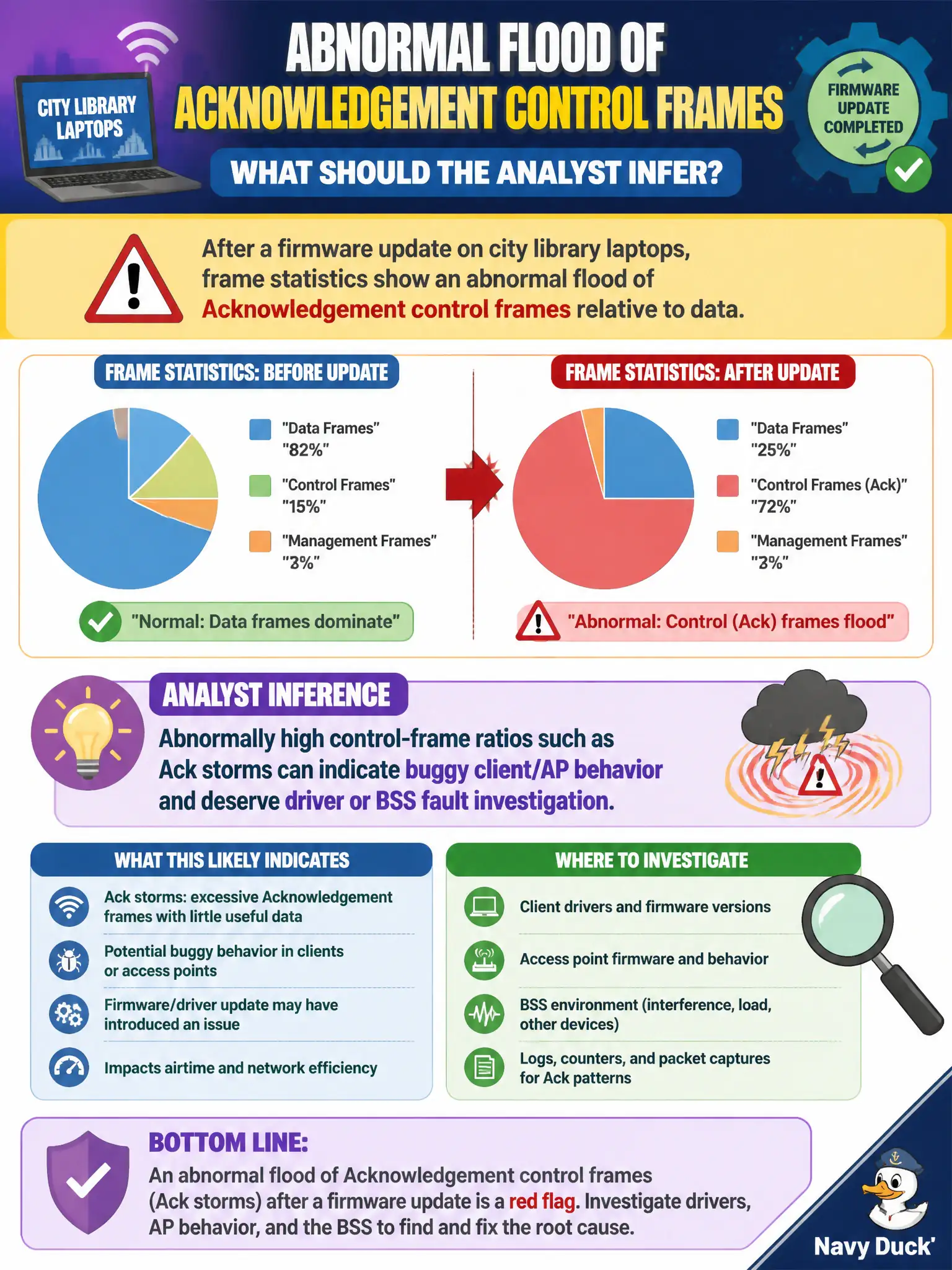
After a firmware update on city library laptops, frame statistics show an abnormal flood of Acknowledgement control frames relative to data. What should the analyst infer?
Select an answer to reveal the explanation.
Short Explanation
Acks should be polite nods, not a standing ovation that never ends. When control frames drown the library stats after a driver update, treat it like a buggy applauder—investigate the client/AP path, don't celebrate.
Full Explanation
Frame statistics that show an abnormal flood of Acknowledgement control frames relative to data after a firmware update on city library laptops point to buggy client or AP behavior worth driver or BSS fault investigation. Ack storms are a control-plane imbalance signal: something in the updated stack or BSS interaction is generating far more Acks than healthy data exchange justifies, not a healthy security proof.
Treating Ack storms as required proof that WPA3 SAE commit messages are healthy fails by concept: SAE health is judged from SAE/EAPOL exchanges, not from excess Ack ratios. Claiming excess Acks always mean the basic rate set is too low and must be raised to 54 Mbps fails by concept: basic-rate tuning is a separate admission/airtime control and is not diagnosed solely by Ack floods. Asserting control frames cannot storm because CSMA/CA hard-limits Ack count per MSDU forever fails by concept: real-world buggy retries, duplicates, and implementation faults can produce pathological control-frame rates despite the conceptual one-Ack-per-immediate-data model.
Exam caveat: After client or AP firmware changes, CWNE analysis treats sudden control-frame ratio shifts as regression evidence requiring controlled rollback or driver comparison, not as automatic RF redesign triggers.
Operational check: Compare pre/post firmware frame-type ratios on the library SSID for the same traffic profile, isolate a single updated laptop, capture Ack-to-data ratios, and test with a prior driver build before changing citywide basic rates.