
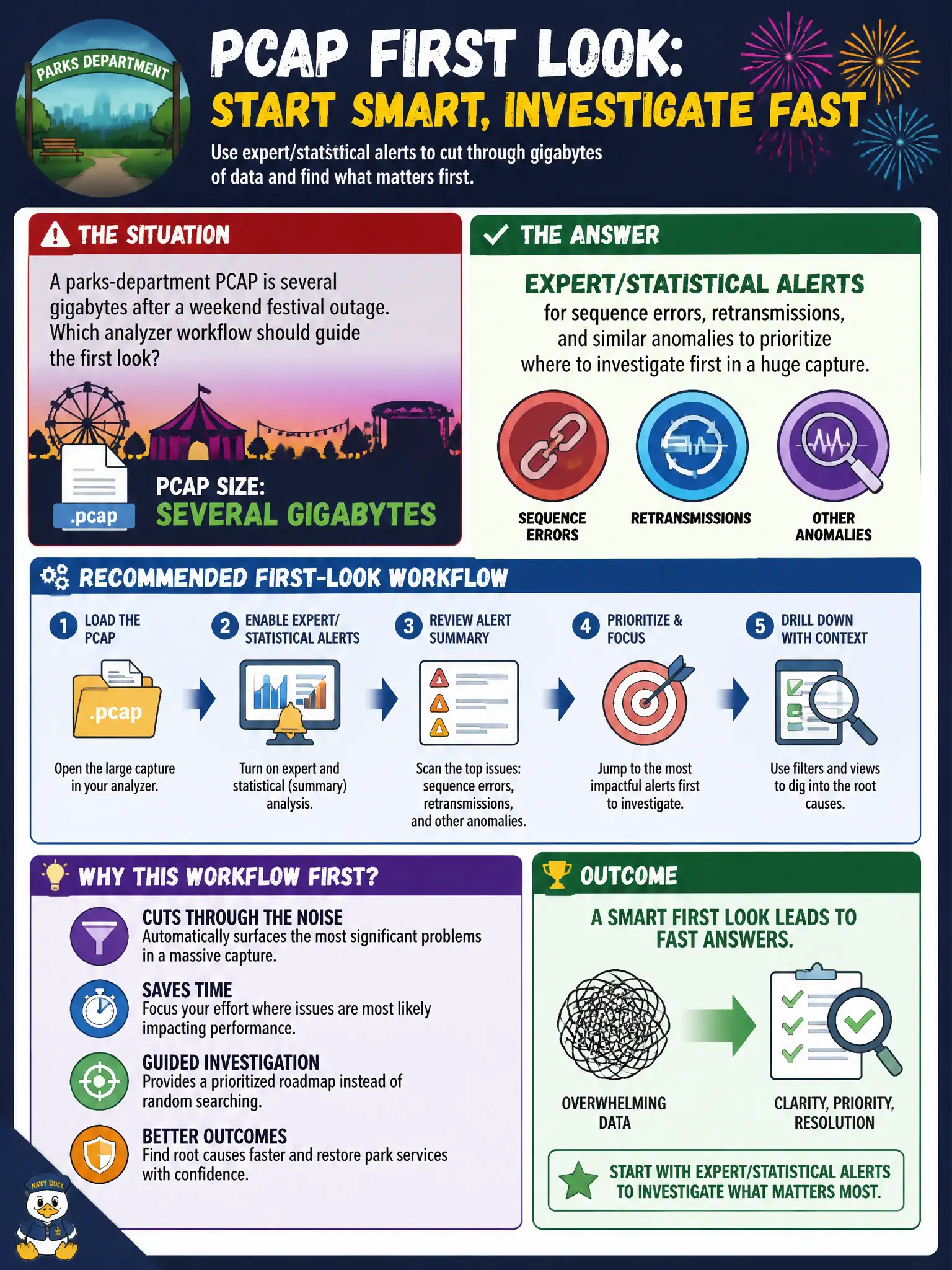
A parks-department PCAP is several gigabytes after a weekend festival outage. Which analyzer workflow should guide the first look?
Select an answer to reveal the explanation.
Short Explanation
A festival-sized PCAP is a haystack—expert alerts are the metal detector. Let sequence errors and retry spikes tell you which corner of the barn to search first. Don't start by reading every straw.
Full Explanation
Very large PCAPs from municipal outages need triage, not linear reading. After a weekend festival outage leaves a parks-department capture several gigabytes wide, the first-look workflow should use expert or statistical alerts for sequence errors, retransmissions, and similar anomalies to prioritize where to investigate. Those summaries surface likely fault clusters so the analyst spends time on high-yield slices instead of drowning in chronological noise.
Manually reading every Beacon IE in chronological order before any filter fails by concept: exhaustive Beacon reading does not scale and delays finding the outage signature in a multi-gigabyte trace. Deleting all control frames so only DHCP remains fails by concept: 802.11 symptoms often live in management and control exchanges; discarding them blinds the investigation when the festival fault may be RF or association related. Sorting solely by absolute frame number without expert or summary views fails by concept: frame number order alone does not highlight anomaly density or error clusters.
Exam caveat: CWNE analyzer workflow questions reward statistical triage and filtered deep-dives over brute-force reading of entire captures.
Operational check: Open the parks PCAP, run expert/statistics views for retransmissions, sequence errors, and top talkers, note the top anomaly windows, then apply time and BSS filters to those windows before decoding individual frames.