
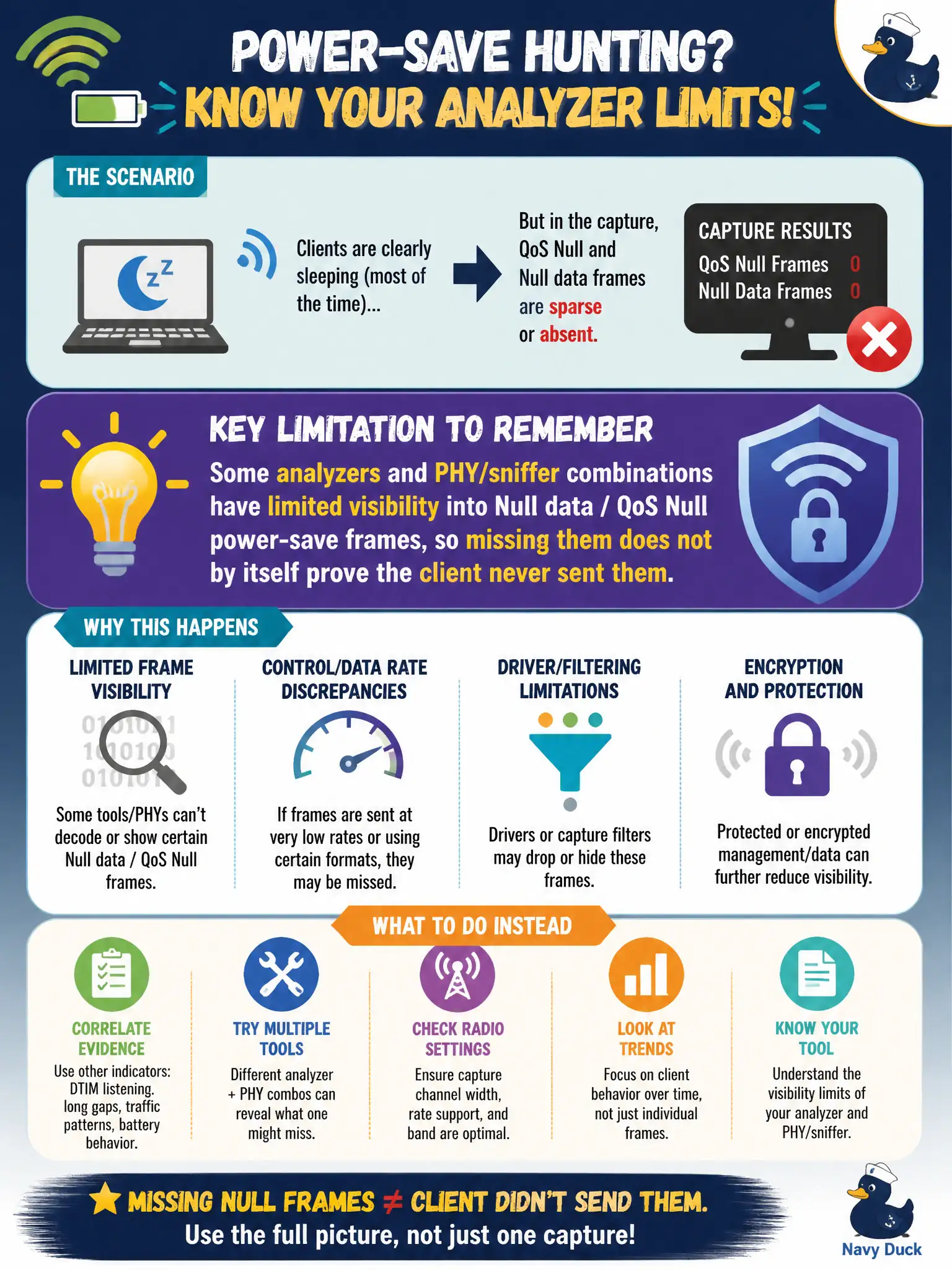
A county NOC engineer hunting power-save behavior notices QoS Null and Null data frames are sparse or absent in a capture despite clients clearly sleeping. What analyzer limitation should the CWNE keep in mind?
Select an answer to reveal the explanation.
Short Explanation
Null frames are the client's "do not disturb" note—and some sniffers just don't hear every whisper. Empty PCAP rows aren't proof the handheld never sent them. Know your adapter's blind spots before blaming the STA.
Full Explanation
Power-save signaling often uses Null data and QoS Null frames to announce sleep and wake state, but analyzer and PHY/sniffer combinations do not always present those frames reliably. When a county NOC engineer hunting power-save behavior finds QoS Null and Null data sparse or absent despite clients clearly sleeping, the CWNE should remember that limited visibility into those frames means their absence in the trace does not by itself prove the client never sent them. Tooling and radio limitations can hide the very frames under investigation.
Declaring Null frames illegal on enterprise SSIDs so absence proves a rogue AP fails by concept: Null/QoS Null power-save frames are legitimate on enterprise BSS operation and are not a rogue signature by omission. Claiming QoS Null frames exist only on 6 GHz fails by concept: power-save Null behavior appears across 2.4/5/6 GHz PHYs when clients use that signaling. Asserting power-save Null frames are always encrypted as MSDUs so GTK decrypt reveals every one fails by concept: Null frames are control-plane-like management of power state and are not simply recoverable as encrypted data MSDUs via GTK alone.
Exam caveat: Negative evidence in a capture is only as strong as the sniffer's PHY and decoder coverage; CWNE analysis separates "not observed" from "not sent," especially for sparse power-save control traffic.
Operational check: Validate sniffer adapter capabilities and decode settings for Null/QoS Null, compare with a second capable adapter or AP client logs for the same sleep window, and only then conclude whether municipal clients omitted power-save signaling.