
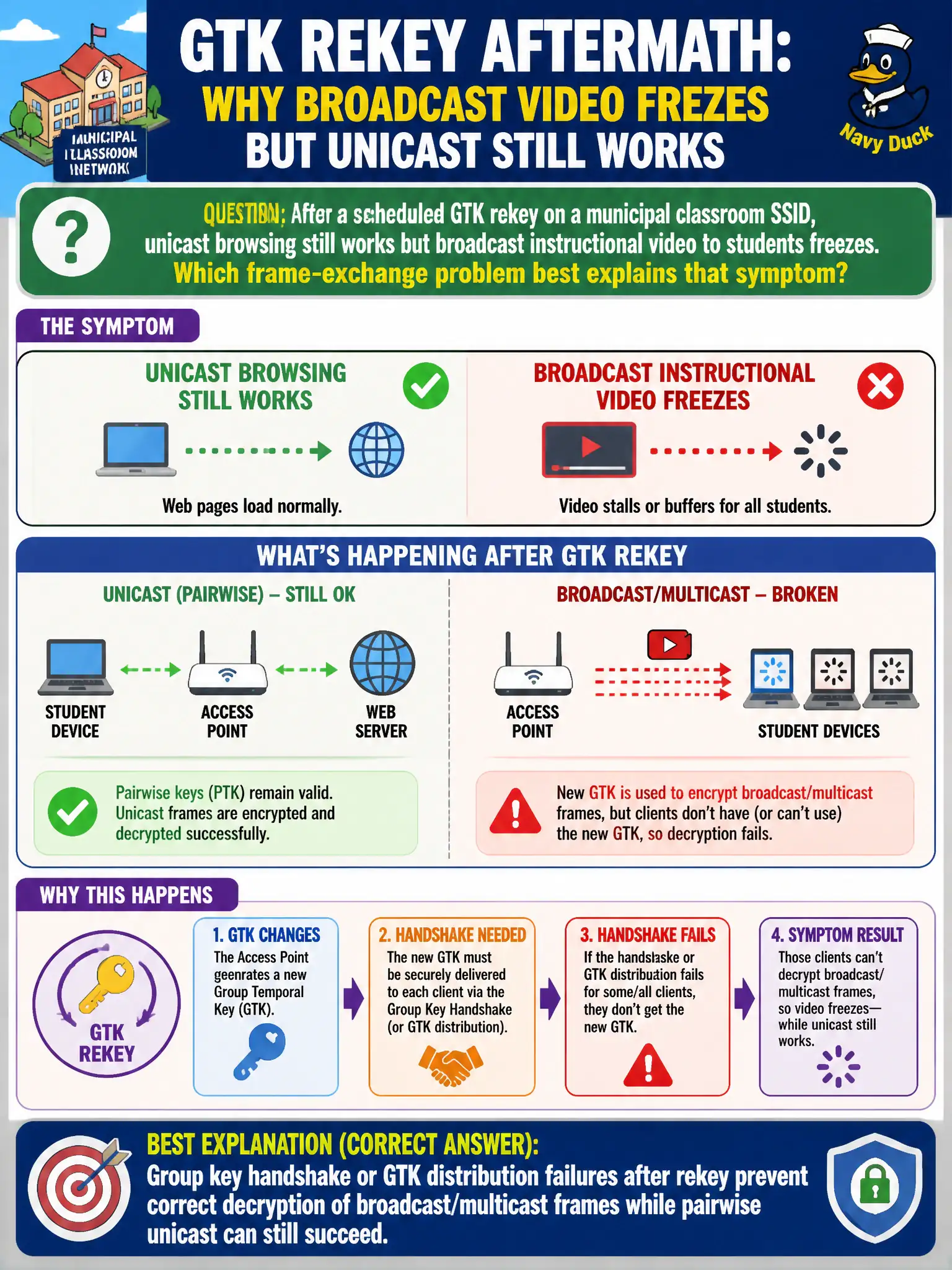
After a scheduled GTK rekey on a municipal classroom SSID, unicast browsing still works but broadcast instructional video to students freezes. Which frame-exchange problem best explains that symptom?
Select an answer to reveal the explanation.
Short Explanation
Unicast is a private hallway chat; broadcast video is the PA system locked with the group key. If GTK rekey goes sideways, kids still browse one-to-one but the shared stream dies. Check the group handshake, not the pairwise tunnel.
Full Explanation
After association, pairwise keys protect unicast while the Group Temporal Key protects broadcast and multicast. On a municipal classroom SSID, if a scheduled GTK rekey goes wrong, students can still browse unicast while broadcast instructional video freezes because group-addressed frames no longer decrypt correctly even though pairwise unicast succeeds. Group key handshake or GTK distribution failures after rekey are the frame-exchange problem that best matches that split symptom.
Blaming missing Block Ack agreements as always dropping broadcast video first fails by concept: Block Ack relates to acknowledged unicast/aggregate exchanges, not the group-key decryption boundary that separates broadcast from pairwise success. Claiming Beacon FCS errors uniquely corrupt multicast IP TTL without touching group keys fails by concept: FCS errors discard frames; they do not selectively rewrite TTL as a multicast-only crypto failure mode. Asserting PMKID caching forces all broadcast onto 2.4 GHz until the next full EAP fails by concept: PMK caching optimizes roam authentication and does not remap broadcast to another band or explain GTK rekey symptoms.
Exam caveat: Unicast-works / multicast-fails after rekey is a classic CWNE pointer to GTK/group handshake issues; do not start with pairwise-only or band-steering theories when the timing aligns with group rekey.
Operational check: Capture EAPOL group-key messages around the scheduled rekey on the classroom BSS, verify GTK installation on affected STAs, and correlate video freeze timestamps with rekey events before changing multicast-to-unicast settings blindly.