
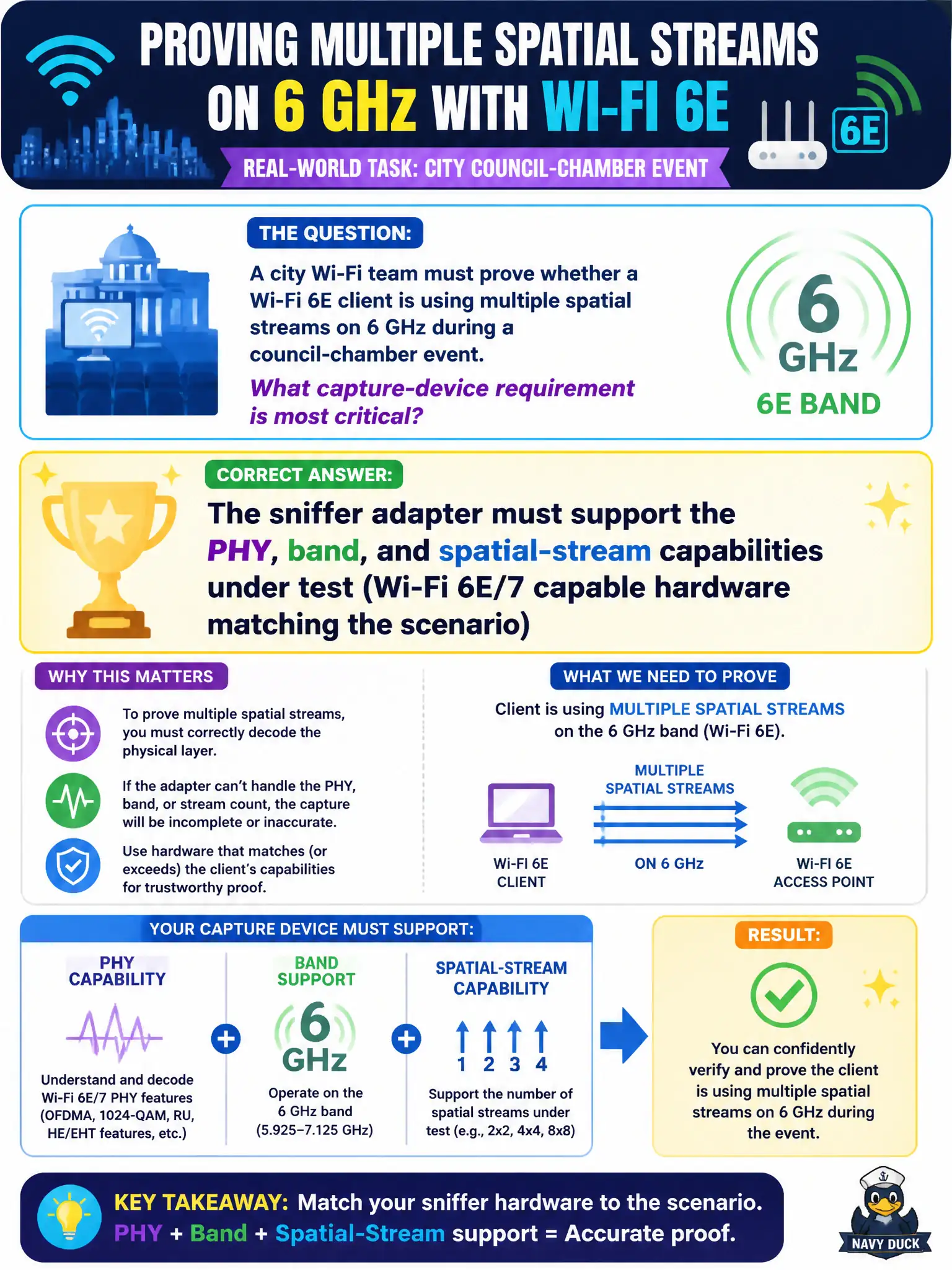
A city Wi-Fi team must prove whether a Wi-Fi 6E client is using multiple spatial streams on 6 GHz during a council-chamber event. What capture-device requirement is most critical?
Select an answer to reveal the explanation.
Short Explanation
You can't photograph a 6 GHz multi-stream dance with a 2.4 GHz disposable camera. The sniffer has to speak the same PHY, band, and streams you're judging. Match the tool to the exam you're giving the air.
Full Explanation
Proving spatial-stream usage on Wi-Fi 6E requires over-the-air visibility into the PHY and band under test. For a city Wi-Fi team validating whether a Wi-Fi 6E client uses multiple spatial streams on 6 GHz during a council-chamber event, the sniffer adapter must support the PHY, band, and spatial-stream capabilities matching the scenario—Wi-Fi 6E/7 capable hardware that can actually see HE/EHT air on 6 GHz. Without that, MCS and NSS conclusions are speculation.
Relying on any 2.4 GHz-only USB dongle with promiscuous mode and large snaplen fails by concept: a 2.4 GHz-only radio cannot capture 6 GHz HE PHY headers or spatial-stream fields for the event under test. Capturing solely on the AP wired SPAN port fails by concept: wired SPAN sees Ethernet/CAPWAP-side traffic, not the over-the-air HE/EHT PHY headers that encode spatial streams on 6 GHz. Smartphone screen-recording of the client Wi-Fi menu fails by concept: UI screenshots are not a substitute for OTA capture of MCS/stream proof.
Exam caveat: CWNE capture-planning items emphasize matching sniffer capability to the PHY/band feature under investigation; enterprise wired taps do not replace air captures for PHY header evidence.
Operational check: Select a 6 GHz-capable multi-stream sniffer, lock it to the council-chamber channel, capture during the client load, and decode HE/EHT PHY metadata for NSS/MCS before reporting stream utilization to stakeholders.